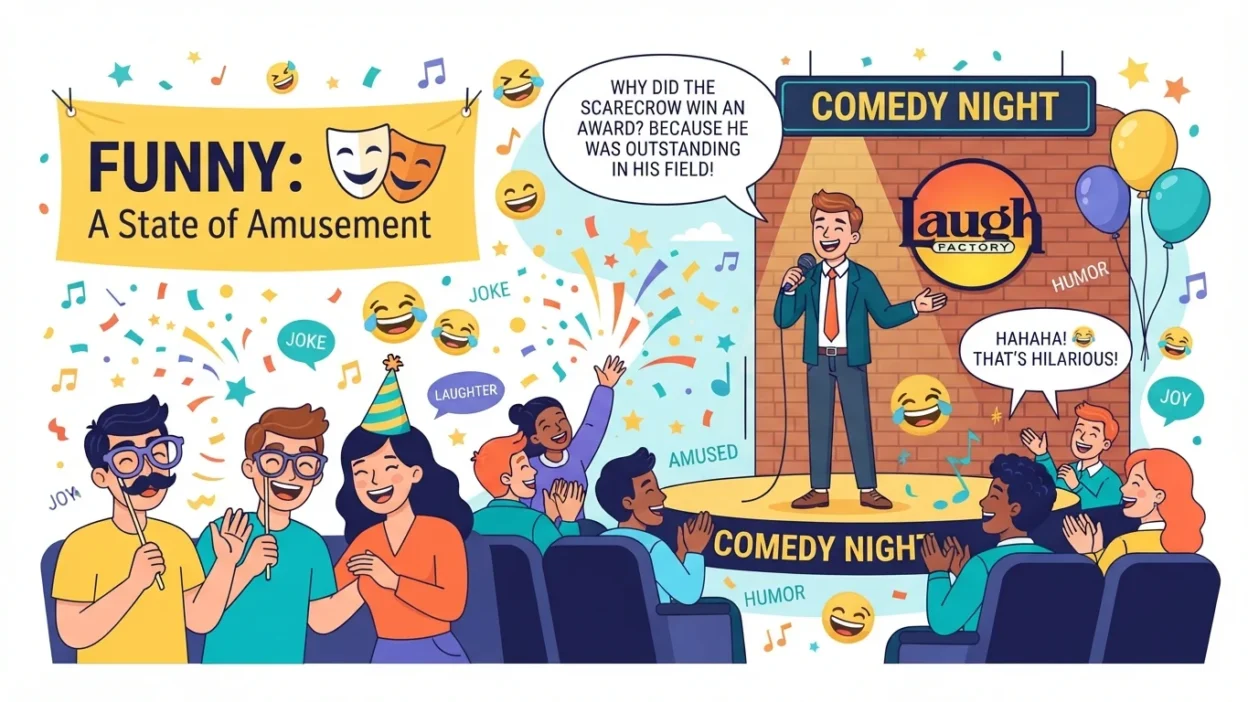
The word funny is commonly used to describe something that causes laughter, is entertaining, or seems unusual or strange. Learning the synonyms of funny can help students, ESL learners, writers, and professionals add variety to their vocabulary and choose words that best fit different contexts.
Whether you’re writing a story, comedy script, social media post, or casual conversation, using alternatives to funny can make your writing more expressive and engaging.
What Does “Funny” Mean?
Funny means:
- Causing laughter or amusement
- Entertaining or humorous
- Strange or unusual
- Odd or unexpected
Example Sentences
- That comedian is incredibly funny.
- The movie was funny from beginning to end.
- I have a funny feeling something is about to happen.
Usage Tip
Use funny when describing something humorous or amusing. In some contexts, it can also mean strange or odd, so choose the appropriate synonym based on the intended meaning.
30 Synonyms of Funny (With Meanings, Examples & Usage)
1. Humorous
Meaning: Full of humor or amusement.
Example: The book contains many humorous stories.
Best Usage Context: Formal and general writing.
2. Hilarious
Meaning: Extremely funny.
Example: The performance was absolutely hilarious.
Best Usage Context: Entertainment reviews.
3. Amusing
Meaning: Pleasantly entertaining.
Example: Her comments were amusing.
Best Usage Context: Everyday communication.
4. Comical
Meaning: Funny in an entertaining way.
Example: His comical expressions made everyone laugh.
Best Usage Context: Literature and comedy.
5. Entertaining
Meaning: Providing enjoyment.
Example: The show was highly entertaining.
Best Usage Context: General writing.
6. Witty
Meaning: Clever and funny.
Example: She made a witty remark.
Best Usage Context: Conversations and writing.
7. Clever
Meaning: Showing intelligence with humor.
Example: His clever jokes impressed the audience.
Best Usage Context: Humor and speeches.
8. Laughable
Meaning: So funny that it causes laughter.
Example: The excuse was laughable.
Best Usage Context: Informal and critical writing.
9. Ridiculous
Meaning: Absurdly funny or unreasonable.
Example: The situation became ridiculous.
Best Usage Context: Everyday communication.
10. Piercing
Meaning: Extremely amusing.
Example: Her story was piercing.
Best Usage Context: Informal conversations.
11. Side-Splitting
Meaning: Exceptionally funny.
Example: The comedy special was side-splitting.
Best Usage Context: Entertainment reviews.
12. Riotous
Meaning: Full of laughter and excitement.
Example: The play was riotous from start to finish.
Best Usage Context: Literary writing.
13. Jolly
Meaning: Cheerful and fun.
Example: He has a jolly personality.
Best Usage Context: General descriptions.
14. Playful
Meaning: Lighthearted and fun.
Example: The puppy had a playful nature.
Best Usage Context: Everyday writing.
15. Silly
Meaning: Foolish in a humorous way.
Example: The children laughed at the silly joke.
Best Usage Context: Casual conversations.
16. Goofy
Meaning: Funny in a quirky or awkward way.
Example: His goofy dance made everyone smile.
Best Usage Context: Informal speech.
17. Zany
Meaning: Wildly funny or eccentric.
Example: The cartoon featured zany characters.
Best Usage Context: Comedy and entertainment.
18. Quirky
Meaning: Unusually amusing or distinctive.
Example: She has a quirky sense of humor.
Best Usage Context: Lifestyle writing.
19. Droll
Meaning: Amusing in a dry or unexpected way.
Example: His droll humor surprised the audience.
Best Usage Context: Literary writing.
20. Farcical
Meaning: Ridiculously humorous.
Example: The misunderstanding became farcical.
Best Usage Context: Drama and literature.
21. Comic
Meaning: Relating to comedy.
Example: He has excellent comic timing.
Best Usage Context: Performing arts.
22. Jocular
Meaning: Fond of joking.
Example: His jocular comments eased the tension.
Best Usage Context: Formal writing.
23. Whimsical
Meaning: Playfully unusual or imaginative.
Example: The artwork had a whimsical style.
Best Usage Context: Creative writing.
24. Odd
Meaning: Strange or unusual.
Example: That’s an odd way to solve the problem.
Best Usage Context: When funny means strange.
25. Peculiar
Meaning: Different from the usual.
Example: She noticed a peculiar smell.
Best Usage Context: Descriptive writing.
26. Bizarre
Meaning: Very strange or unusual.
Example: The dream was bizarre.
Best Usage Context: Informal and descriptive writing.
27. Curious
Meaning: Unusual or intriguing.
Example: It was a curious coincidence.
Best Usage Context: Formal and informal writing.
28. Absurd
Meaning: Ridiculously unreasonable or funny.
Example: The idea seemed absurd.
Best Usage Context: Critical writing.
29. Delightful
Meaning: Bringing joy and amusement.
Example: The children’s performance was delightful.
Best Usage Context: Positive reviews.
30. Priceless
Meaning: Extremely amusing or unforgettable.
Example: His reaction was priceless.
Best Usage Context: Informal conversations.
Comparison Table: When to Use Different Funny Synonyms
| Context | Best Synonyms |
|---|---|
| Everyday Conversations | Amusing, Silly, Goofy |
| Comedy & Entertainment | Hilarious, Side-Splitting, Comic |
| Formal Writing | Humorous, Witty, Jocular |
| Creative Writing | Whimsical, Droll, Comical |
| Meaning “Strange” | Odd, Peculiar, Bizarre |
How to Choose the Right Synonym
For Everyday Use
Use:
- Amusing
- Silly
- Goofy
For Comedy
Use:
- Hilarious
- Side-Splitting
- Comic
For Formal Writing
Use:
- Humorous
- Witty
- Jocular
For Creative Descriptions
Use:
- Whimsical
- Droll
- Comical
When Meaning “Strange”
Use:
- Odd
- Peculiar
- Bizarre
Conclusion
Learning the synonyms of funny allows you to describe humor, entertainment, and unusual situations with greater precision. While funny is a versatile word, alternatives such as humorous, hilarious, amusing, witty, and comical are ideal for describing things that make people laugh, whereas words like odd, peculiar, and bizarre are better suited when funny means strange or unusual.
Using the right synonym for the context will make your writing more engaging, expressive, and enjoyable for your readers.

A creative writer with a deep interest in word usage and meaning.
He explores synonyms to enhance both academic and creative expression.
Zayn’s work aims to make language richer and more accessible for everyone.