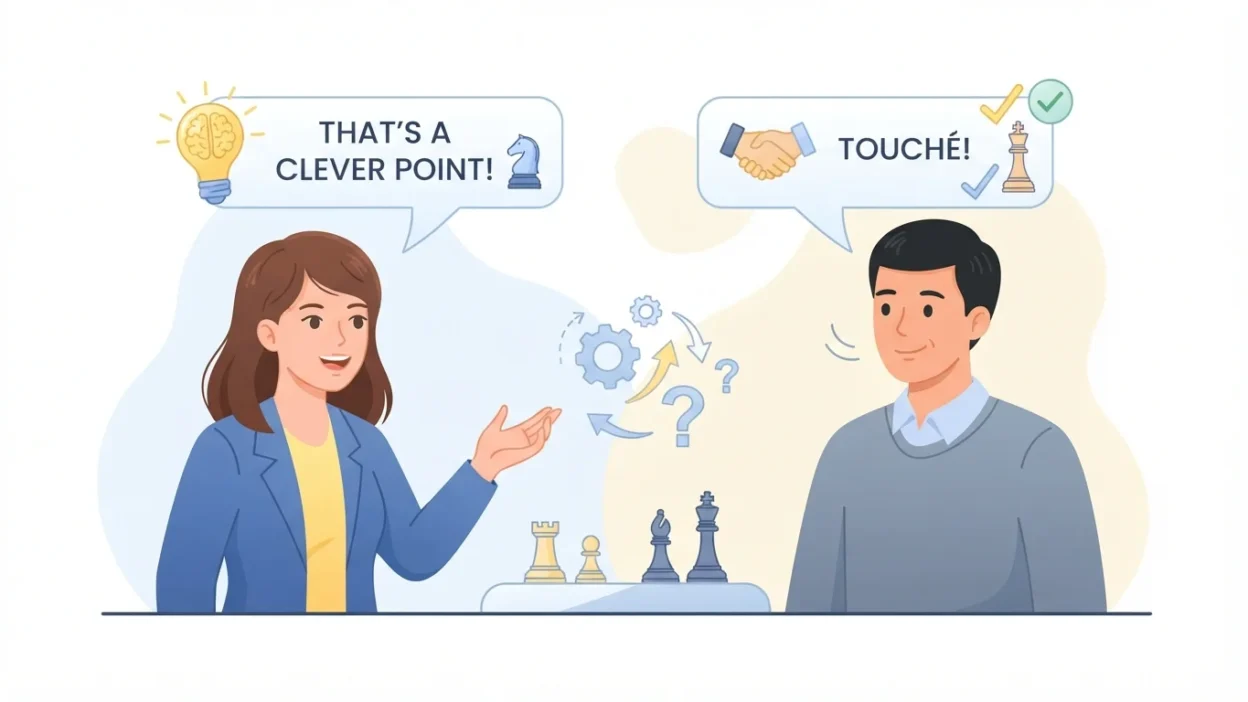
The word touché is a French expression that has become common in English. It is used to acknowledge that someone has made a clever point, delivered a successful comeback, or won an argument. Learning the synonyms of touché can help students, writers, ESL learners, and professionals express agreement, admiration, or recognition in conversations and writing.
Whether you’re writing dialogue, social media posts, or casual conversations, using alternatives to touché can make your communication more natural and engaging.
What Does “Touché” Mean?
Touché means:
- You made a good point.
- I admit you’re right.
- That’s a clever comeback.
- Well played.
Example Sentences
- “You forgot your keys again.” “Touché.”
- Touché! I didn’t think of it that way.
- He smiled and said, “Touché,” after hearing her witty response.
Usage Tip
Use touché in friendly debates, witty conversations, or discussions where you want to acknowledge someone’s clever or valid point.
30 Synonyms of Touché (With Meanings, Examples & Usage)
1. Well Played
Meaning: Acknowledging a clever move or remark.
Example: Well played—I didn’t expect that response.
Best Usage Context: Casual conversations and games.
2. Good Point
Meaning: Recognizing a valid argument.
Example: That’s a good point.
Best Usage Context: Everyday discussions.
3. Fair Point
Meaning: Admitting someone has a reasonable argument.
Example: Fair point. I hadn’t considered that.
Best Usage Context: Professional and casual conversations.
4. You Got Me
Meaning: Admitting someone proved you wrong.
Example: You got me with that one.
Best Usage Context: Informal conversations.
5. I Stand Corrected
Meaning: A formal admission of being mistaken.
Example: I stand corrected after seeing the evidence.
Best Usage Context: Formal discussions.
6. You’re Right
Meaning: Agreeing with someone.
Example: You’re right—I overlooked that detail.
Best Usage Context: Everyday communication.
7. I Agree
Meaning: Expressing agreement.
Example: I agree with your conclusion.
Best Usage Context: General writing.
8. Valid Point
Meaning: Acknowledging a logical argument.
Example: That’s a valid point.
Best Usage Context: Academic and professional writing.
9. Point Taken
Meaning: Accepting someone’s criticism or observation.
Example: Point taken. I’ll remember that.
Best Usage Context: Workplace conversations.
10. True Enough
Meaning: Agreeing that something is accurate.
Example: True enough—I can’t argue with that.
Best Usage Context: Informal speech.
11. Absolutely
Meaning: Complete agreement.
Example: Absolutely, that’s correct.
Best Usage Context: Everyday conversations.
12. Indeed
Meaning: Confirming a statement.
Example: Indeed, that’s an important observation.
Best Usage Context: Formal writing.
13. Exactly
Meaning: Showing complete agreement.
Example: Exactly—that’s what I meant.
Best Usage Context: General communication.
14. Well Said
Meaning: Complimenting a thoughtful remark.
Example: Well said. I couldn’t agree more.
Best Usage Context: Speeches and discussions.
15. Nicely Put
Meaning: Praising how something was expressed.
Example: Nicely put—that explains it perfectly.
Best Usage Context: Professional and casual settings.
16. You Win
Meaning: Admitting defeat in a friendly exchange.
Example: You win. That’s a better argument.
Best Usage Context: Informal conversations.
17. Fair Enough
Meaning: Accepting another person’s viewpoint.
Example: Fair enough. Let’s move on.
Best Usage Context: Everyday communication.
18. No Argument There
Meaning: Indicating complete agreement.
Example: No argument there.
Best Usage Context: Informal discussions.
19. I Can’t Disagree
Meaning: Admitting the other person is correct.
Example: I can’t disagree with that.
Best Usage Context: General conversations.
20. That’s True
Meaning: Agreeing with a statement.
Example: That’s true. I hadn’t noticed.
Best Usage Context: Everyday writing.
21. You Have a Point
Meaning: Recognizing a reasonable argument.
Example: You have a point about the budget.
Best Usage Context: Business and debates.
22. Good One
Meaning: Praising a clever remark.
Example: Good one! That was funny.
Best Usage Context: Informal conversations.
23. Nice Comeback
Meaning: Complimenting a witty response.
Example: Nice comeback—I wasn’t expecting that.
Best Usage Context: Casual dialogue.
24. Clever Response
Meaning: Acknowledging wit.
Example: That was a clever response.
Best Usage Context: General communication.
25. Well Done
Meaning: Praising a successful effort.
Example: Well done—you made your point.
Best Usage Context: General writing.
26. I Concede
Meaning: Formally admitting another person is right.
Example: I concede that your argument is stronger.
Best Usage Context: Formal debates.
27. I Yield
Meaning: Giving in to another person’s argument.
Example: I yield. You’ve convinced me.
Best Usage Context: Formal discussions.
28. That’s Convincing
Meaning: Recognizing a persuasive point.
Example: That’s convincing. I’ll reconsider.
Best Usage Context: Professional settings.
29. Agreed
Meaning: Expressing agreement.
Example: Agreed. Let’s proceed.
Best Usage Context: Business and everyday communication.
30. Well Observed
Meaning: Praising an insightful comment.
Example: Well observed—that’s an important detail.
Best Usage Context: Formal and academic writing.
Comparison Table: When to Use Different Touché Synonyms
| Context | Best Synonyms |
|---|---|
| Everyday Conversations | Well Played, You Got Me, Fair Enough |
| Friendly Debates | Good Point, You Have a Point, Point Taken |
| Professional Writing | Valid Point, I Stand Corrected, I Concede |
| Formal Discussions | Indeed, Well Observed, I Yield |
| Casual Humor | Good One, Nice Comeback, You Win |
How to Choose the Right Synonym
For Casual Conversations
Use:
- Well Played
- You Got Me
- Fair Enough
For Debates
Use:
- Good Point
- You Have a Point
- Point Taken
For Professional Settings
Use:
- Valid Point
- I Stand Corrected
- Agreed
For Formal Writing
Use:
- Indeed
- I Concede
- Well Observed
For Humorous Exchanges
Use:
- Good One
- Nice Comeback
- You Win
Conclusion
Learning the synonyms of touché helps you acknowledge clever remarks, valid arguments, and witty comebacks with greater variety. While touché is a popular expression, alternatives such as well played, good point, point taken, fair enough, and you got me can better suit different situations and levels of formality.
Using the right synonym enhances your conversations and writing, making your responses sound more natural, engaging, and expressive.

An expert in English grammar and expressive writing techniques.
She focuses on helping readers expand their vocabulary with clarity.
Elina believes the right word can transform ordinary writing into powerful communication.