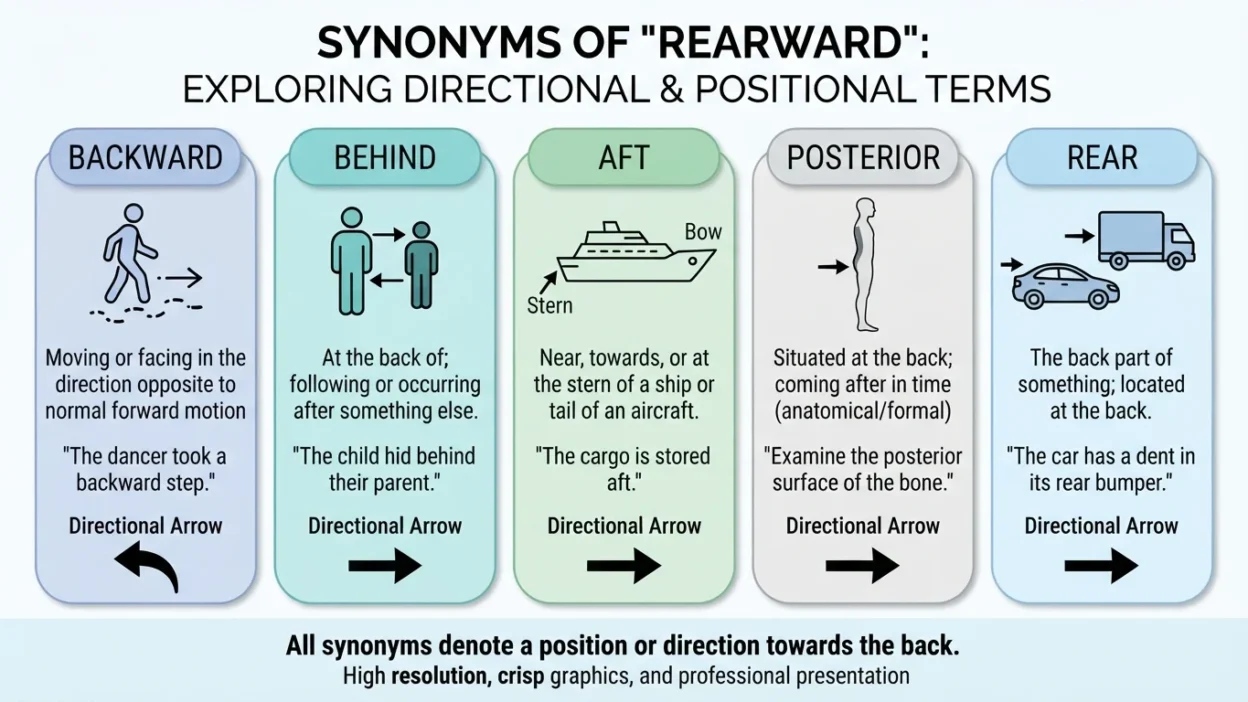
The word rearward refers to something that is toward the back, behind, or in the direction of the rear. It is commonly used in military, transportation, aviation, architecture, and everyday contexts to describe position or movement. Learning the synonyms of rearward can help students, writers, and professionals add variety and precision to their vocabulary.
Whether you’re writing a story, technical document, travel guide, or academic paper, using alternatives to rearward can make your writing clearer and more engaging.
What Does “Rearward” Mean?
Rearward means:
- Toward the back
- In or toward the rear
- Behind something
- Moving backward
Example Sentences
- The soldiers moved rearward after the attack.
- The rearward section of the train was less crowded.
- He took a rearward glance before crossing the road.
Usage Tip
Use rearward when describing something located or moving toward the back. Depending on the context, some synonyms emphasize position, while others describe movement.
30 Synonyms of Rearward (With Meanings, Examples & Usage)
1. Backward
Meaning: Toward the back or behind.
Example: She stepped backward to avoid the puddle.
Best Usage Context: Everyday conversations.
2. Behind
Meaning: At the back of something.
Example: The garden is behind the house.
Best Usage Context: General writing.
3. Back
Meaning: The rear part or direction.
Example: Please move to the back of the room.
Best Usage Context: Everyday communication.
4. Aft
Meaning: Toward the rear of a ship or aircraft.
Example: The passengers gathered in the aft cabin.
Best Usage Context: Maritime and aviation writing.
5. Posterior
Meaning: Situated at the back.
Example: The posterior section of the structure required repairs.
Best Usage Context: Medical and scientific writing.
6. Hind
Meaning: Located at the back.
Example: The horse injured its hind leg.
Best Usage Context: Biology and animal descriptions.
7. Following
Meaning: Coming behind.
Example: The following vehicle kept a safe distance.
Best Usage Context: General writing.
8. After
Meaning: Behind in position.
Example: The second car came after the first.
Best Usage Context: Everyday writing.
9. Trailing
Meaning: Positioned behind.
Example: The trailing runner finished strongly.
Best Usage Context: Sports and narratives.
10. Lagging
Meaning: Falling behind.
Example: The lagging group eventually caught up.
Best Usage Context: General discussions.
11. Retreating
Meaning: Moving backward.
Example: The troops were retreating toward safety.
Best Usage Context: Military and historical writing.
12. Receding
Meaning: Moving farther back.
Example: The shoreline appeared receding in the distance.
Best Usage Context: Descriptive writing.
13. Reverse
Meaning: Moving in the opposite direction.
Example: The driver put the car in reverse.
Best Usage Context: Transportation.
14. Retrograde
Meaning: Moving backward.
Example: The planet appeared in retrograde motion.
Best Usage Context: Scientific and astronomical writing.
15. Backmost
Meaning: Farthest toward the rear.
Example: Sit in the backmost row.
Best Usage Context: Descriptive writing.
16. Hindmost
Meaning: Furthest behind.
Example: The hindmost rider struggled to keep pace.
Best Usage Context: Literary writing.
17. Last
Meaning: Final in order or position.
Example: She stood in the last row.
Best Usage Context: General communication.
18. End
Meaning: The rear portion.
Example: The storage area is at the end of the hallway.
Best Usage Context: Everyday writing.
19. Tail-End
Meaning: The very back part.
Example: They sat at the tail-end of the bus.
Best Usage Context: Informal writing.
20. Rear
Meaning: The back section.
Example: The rear entrance is open.
Best Usage Context: General and technical writing.
21. Backside
Meaning: The back surface or side.
Example: The backside of the building faces the park.
Best Usage Context: Informal descriptions.
22. Reverse Direction
Meaning: Toward the opposite direction.
Example: The vehicle moved in reverse direction.
Best Usage Context: Transportation.
23. Toward the Rear
Meaning: In the direction of the back.
Example: Please move toward the rear of the hall.
Best Usage Context: Instructions.
24. Rear-End
Meaning: The back portion.
Example: The rear-end of the truck was damaged.
Best Usage Context: Automotive writing.
25. Back Section
Meaning: The section at the rear.
Example: The back section contains additional seating.
Best Usage Context: General descriptions.
26. Rear Position
Meaning: A location at the back.
Example: The guards took a rear position.
Best Usage Context: Military and organizational writing.
27. Back Rank
Meaning: The row at the rear.
Example: The soldiers stood in the back rank.
Best Usage Context: Military contexts.
28. Rear Line
Meaning: The line positioned behind others.
Example: Supplies were stored near the rear line.
Best Usage Context: Military writing.
29. Backward Direction
Meaning: Movement toward the back.
Example: The machine shifted in a backward direction.
Best Usage Context: Technical writing.
30. Rear Section
Meaning: The part located at the back.
Example: The rear section of the aircraft remained intact.
Best Usage Context: Transportation and engineering.
Comparison Table: When to Use Different Rearward Synonyms
| Context | Best Synonyms |
|---|---|
| Everyday Conversations | Backward, Behind, Back |
| Transportation | Rear, Reverse, Rear-End |
| Military | Retreating, Rear Position, Back Rank |
| Aviation & Maritime | Aft, Rear Section, Toward the Rear |
| Scientific & Medical | Posterior, Hind, Retrograde |
How to Choose the Right Synonym
For Everyday Use
Use:
- Backward
- Behind
- Back
For Transportation
Use:
- Rear
- Reverse
- Rear-End
For Military Writing
Use:
- Retreating
- Rear Position
- Back Rank
For Aviation and Maritime
Use:
- Aft
- Rear Section
- Toward the Rear
For Scientific Writing
Use:
- Posterior
- Hind
- Retrograde
Conclusion
Learning the synonyms of rearward allows you to describe positions, directions, and movement toward the back with greater precision. While rearward is commonly used in formal and technical contexts, alternatives such as backward, behind, aft, posterior, and rear are better suited to specific situations.
Using the right synonym based on the context makes your writing more natural, accurate, and engaging, whether you’re describing movement, location, or direction.

A creative writer with a deep interest in word usage and meaning.
He explores synonyms to enhance both academic and creative expression.
Zayn’s work aims to make language richer and more accessible for everyone.