Have you ever wondered whether the correct phrase is take effect or take affect? You’re not alone. Because effect and affect are commonly confused words in English, many writers mistakenly use take affect instead of take effect.
The good news is that the rule is easy to remember. Take effect is the correct idiom when something begins to work, become active, or start producing results. Take affect is almost always incorrect because affect is typically used as a verb, not a noun. In this guide, you’ll learn the difference, see real-world examples, avoid common mistakes, and master this commonly confused phrase.
Quick Answer
- Take effect is the correct phrase and means to begin working or become active.
- Take affect is incorrect in standard English.
Always use “take effect” when referring to something that starts working or becomes valid.
What Does “Take Effect” Mean?
Take effect is an idiomatic expression meaning:
- To become active
- To start working
- To become legally valid
- To begin producing results
The phrase is commonly used when talking about laws, policies, medicines, contracts, rules, and changes.
Examples of “Take Effect”
- The new law will take effect next month.
- The medicine should take effect within an hour.
- The price increase will take effect on Monday.
- The updated policy takes effect immediately.
- The contract will take effect after both parties sign it.
In all these examples, take effect means “begin to work” or “become effective.”
What Does “Take Affect” Mean?
Take affect is not a correct English phrase.
The confusion happens because affect and effect sound similar, but they have different meanings.
- Affect is usually a verb meaning to influence or change something.
- Effect is usually a noun meaning a result or is used in the phrase take effect.
Example
❌ The new rules will take affect tomorrow.
✅ The new rules will take effect tomorrow.
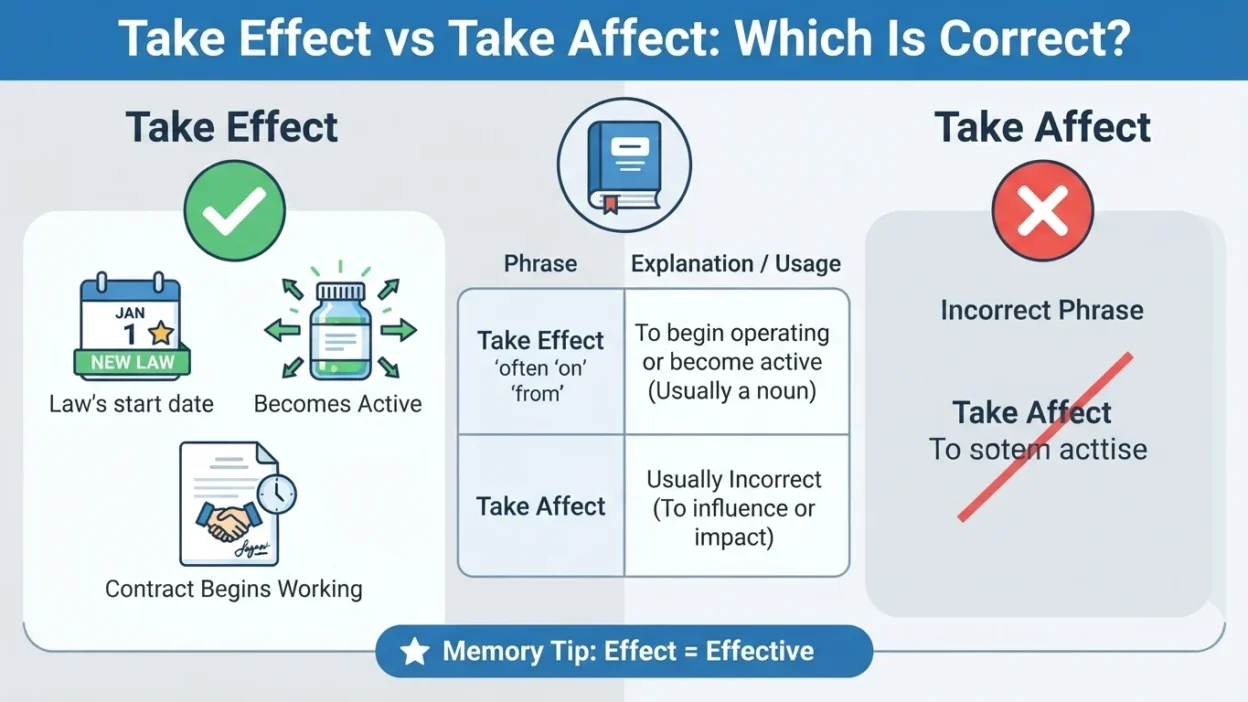
Take Effect vs Take Affect: Comparison Table
| Feature | Take Effect | Take Affect |
|---|---|---|
| Correct phrase | ✅ Yes | ❌ No |
| Meaning | Begin working or become active | Incorrect expression |
| Common usage | Laws, medicine, policies, contracts | None |
| Standard English | Yes | No |
Why Is “Take Effect” Correct?
The word effect functions as a noun in the expression take effect.
It refers to the point at which something becomes active or produces a result.
Examples include:
- A new policy takes effect today.
- The changes take effect next week.
- The medication takes effect quickly.
The phrase has been part of standard English for centuries.
Understanding “Affect” vs “Effect”
Many writers confuse these two words.
Affect
Usually a verb meaning to influence.
Examples:
- Lack of sleep can affect your health.
- Weather can affect travel plans.
- Stress may affect concentration.
Effect
Usually a noun meaning a result.
Examples:
- The new rule had a positive effect.
- The medicine produced an immediate effect.
- The campaign had little effect.
Remember:
- Affect = Action
- Effect = End Result
Common Mistakes to Avoid
Incorrect
- The agreement will take affect next week.
Correct
- The agreement will take effect next week.
Incorrect
- The medicine should take affect soon.
Correct
- The medicine should take effect soon.
Incorrect
- The changes took affect yesterday.
Correct
- The changes took effect yesterday.
Easy Memory Trick
Here’s a simple trick:
Think of effect as effective.
If something is beginning to work or become active, it is becoming effective, so the correct phrase is take effect.
Remember:
- Take effect = Become effective
- Affect = Influence
This memory trick helps you choose the correct word every time.
American vs British English
There is no difference between American and British English.
| American English | British English |
|---|---|
| Take effect | Take effect |
| Take affect | Incorrect |
Both varieties of English use take effect as the standard expression.
Related Words and LSI Keywords
Using related vocabulary naturally improves topical authority and readability.
- Become effective
- Go into effect
- Come into force
- Become active
- Begin working
- Start operating
- Policy
- Law
- Contract
- Regulation
- Rule
- Medication
- Result
- Influence
- Impact
These related terms improve SEO while helping readers understand the phrase in different contexts.
Expert Writing Tip
Professional writers, editors, and legal experts consistently use take effect because it is the standard English expression. Whether you’re writing about laws, business agreements, medical treatments, or workplace policies, this phrase clearly communicates that something is beginning to operate or become valid.
Whenever you’re unsure, remember that effect belongs in the phrase because it refers to the result or activation of something. Using take affect will almost always be considered a spelling or grammar mistake.
Frequently Asked Questions
Is “take effect” correct?
Yes. Take effect is the correct phrase and means to begin working or become active.
Is “take affect” correct?
No. Take affect is not a correct expression in standard English.
Why do people confuse “effect” and “affect”?
Because the words are pronounced similarly and have related meanings, many writers accidentally use one in place of the other.
What does “take effect” mean?
It means something becomes active, valid, or starts producing results.
Is there a difference between American and British English?
No. Both American and British English use take effect.
Can medicine “take effect”?
Yes. It’s very common to say that medicine takes effect after a certain amount of time.
What is an easy way to remember the difference?
Remember: Take effect = Become effective. If something is starting to work, effect is the correct word.
Summary
The difference between take effect and take affect is simple. Take effect is the correct and widely accepted phrase used when something begins to work, becomes active, or starts producing results. It commonly appears in discussions about laws, contracts, medications, policies, and other changes that become valid or operational.
Take affect, on the other hand, is an incorrect expression because affect is generally a verb meaning to influence rather than the noun needed in this idiom. By remembering that effect relates to becoming effective, you can avoid this common mistake and write with greater confidence and accuracy.

A creative writer with a deep interest in word usage and meaning.
He explores synonyms to enhance both academic and creative expression.
Zayn’s work aims to make language richer and more accessible for everyone.