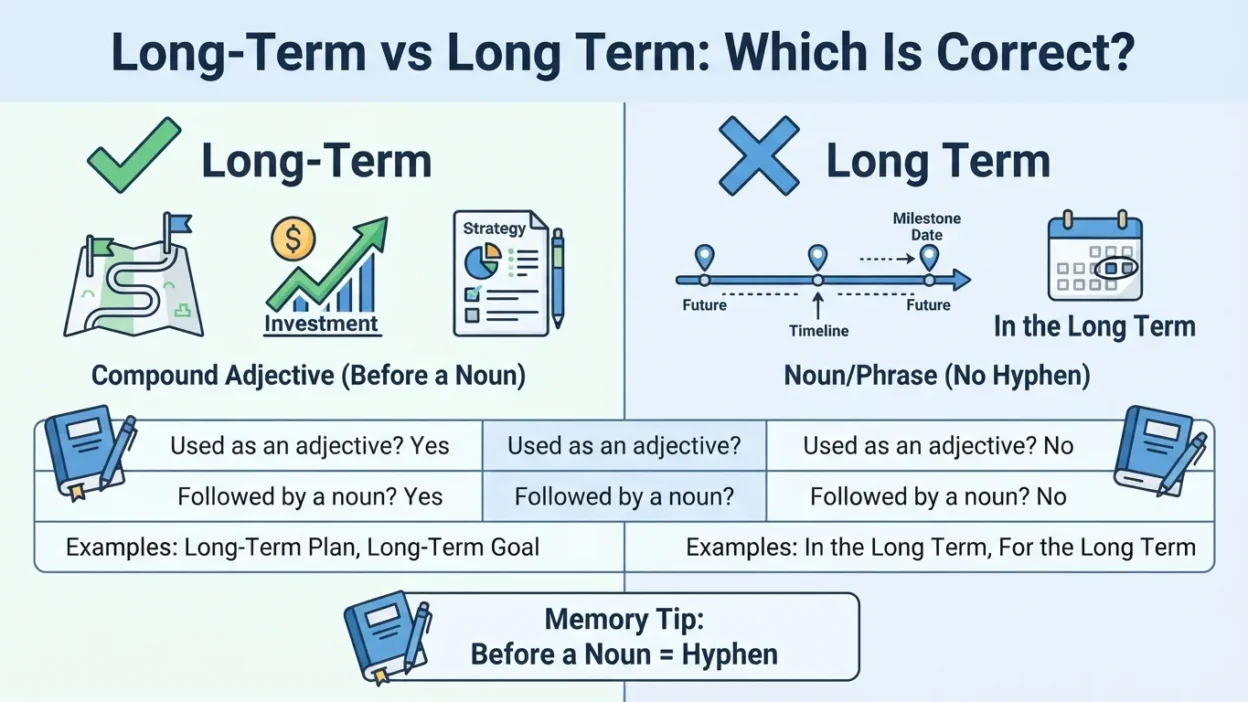
Have you ever wondered whether to write long-term with a hyphen or long term as two separate words? This is a common grammar question because both forms are correct—but they are used differently depending on how they function in a sentence.
Understanding the difference between long-term and long term will help you write more clearly and professionally. Whether you’re creating business content, academic papers, blog posts, or everyday emails, using the correct form improves readability and follows standard English grammar rules. In this guide, you’ll learn when to use each version, see practical examples, avoid common mistakes, and discover an easy memory trick.
Quick Answer
- Long-term (with a hyphen) is used as an adjective before a noun.
- Long term (without a hyphen) is used as a noun or adverbial phrase.
Both forms are correct—the right choice depends on how the phrase is used in the sentence.
What Does “Long-Term” Mean?
Long-term is a hyphenated compound adjective. It describes a noun and refers to something that lasts or continues for an extended period.
Use long-term when it comes before a noun.
Examples of “Long-Term”
- We need a long-term strategy.
- She has a long-term investment plan.
- The company focuses on long-term growth.
- They signed a long-term agreement.
- A long-term solution is better than a temporary fix.
In each example, long-term describes the noun that follows.
What Does “Long Term” Mean?
Long term is used without a hyphen when it functions as a noun phrase or adverbial expression. It refers to an extended period of time rather than describing a noun.
Examples of “Long Term”
- This decision will benefit us in the long term.
- We should think long term before making changes.
- The investment paid off over the long term.
- Success comes from planning for the long term.
- They focused on profits in the long term.
Here, long term is not directly modifying a noun.
Long-Term vs Long Term: Comparison Table
| Feature | Long-Term | Long Term |
|---|---|---|
| Part of speech | Compound adjective | Noun or adverbial phrase |
| Hyphen needed | ✅ Yes | ❌ No |
| Comes before a noun | Yes | No |
| Refers to an extended period | Yes | Yes |
| Correct usage | Before nouns | After verbs or in phrases |
The Main Difference
The easiest way to remember the difference is:
- Long-term = Describes a noun.
- Long term = Refers to time itself.
Compare these examples:
Adjective
- We need a long-term solution.
- They adopted a long-term policy.
- She made a long-term commitment.
Noun or Phrase
- We should think long term.
- It will help in the long term.
- The company succeeded over the long term.
Which Form Should You Use?
Use long-term when writing about:
- Plans
- Goals
- Strategies
- Investments
- Relationships
- Projects
- Solutions
Use long term when writing about:
- Time
- Future results
- Long-range thinking
- Outcomes
- Duration
Common Mistakes to Avoid
Many writers forget to add the hyphen when long-term comes before a noun.
Incorrect
- We need a long term strategy.
Correct
- We need a long-term strategy.
Incorrect
- It will help us in the long-term.
Correct
- It will help us in the long term.
Correct
- She has a long-term goal.
- We should think long term.
Easy Memory Trick
Here’s a simple trick:
If the phrase comes before a noun, use a hyphen.
- Long-term investment ✅
- Long-term plan ✅
- Long-term relationship ✅
If the phrase stands alone or follows a verb, don’t use a hyphen.
- Think long term. ✅
- It helps in the long term. ✅
American vs British English
There is no difference between American and British English.
| American English | British English |
|---|---|
| Long-term strategy | Long-term strategy |
| In the long term | In the long term |
Both varieties of English follow the same hyphenation rule.
Related Words and LSI Keywords
Using related vocabulary naturally improves topical authority and readability.
- Long-range
- Future
- Lasting
- Sustainable
- Permanent
- Extended
- Enduring
- Strategic planning
- Long-lasting
- Ongoing
- Investment
- Planning
- Goals
- Future growth
- Time period
These related terms strengthen SEO while helping readers understand the concept more clearly.
Expert Writing Tip
Professional writers follow a simple rule: hyphenate compound adjectives before a noun but remove the hyphen when the phrase follows the noun or functions independently. This guideline applies not only to long-term, but also to expressions like well-known, high-quality, and full-time.
Using the correct form improves readability, demonstrates attention to grammar, and creates polished, professional writing.
Frequently Asked Questions
Is “long-term” correct?
Yes. Long-term is correct when it functions as a compound adjective before a noun.
Is “long term” correct?
Yes. Long term is correct when it refers to an extended period or is used in phrases such as in the long term.
Which is more common?
Both are common, but they are used in different grammatical situations.
Why is there a hyphen in “long-term”?
The hyphen joins long and term into a single adjective that modifies a noun.
Is there a difference between American and British English?
No. Both American and British English use the same rule.
Should I write “long-term goals” or “long term goals”?
The correct form is long-term goals because the phrase comes before the noun.
Is “in the long-term” correct?
No. The preferred form is in the long term, without a hyphen.
Summary
The difference between long-term and long term depends on grammar rather than meaning. Long-term is a hyphenated compound adjective used before a noun, as in long-term strategy or long-term investment. Long term is used without a hyphen when referring to an extended period of time, as in in the long term or think long term.
A simple way to remember the rule is this: if the phrase describes a noun, use a hyphen; if it refers to time itself, leave the hyphen out. Following this guideline will make your writing clearer, more professional, and grammatically accurate.

An expert in English grammar and expressive writing techniques.
She focuses on helping readers expand their vocabulary with clarity.
Elina believes the right word can transform ordinary writing into powerful communication.