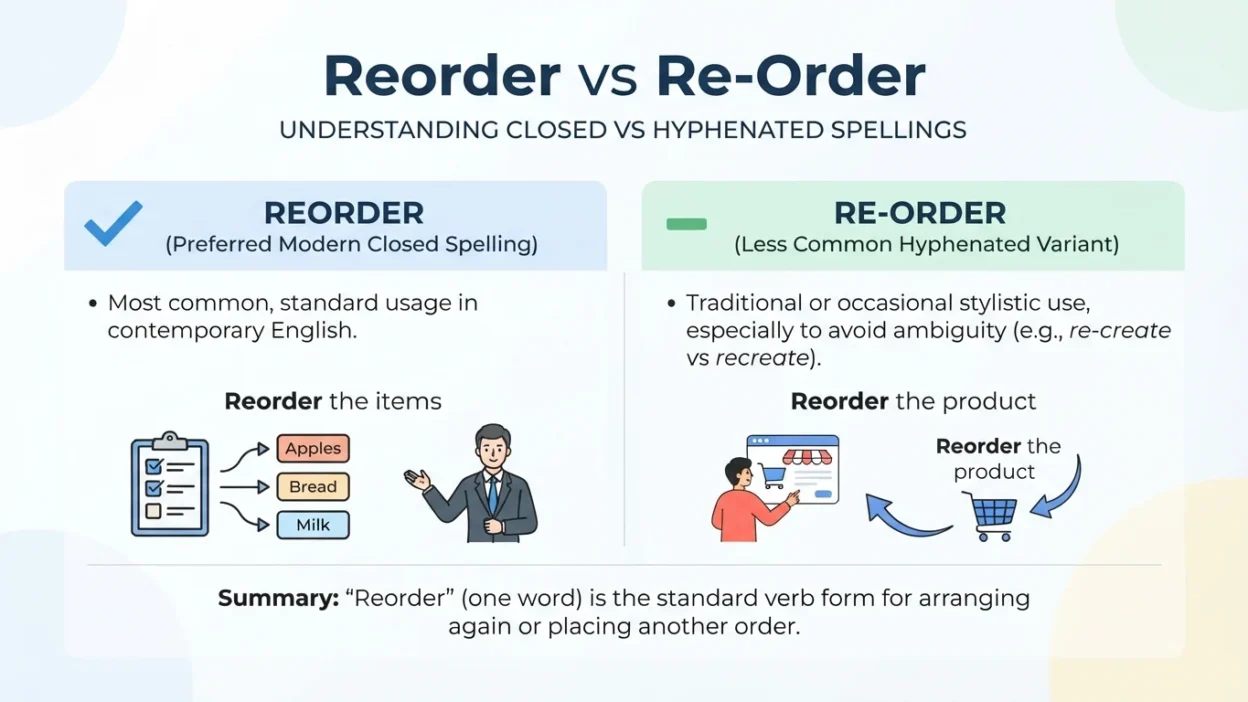
Should you write “reorder” or “re-order”? Both forms can be found in English, but modern usage generally favors the closed spelling reorder. The word is formed from the prefix re-, meaning “again,” and the verb order, meaning to arrange, request, or organize something.
You may see re-order in older writing, certain style guides, or situations where a writer wants to make the prefix especially clear. However, in most modern American and British English, reorder is the natural choice. The same pattern appears in many other words beginning with re-, such as reorganize, reread, rebuild, reconsider, and rewrite.
Quick Answer
Reorder is generally the preferred modern spelling. It can mean to order something again, to arrange something again, or to change the sequence of something.
Re-order is also understandable and appears in some writing, but the hyphen is usually unnecessary in ordinary modern English. For general writing, business communication, websites, and educational content, reorder is a safe choice.
Why Do People Confuse “Reorder” and “Re-Order”?
The confusion comes from the prefix re-.
The prefix re- usually means again or back, depending on the word.
For example:
- rewrite = write again
- reread = read again
- rebuild = build again
- reorganize = organize again
- reconsider = consider again
- reorder = order again
Because re- is a prefix, some writers naturally add a hyphen to make the word easier to read:
re-order
However, English increasingly prefers closed compounds when the meaning is clear:
reorder
This is why reorder is generally the better default.
Reorder
Reorder is the standard modern closed spelling.
It can have several related meanings depending on context.
1. Order Something Again
A customer can reorder a product that they purchased previously.
I need to reorder my favorite shampoo.
The restaurant allowed customers to reorder their usual meals.
2. Arrange Something Again
You can reorder information, sentences, paragraphs, or items.
Please reorder the paragraphs to improve the flow.
The editor decided to reorder the chapters.
3. Change the Sequence
In technology and data management, reorder often means changing the position or sequence of items.
You can reorder the columns by dragging them.
The app lets users reorder their playlists.
Re-Order
Re-order is a hyphenated form of the same word.
It is not generally considered a different word in meaning. The hyphen simply separates re- from order.
For example:
Please re-order the list.
The meaning is essentially the same as:
Please reorder the list.
However, the closed spelling is usually more natural in contemporary general English.
The hyphenated form may still appear in some publications, internal documents, older texts, or contexts where clarity is a concern.
Comparison Table
| Feature | Reorder | Re-Order |
|---|---|---|
| Spelling | Closed | Hyphenated |
| Meaning | Order again / arrange again | Same |
| Modern usage | Generally preferred | Less common |
| Grammar | Verb and sometimes noun | Verb and sometimes noun |
| Best general choice | Yes | Usually unnecessary |
| Example | Please reorder the items. | Please re-order the items. |
When to Use “Reorder”
Use reorder when you mean:
Order Again
I need to reorder those printer cartridges.
Arrange Again
We should reorder the sections of the report.
Change the Sequence
You can reorder the list alphabetically.
Request Something Again
The customer wants to reorder the same product.
In most everyday and professional contexts, reorder is the simplest choice.
When to Use “Re-Order”
Use re-order only when a particular style guide, publication, organization, or context prefers the hyphenated form.
For example, a company may consistently use hyphens in words beginning with certain prefixes.
You might therefore see:
Re-order the items before publishing.
But if you are writing general modern English and have no special style requirement, reorder is usually preferable.
Reorder as a Verb
The most common use of reorder is as a verb.
Examples:
- I need to reorder my prescription notebook.
- Please reorder the sentences.
- We decided to reorder the menu.
- Customers can reorder products online.
- You can reorder these items by price.
- The teacher asked students to reorder the words.
- We should reorder the chapters.
- The system allows users to reorder the list.
- I plan to reorder the same product.
- The editor decided to reorder the sections.
Reorder as a Noun
Reorder can also be used as a noun, particularly in business, retail, inventory, and e-commerce contexts.
Examples:
- The store placed a reorder for the popular product.
- The supplier received a reorder from the customer.
- This item has generated several reorders.
In these contexts, the closed spelling reorder is common.
Common Mistakes
Mistake 1: Assuming the Hyphen Is Always Required
❌ Please re-order the paragraphs.
This is understandable, but the hyphen is usually unnecessary.
✅ Please reorder the paragraphs.
Mistake 2: Writing “Re order”
The two-word form is generally incorrect when reorder is intended.
❌ Please re order the products.
✅ Please reorder the products.
Mistake 3: Confusing “Reorder” With “Order”
Order can mean to arrange something or request something.
Reorder adds the idea of doing it again.
Compare:
Please order the books.
This means request the books.
Please reorder the books.
This can mean request them again or arrange them in a different sequence, depending on context.
Mistake 4: Using “Re-Order” Inconsistently
If your document uses closed forms such as reorganize, rewrite, and rearrange, suddenly using re-order may make your spelling inconsistent.
Consistency matters in professional writing.
Memory Trick
Think of re- as meaning again.
Order → reorder
Just like:
- write → rewrite
- read → reread
- build → rebuild
- arrange → rearrange
- organize → reorganize
- order → reorder
Easy Rule
Re + order = reorder
In modern general English, you usually do not need the hyphen.
American vs British English
Both American and British English commonly use reorder as the closed form.
There is no major American-versus-British spelling difference here.
Examples:
American English:
You can reorder the items in the list.
British English:
You can reorder the items in the list.
The hyphenated re-order may still appear in either variety, especially because individual publications and organizations can have different style preferences.
Similar Words
The same spelling pattern appears in many other words beginning with re-.
| Word | Meaning |
|---|---|
| Rewrite | Write again |
| Reread | Read again |
| Rebuild | Build again |
| Reorganize | Organize again |
| Rearrange | Arrange again |
| Reconsider | Consider again |
| Reevaluate | Evaluate again |
| Reconnect | Connect again |
| Reuse | Use again |
| Reopen | Open again |
These examples show why reorder fits the modern pattern.
Reorder vs Re-Order in Formal Writing
For academic writing, business documents, websites, reports, and general professional communication, reorder is usually the cleaner choice.
For example:
Please reorder the following steps.
This looks natural and follows modern spelling conventions.
However, if a specific publication or organization uses re-order consistently, following that established style can be appropriate.
The important point is to avoid switching randomly between forms within the same document.
Final Verdict
Reorder is generally the preferred modern spelling.
Re-order is a recognizable hyphenated variant, but the hyphen is usually unnecessary in contemporary general English.
Use:
Please reorder the items.
rather than:
Please re-order the items.
Unless a particular style guide or organization requires the hyphen, reorder is the best default for modern writing.
FAQs
Is “reorder” one word?
Yes. Reorder is commonly written as one word and is the preferred modern spelling in general English.
Is “re-order” wrong?
Not necessarily. Re-order is a recognizable variant, but the hyphen is generally unnecessary in modern standard usage.
Is “reorder” American or British?
Reorder is used in both American and British English.
Does reorder mean order again?
Yes. One common meaning of reorder is to order something again.
I need to reorder the same product.
It can also mean to arrange something in a different sequence.
Should I write “reorder” or “re-order” in formal writing?
In most modern formal and professional writing, reorder is the better default. However, always follow the style guide of the organization or publication you are writing for.
Is “re order” correct?
No, not when you mean the verb reorder. The standard form is one word: reorder.
What is the past tense of reorder?
The past tense is reordered.
The editor reordered the paragraphs.
The same form is used as the past participle:
The paragraphs have been reordered.
Conclusion
The choice between reorder and re-order is mainly a matter of modern spelling convention rather than meaning. Both forms can communicate the same idea, but reorder is generally the preferred closed form in contemporary English. It works naturally in everyday writing, professional communication, technology, e-commerce, education, and business contexts.
When you mean order something again or arrange something again, choose reorder unless a specific style guide tells you otherwise. The easiest way to remember it is to treat re- like the prefix in rewrite, reread, rebuild, and reorganize. In modern general English, these words are normally written without a hyphen.
Remember This
Reorder = preferred modern spelling
Re-order = acceptable variant in some styles, but usually unnecessary
Re order = generally incorrect
Easy rule: Re + order → reorder.

A passionate linguist who specializes in word relationships and vocabulary building.
He has spent years studying synonyms and semantic patterns across languages.
Arman writes to make language learning simple, precise, and engaging.