Have you ever hesitated before typing “you too” or “you to” in a text message, email, or social media comment? You’re not alone. These two phrases sound exactly the same, but they have very different meanings and uses in English.
The good news is that the rule is simple. You too is the correct phrase when you’re returning a wish or including someone in a statement, while you to is only correct in specific grammatical situations where to functions as a preposition or part of an infinitive. In this guide, you’ll learn the difference, explore examples, avoid common mistakes, and discover an easy way to remember which one to use.
Quick Answer
- You too is the correct phrase when you mean “also you” or “the same to you.”
- You to is only correct when to is part of a larger grammatical structure, such as an infinitive or a prepositional phrase.
In most everyday conversations, “you too” is the correct choice.
What Does “You Too” Mean?
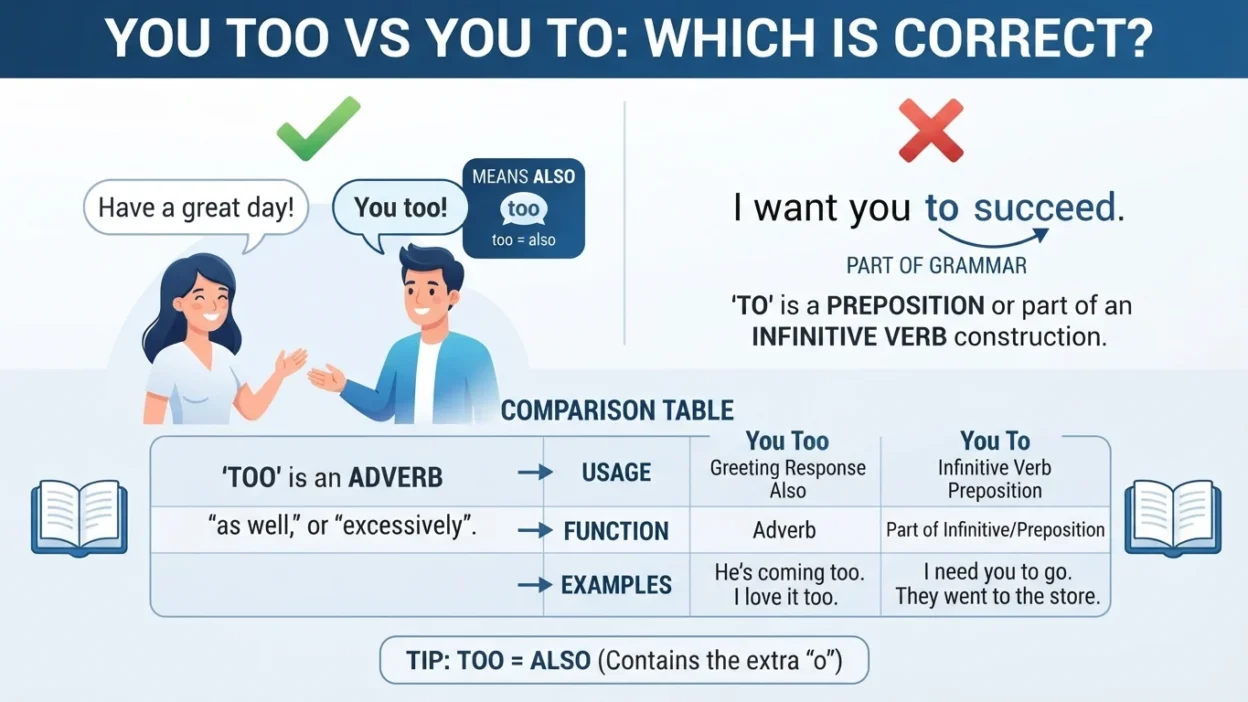
You too means “also you” or “the same to you.” It is commonly used to return a greeting, compliment, wish, or expression of kindness.
The word too means also or as well.
Examples of “You Too”
- Have a great day!
- You too!
- Good luck on your exam.
- You too!
- Stay safe.
- You too.
- It was nice meeting you.
- You too!
- Enjoy your vacation.
- You too!
This is the phrase you’ll use most often in everyday English.
What Does “You To” Mean?
You to is not usually a complete phrase on its own. It becomes correct only when to connects with another word or verb.
For example:
- I want you to help me.
- It’s important for you to arrive early.
- I invited you to dinner.
- This gift belongs to you.
- The decision is up to you.
In these examples, to is functioning as part of the sentence’s grammar—not as the word too meaning “also.”
You Too vs You To: Comparison Table
| Feature | You Too | You To |
|---|---|---|
| Meaning | Also you; the same to you | Part of a grammatical structure |
| Everyday replies | ✅ Yes | ❌ No |
| Means “also” | Yes | No |
| Requires additional words | No | Usually yes |
| Correct by itself | Yes | Usually no |
The Main Difference
The easiest way to remember the difference is:
- Too = Also.
- To = Direction, purpose, or part of a verb.
Compare these examples:
Returning a Wish
- Have a wonderful weekend!
- You too! ✅
Using “To”
- I need you to finish the report. ✅
- This letter belongs to you. ✅
Which Phrase Should You Use?
Use you too when:
- Returning a greeting
- Returning a compliment
- Returning good wishes
- Saying “same to you”
Use you to when:
- It is followed by a verb.
- It is part of a prepositional phrase.
- It expresses purpose or direction.
Common Mistakes to Avoid
Many English learners accidentally replace too with to because the words sound identical.
Incorrect
- Have a great evening!
- You to!
Correct
- Have a great evening!
- You too!
Incorrect
- Nice meeting you.
- You to.
Correct
- Nice meeting you.
- You too.
Correct
- I need you to call me tomorrow.
- This package belongs to you.
Easy Memory Trick
Here’s a simple trick:
Too = Also
If you can replace too with also, then you too is correct.
Example:
- Have a nice day!
- You also!
Since that works, you too is correct.
If also doesn’t fit, you probably need to instead.
American vs British English
There is no difference between American and British English.
| American English | British English |
|---|---|
| You too | You too |
| You to | You to |
Both varieties of English follow the same grammar rules.
Related Words and LSI Keywords
Using related vocabulary naturally improves topical authority and readability.
- Also
- As well
- Same to you
- Likewise
- Me too
- Thank you
- Good luck
- Best wishes
- Infinitive
- Preposition
- Grammar
- English usage
- Homophones
- Everyday English
- Common grammar mistakes
These related terms help readers better understand the topic while improving SEO relevance.
Expert Writing Tip
One of the easiest ways to avoid this mistake is to remember that too almost always means also or in addition. When replying to someone’s greeting or kind words, you too is nearly always the correct choice.
Reserve to for situations where it connects words within a sentence, such as before a verb (you to help) or in a phrase (to you). This simple distinction will make your writing sound more natural and grammatically correct.
Frequently Asked Questions
Is “you too” correct?
Yes. You too is the correct phrase when returning a greeting, compliment, or good wish.
Is “you to” correct?
Yes, but only when to is part of a larger grammatical structure, such as I need you to help or This belongs to you.
Which is more common?
You too is far more common in everyday conversations because it is frequently used in responses.
What does “too” mean?
Too means also, as well, or in addition.
Is there a difference between American and British English?
No. Both American and British English use you too and you to in exactly the same way.
Why do people confuse these phrases?
Because to and too are homophones—they sound the same but have different meanings and grammatical functions.
How can I remember the correct spelling?
If you can replace the word with also, use too. Otherwise, use to when it functions as a preposition or part of an infinitive.
Summary
The difference between you too and you to is simple once you understand the role of each word. You too means “also you” or “the same to you,” making it the correct response to greetings, compliments, and good wishes. You to is only correct when to serves as a preposition or forms part of an infinitive, such as I want you to succeed or This gift is for you.
For most everyday conversations, texts, emails, and social media replies, you too is the phrase you’ll use. Remember that too means also, while to connects words in a sentence. Mastering this simple rule will help you avoid one of the most common grammar mistakes in English.

A creative writer with a deep interest in word usage and meaning.
He explores synonyms to enhance both academic and creative expression.
Zayn’s work aims to make language richer and more accessible for everyone.