If you’ve ever wondered whether to write totalling or totaling, you’re not alone. These two spellings often confuse writers because both are correct—but they follow different regional spelling conventions. Whether you’re writing an email, report, academic paper, or blog post, choosing the right spelling helps your writing look polished and professional.
In this guide, you’ll learn the difference between totalling and totaling, when to use each spelling, see real-world examples, discover common mistakes to avoid, and understand the differences between American and British English. By the end, you’ll know exactly which spelling fits your audience.
Quick Answer
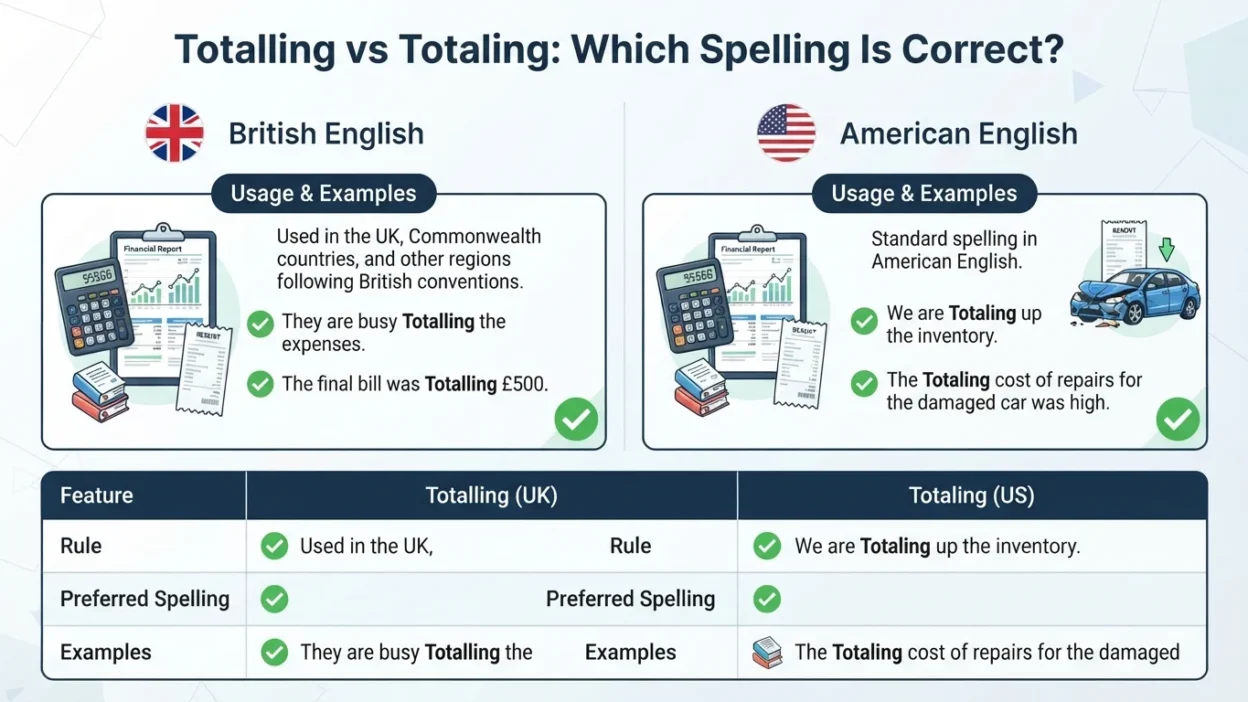
- Totaling is the preferred spelling in American English.
- Totalling is the preferred spelling in British English and other varieties of English that follow British spelling conventions.
Both spellings are correct—the choice depends on the English style you’re using.
What Does “Total” Mean?
The verb total means to add up numbers, reach a final amount, or completely destroy something, especially a vehicle. As a noun, it refers to the final sum or complete amount.
The present participle forms are:
- Totaling (American English)
- Totalling (British English)
Both forms have exactly the same meaning.
What Does “Totaling” Mean?
Totaling is the American English spelling of the present participle and gerund of total.
It commonly means:
- Adding up figures
- Reaching a specific amount
- Completely damaging a vehicle beyond repair
Examples of “Totaling”
- The expenses are totaling more than expected.
- She spent the afternoon totaling the monthly sales.
- The accident ended up totaling the car.
- The donations are totaling over $50,000.
- We are totaling the final scores.
What Does “Totalling” Mean?
Totalling has the same meaning as totaling, but it follows British English spelling rules, where the final consonant is often doubled before adding -ing.
Examples of “Totalling”
- The accountant is totalling the invoices.
- Repairs ended up totalling the vehicle.
- Their purchases are totalling more than £500.
- The team spent hours totalling the annual budget.
If you’re writing for a British audience, totalling is usually the preferred spelling.
Totalling vs Totaling: Comparison Table
| Feature | Totalling | Totaling |
|---|---|---|
| Meaning | Adding up or completely damaging | Adding up or completely damaging |
| American English | Less common | Preferred |
| British English | Preferred | Less common |
| Pronunciation | Same | Same |
| Correct spelling | Yes | Yes |
Which Spelling Should You Use?
The best spelling depends on your audience.
Use totaling if you’re writing for:
- American readers
- U.S. businesses
- American schools
- Most U.S.-based websites
Use totalling if you’re writing for:
- British readers
- UK businesses
- Australian audiences
- Canadian publications following British spelling
- International organizations using British English
For SEO, choose the spelling that matches your target audience and use it consistently throughout your content.
Why Are There Two Spellings?
The difference comes from regional spelling conventions.
In British English, many verbs ending in a single consonant double that consonant before adding -ing.
Examples include:
- Travel → Travelling
- Cancel → Cancelling
- Total → Totalling
American English usually keeps a single l in these forms:
- Traveling
- Canceling
- Totaling
This difference is a matter of spelling preference, not meaning.
Common Mistakes to Avoid
Many writers assume one spelling is always incorrect.
Incorrect
- Totalling is wrong.
Correct
- Totalling is correct in British English.
Incorrect
- Totaling is only used informally.
Correct
- Totaling is the standard American English spelling.
Incorrect
- The two words have different meanings.
Correct
- They have exactly the same meaning.
Easy Memory Trick
Here’s an easy way to remember:
- American English = One “L” → Totaling
- British English = Two “L”s → Totalling
If you’re unsure which spelling to use, think about your intended audience before you start writing.
American vs British English
This is where the main difference appears.
| American English | British English |
|---|---|
| Totaling | Totalling |
| Totaled | Totalled |
| Total | Total |
Both styles are correct when used consistently.
Related Words and LSI Keywords
Using related vocabulary naturally improves topical authority and readability.
- Add up
- Calculate
- Sum
- Final amount
- Grand total
- Accounting
- Budget
- Expenses
- Financial total
- Vehicle damage
- Arithmetic
- Calculation
- Running total
- Overall cost
- Numerical sum
These related terms help readers better understand the different uses of totaling and totalling.
Expert Writing Tip
Professional writers should always match their spelling to their audience. If you’re writing for a U.S. audience, use totaling throughout your document. If you’re writing for readers in the UK or other countries that follow British English, use totalling consistently.
Mixing American and British spellings within the same article can distract readers and reduce the overall professionalism of your writing. Consistency is one of the key elements of clear, high-quality content.
Frequently Asked Questions
Is “totalling” correct?
Yes. Totalling is the preferred British English spelling.
Is “totaling” correct?
Yes. Totaling is the preferred American English spelling.
Which spelling is more common?
Globally, both are common. The preferred spelling depends on whether you’re using American or British English.
Do “totalling” and “totaling” have different meanings?
No. Both mean adding up numbers or completely damaging something, especially a vehicle.
Which spelling should I use for SEO?
Use the spelling that matches your target audience. For U.S. readers, choose totaling. For UK readers, choose totalling.
Are they pronounced differently?
No. Both spellings have the same pronunciation.
Is one spelling more formal than the other?
No. Both are standard spellings within their respective forms of English.
Summary
The difference between totalling and totaling is based entirely on regional spelling conventions. Both words mean adding up numbers, reaching a final amount, or completely damaging something, such as a vehicle. The meanings are identical, and the only distinction is whether you’re writing in American or British English.
If your audience is primarily in the United States, totaling is the preferred spelling. If you’re writing for readers in the United Kingdom or other regions that follow British English, totalling is the better choice. Whichever version you select, use it consistently throughout your writing to create a professional, reader-friendly experience.