“Who to contact” and “whom to contact” are both grammatically possible, but they belong to different levels of formality. The confusion comes from the traditional distinction between who and whom. In modern English, especially in everyday American and British usage, who is much more common, even in situations where traditional grammar would recommend whom.
The phrase usually appears in questions, instructions, emails, websites, customer-service messages, and professional communication. If you are wondering whether to write “Who to contact?” or “Whom to contact?”, the answer depends largely on context and formality. “Who to contact” is natural and widely accepted in modern English, while “whom to contact” is more formal and follows traditional grammatical rules.
Quick Answer
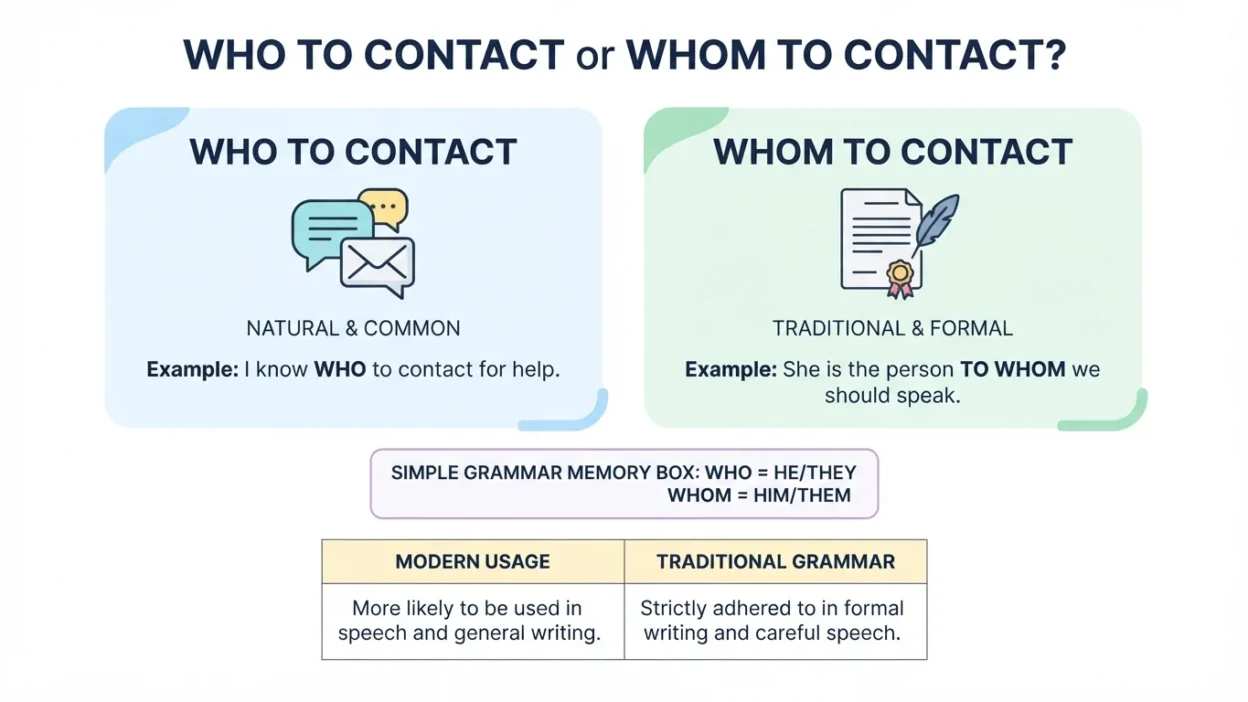
“Who to contact” is the most natural and commonly used expression in modern English. “Whom to contact” is also grammatically correct, especially in formal writing. Use who for everyday communication and whom when you want a more traditional or formal style.
Why Do People Confuse “Who to Contact” and “Whom to Contact”?
The confusion comes from the traditional difference between who and whom.
- Who is traditionally used as a subject.
- Whom is traditionally used as an object.
For example:
- Who called you?
Here, “who” is the subject of “called.” - Whom did you call?
Here, “whom” is the object of “call.”
In “who to contact,” the word “who” is connected to the verb contact, which traditionally takes an object. Therefore, traditional grammar would favor “whom to contact.”
However, modern English often uses who instead of whom, particularly in everyday speech and informal writing.
Who to Contact
“Who to contact” is the more common and natural phrase in modern English.
It means which person you should contact or the person you should get in touch with.
Examples
- Do you know who to contact about this problem?
- I’m not sure who to contact for technical support.
- Please let me know who to contact.
- Can you tell me who to contact about my application?
- She asked me who to contact regarding the meeting.
This construction sounds natural in emails, conversations, workplace communication, websites, and general writing.
Why “Who to Contact” Sounds Natural
English has increasingly moved away from using whom in ordinary conversation. Many speakers use who in places where traditional grammar would prescribe whom.
For example:
I don’t know who to contact.
This sounds completely natural to most modern English speakers.
Whom to Contact
“Whom to contact” is also grammatically correct.
It follows the traditional rule that whom should be used when the person is the object of a verb or preposition.
Examples
- Please tell me whom to contact.
- She asked whom to contact about the issue.
- Do you know whom to contact for further information?
- The website explains whom to contact with questions.
- He wasn’t sure whom to contact for assistance.
This version can sound more formal, old-fashioned, or highly polished depending on the context.
Who to Contact vs Whom to Contact
| Phrase | Grammar | Tone | Common Usage |
|---|---|---|---|
| Who to contact | Modern standard usage | Natural, conversational | Very common |
| Whom to contact | Traditional/formal grammar | Formal | Less common |
| Who should I contact? | Modern standard usage | Natural | Very common |
| Whom should I contact? | Traditional grammar | Formal | Less common |
Both “who to contact” and “whom to contact” can be correct. The main difference is formality and modern usage, rather than meaning.
When to Use “Who to Contact”
Use “who to contact” when you want your writing to sound natural, clear, and conversational.
It works particularly well in:
- Emails
- Everyday conversations
- Workplace messages
- Customer-service questions
- Websites
- Social media
- Informal and semi-formal writing
- General educational content
Examples
Everyday:
I don’t know who to contact.
Workplace:
Could you tell me who to contact about the project?
Customer service:
I’m unsure who to contact about my account.
Email:
Please let me know who to contact if I have any questions.
For most everyday situations, who to contact is an excellent choice.
When to Use “Whom to Contact”
Use “whom to contact” when you deliberately want a more formal or traditional tone.
It may appear in:
- Formal correspondence
- Legal writing
- Academic writing
- Traditional business writing
- Official documents
- Highly formal announcements
Examples
Please advise us whom to contact regarding this matter.
The document explains whom to contact in the event of an emergency.
Could you please indicate whom to contact for additional information?
Although grammatically traditional, whom can sound unnecessarily formal in casual communication.
Who to Contact or Whom to Contact: Easy Grammar Test
There is a useful traditional test.
Replace the question word with he/him or they/them.
If he/they works, traditionally use who.
If him/them works, traditionally use whom.
Consider:
Who contacted you?
You would say:
He contacted me.
So who is correct.
Now consider:
Whom did you contact?
You would say:
I contacted him.
So traditional grammar recommends whom.
For:
Whom should I contact?
The answer is:
You should contact him.
Therefore, traditional grammar recommends whom.
However, in modern everyday English, many speakers naturally say:
Who should I contact?
That form is widely accepted and very common.
“Who Should I Contact?” vs “Whom Should I Contact?”
This is another common variation.
Who should I contact?
This is the more natural modern expression.
Who should I contact about the problem?
It is clear, grammatical in modern standard usage, and appropriate for most situations.
Whom should I contact?
This follows the traditional object rule.
Whom should I contact about the problem?
It is grammatically formal and can sound more sophisticated or official.
For most modern communication, “Who should I contact?” is the more natural choice.
Examples: Who to Contact
Here are several natural examples:
- Do you know who to contact about this issue?
- I’m not sure who to contact for help.
- Please tell me who to contact.
- She asked me who to contact.
- Could you tell me who to contact about registration?
- I don’t know who to contact regarding the payment.
- He explained who to contact in an emergency.
- Can you tell us who to contact for more information?
- The website tells visitors who to contact.
- We need to know who to contact before making a decision.
Examples: Whom to Contact
- Do you know whom to contact about this matter?
- Please advise me whom to contact.
- She asked whom to contact for assistance.
- The letter explains whom to contact.
- He wasn’t sure whom to contact.
- Please let us know whom to contact with questions.
- The policy states whom to contact in an emergency.
- They asked the manager whom to contact.
- We need to determine whom to contact.
- The official notice explains whom to contact for further details.
Common Mistakes
Mistake 1: Thinking “Who to Contact” Is Always Wrong
This is a common misconception.
Who to contact is extremely common in modern English and is accepted in standard usage.
Mistake 2: Assuming “Whom” Is Always Better
Using whom does not automatically make a sentence better.
For example:
Please tell me whom to contact.
is formal and grammatically traditional, but:
Please tell me who to contact.
is perfectly natural for most modern communication.
Mistake 3: Using “Who” and “Whom” Without Considering Tone
Grammar isn’t the only consideration. Style matters too.
Compare:
Who should I contact?
with:
Whom should I contact?
Both communicate the same basic idea, but the second sounds more formal.
Mistake 4: Confusing “Whom” With “Who’s”
Remember:
- who = person/persons
- whom = traditional object form
- who’s = who is / who has
- whose = possessive form
For example:
Who is calling?
Whom did you call?
Who’s responsible?
Whose phone is this?
Memory Trick
Use this simple trick:
WHO = HE / THEY
WHOM = HIM / THEM
For example:
Who called?
He called.
So use who.
Whom did you call?
You called him.
So traditional grammar uses whom.
For the phrase itself:
Whom to contact → contact him/them
But remember that modern English frequently uses who instead.
American vs British English
There is no major American-versus-British spelling difference between who and whom.
Both varieties recognize both forms.
However, whom is generally more restricted and formal in everyday English. In both American and British English, speakers commonly use who in ordinary conversation.
British English can sometimes retain whom in formal writing and after certain prepositions:
To whom it may concern
American English also uses this formal construction.
In ordinary communication, however, you are likely to encounter:
Who should I contact?
more frequently than:
Whom should I contact?
Similar Expressions
Several expressions communicate the same basic idea.
Who should I contact?
A direct and natural question.
Who should I contact about my order?
Who can I contact?
Focuses on the person available or appropriate to help.
Who can I contact for technical support?
Whom should I contact?
A more formal version of “Who should I contact?”
Whom should I contact regarding this matter?
Who do I contact?
Informal and conversational.
Who do I contact if I need help?
Who to reach out to?
A modern conversational alternative.
Do you know who to reach out to?
Who to get in touch with?
Another natural alternative.
I don’t know who to get in touch with.
FAQs
Is “who to contact” grammatically correct?
Yes. “Who to contact” is widely accepted in modern English and is extremely common in everyday communication.
Is “whom to contact” correct?
Yes. “Whom to contact” is grammatically correct according to traditional rules because “whom” functions as the object of “contact.”
Which is more common: “who to contact” or “whom to contact”?
“Who to contact” is more common in modern everyday English. “Whom to contact” is more formal and less common in ordinary conversation.
Should I use “who” or “whom” in an email?
For most professional emails, who is perfectly acceptable and usually sounds more natural. Use whom if the email is highly formal or follows a style that favors traditional grammar.
Is “Who should I contact?” correct?
Yes. “Who should I contact?” is a standard and very common modern English question.
Is “Whom should I contact?” correct?
Yes. “Whom should I contact?” follows traditional grammar because “whom” is the object of “contact.”
Is “Who to contact” formal or informal?
It can be used in both formal and informal contexts, but it generally sounds more natural and conversational than “whom to contact.”
Final Verdict
Both “who to contact” and “whom to contact” can be correct. The traditional grammatical rule favors “whom to contact” because the person is the object of the verb contact. However, modern English frequently uses who in this construction, and “who to contact” is natural, common, and widely accepted.
If you’re writing a normal email, message, article, website, or workplace communication, “who to contact” is usually the easiest and most natural choice. If you’re writing something highly formal or intentionally following traditional grammar, “whom to contact” may be appropriate.
Conclusion
The choice between “who to contact” and “whom to contact” mainly comes down to modern usage versus traditional formality. Traditional grammar says whom because the person is receiving the action of the verb “contact.” Modern English, however, often prefers who, especially in speech and everyday writing. This is why “Who should I contact?” sounds completely natural to most English speakers.
For practical writing, don’t feel that you must use whom simply because it sounds more grammatical. “Who to contact” is clear, natural, and widely used. Remember the traditional test—who = he/they, whom = him/them—but also consider your audience and the level of formality you want.
Remember This
Who to contact = natural, modern, and widely used.
Whom to contact = traditional, formal, and grammatically correct.
Easy rule:
WHO → HE/THEY
WHOM → HIM/THEM

A passionate linguist who specializes in word relationships and vocabulary building.
He has spent years studying synonyms and semantic patterns across languages.
Arman writes to make language learning simple, precise, and engaging.