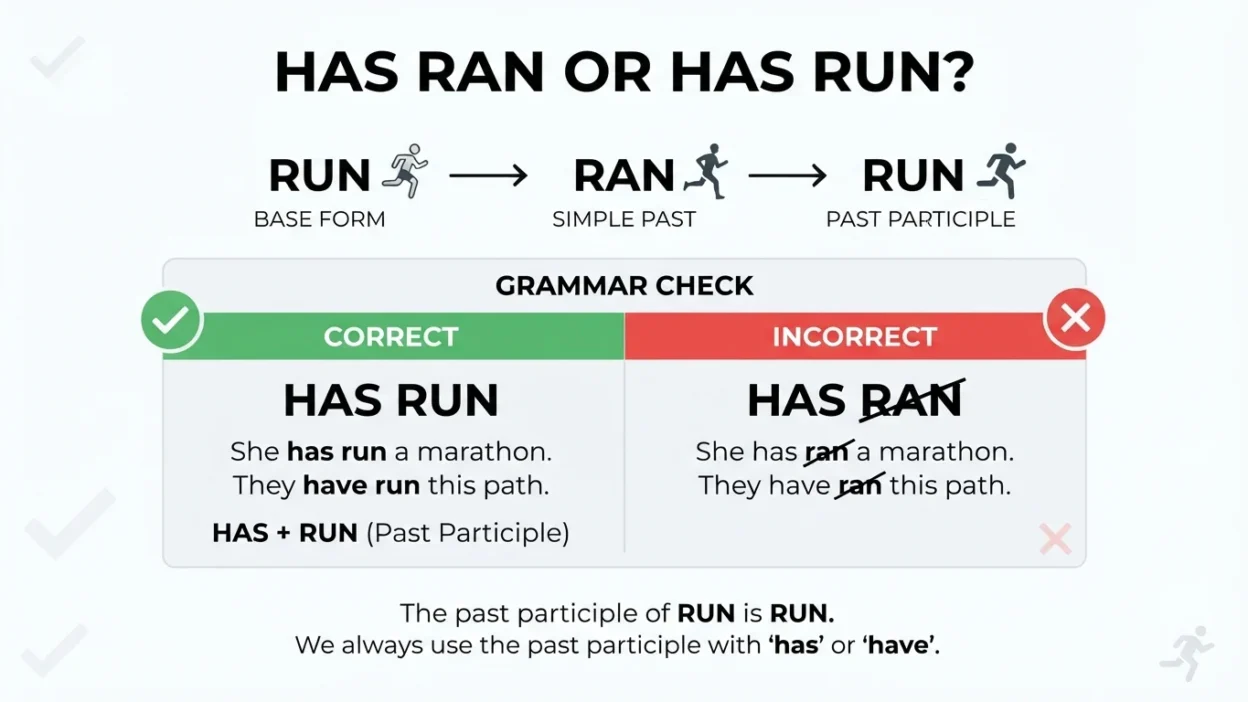
“Has ran” and “has run” are often confused because ran and run are both forms of the irregular verb run. However, they cannot be used interchangeably. The correct choice depends on the helping verb used in the sentence.
The key rule is simple: after has, have, or had, you generally need the past participle form of the verb. For run, that form is run, not ran. Therefore, “has run” is correct, while “has ran” is incorrect in standard English.
Quick Answer
Has run is correct. Has ran is incorrect in standard English.
The verb run has three important forms:
| Base Form | Past Simple | Past Participle |
|---|---|---|
| run | ran | run |
Because has is a helping verb used with the past participle in the present perfect tense, we say:
She has run five miles.
Not:
She has ran five miles. ❌
Why Do People Confuse “Has Ran” and “Has Run”?
The confusion comes from the unusual forms of the verb run.
Most learners know:
- run → present
- ran → past
But they may not immediately remember that the past participle goes back to run.
Compare:
I run every morning.
I ran yesterday.
I have run five miles today.
The form changes depending on the tense and helping verb.
What Does “Has Run” Mean?
Has run is the correct present perfect construction.
It is formed with:
has + past participle
Since the past participle of run is run, the correct structure is:
has + run = has run
Examples
- She has run three miles today.
- He has run this business for ten years.
- The dog has run away.
- The machine has run continuously since morning.
- She has run several successful campaigns.
What Does “Has Ran” Mean?
“Has ran” is not correct in standard English because ran is the simple past form, not the past participle.
The simple past can stand alone:
She ran yesterday. ✅
But after has, you need the past participle:
She has run today. ✅
Not:
She has ran today. ❌
Run vs Ran vs Run
Understanding all three forms makes this rule much easier.
1. Run — Base Form
Use run for the base form of the verb.
I run every morning.
It can also follow modal verbs and certain auxiliary verbs:
I can run fast.
2. Ran — Simple Past
Use ran for an action completed in the past.
She ran five miles yesterday.
No has, have, or had is needed.
3. Run — Past Participle
Use run after has, have, or had in perfect constructions.
She has run five miles.
They have run the company successfully.
He had run before the rain started.
Comparison Table
| Form | Correct Example | Tense/Use |
|---|---|---|
| Run | I run every day. | Present/base form |
| Ran | I ran yesterday. | Simple past |
| Run | I have run today. | Past participle |
| Has run | She has run five miles. | Present perfect |
| Had run | She had run five miles. | Past perfect |
When to Use “Has Run”
Use has run when the subject is singular third person and you are forming the present perfect tense.
The structure is:
Subject + has + past participle
Examples:
- He has run every day this week.
- She has run three marathons.
- The company has run several successful campaigns.
- The engine has run for six hours.
- The child has run outside.
With “already”
She has already run five kilometers.
With “never”
He has never run a marathon.
With “just”
She has just run to the store.
When to Use “Ran”
Use ran when talking about a completed action in the simple past.
Examples:
- She ran yesterday.
- He ran to the station.
- They ran five miles last weekend.
- I ran home after work.
- The dog ran across the street.
A useful clue is a specific finished past-time expression such as:
- yesterday
- last week
- last year
- two hours ago
- in 2024
- this morning, when the morning is finished
For example:
She ran five miles yesterday.
Not:
She has run five miles yesterday. ❌
“Has Run” vs “Ran”
These two forms are both correct, but they express different grammatical relationships with time.
Has run
She has run five miles today.
The action is connected to the present.
Ran
She ran five miles yesterday.
The action happened at a finished time in the past.
Compare:
He has run three marathons.
This tells us about his experience up to now.
He ran a marathon last year.
This refers to a specific past event.
10 Examples of “Has Run”
- She has run five miles today.
- He has run several successful businesses.
- The athlete has run in three international competitions.
- The machine has run continuously for hours.
- She has run out of money.
- The dog has run away.
- He has run the program several times.
- The company has run several advertising campaigns.
- She has run every morning this week.
- The engine has run without any problems.
Common Mistakes
Mistake 1: Using “ran” after “has”
❌ She has ran five miles.
✅ She has run five miles.
Mistake 2: Using “ran” after “have”
❌ They have ran three kilometers.
✅ They have run three kilometers.
Mistake 3: Using “ran” after “had”
❌ He had ran before I arrived.
✅ He had run before I arrived.
The same rule applies to has, have, and had.
Mistake 4: Thinking “run” is always present tense
Not necessarily.
Run can be the base form or the past participle.
I run every day.
I have run every day this week.
The helping verb tells you how run is functioning.
Memory Trick
Here is an easy way to remember the three forms:
RUN → RAN → RUN
Think:
Today: run
Yesterday: ran
Has/have/had: run
So:
- I run.
- I ran.
- I have run.
Golden Rule
After HAS, HAVE, or HAD → use RUN, not RAN.
That one rule will help you avoid most mistakes.
Has Run or Has Ran in American and British English?
There is no difference between American and British English on this basic grammar rule.
Both varieties use:
She has run five miles. ✅
And both consider:
She has ran five miles. ❌
nonstandard in ordinary formal English.
The distinction between ran and run is grammatical, not a difference between American and British spelling.
Similar Verb Patterns
Run belongs to a group of irregular verbs where the simple past and past participle are different.
Compare:
| Base | Past | Past Participle |
|---|---|---|
| run | ran | run |
| begin | began | begun |
| sing | sang | sung |
| drink | drank | drunk |
| swim | swam | swum |
For example:
She began the project yesterday.
But:
She has begun the project.
Similarly:
He ran yesterday.
But:
He has run today.
How to Choose the Correct Form
Ask yourself what comes before the verb.
If there is “has”
Use run:
She has run.
If there is “have”
Use run:
They have run.
If there is “had”
Use run:
He had run.
If you are simply talking about a completed past action
Use ran:
She ran yesterday.
Quick Guide
- I run → base/present
- I ran → simple past
- I have run → present perfect
- She has run → present perfect
- They had run → past perfect
- She has ran → ❌ incorrect
Final Verdict
“Has run” is correct, while “has ran” is incorrect in standard English. The reason is grammatical: ran is the simple past form of run, whereas run is the past participle.
Whenever you use has, have, or had to form a perfect tense, use run:
has run ✅
have run ✅
had run ✅
Use ran when the verb is in the simple past:
She ran yesterday. ✅
Remember This
Run – Ran – Run
Present: run
Past: ran
Past participle: run
Has + run, never has + ran.
FAQs
Is “has ran” grammatically correct?
No. In standard English, has ran is incorrect. The correct form is has run.
Is “has run” correct?
Yes. Has run is the correct present perfect construction.
What is the past tense of run?
The simple past tense of run is ran.
She ran yesterday.
What is the past participle of run?
The past participle is run.
She has run five miles.
Can I say “I have ran”?
No. Say:
I have run.
Not:
I have ran. ❌
Can I say “I ran”?
Yes. I ran is correct when using the simple past.
I ran five miles yesterday.
What is the difference between “has run” and “ran”?
Has run is present perfect and connects a past action to the present. Ran is simple past and normally refers to a completed past action.
What is the easiest way to remember “has run” vs “has ran”?
Remember:
Has + past participle = has run.
The three forms are:
run → ran → run
Conclusion
The correct phrase is “has run,” not “has ran.” Although ran is the past form of run, it cannot normally be used after has, have, or had. Those helping verbs require the past participle, and the past participle of run is run.
If you remember just one pattern, remember run → ran → run. Use ran for the simple past, such as “She ran yesterday,” and use run after has, have, or had, such as “She has run five miles.” This simple distinction will make your writing and speaking much more accurate.