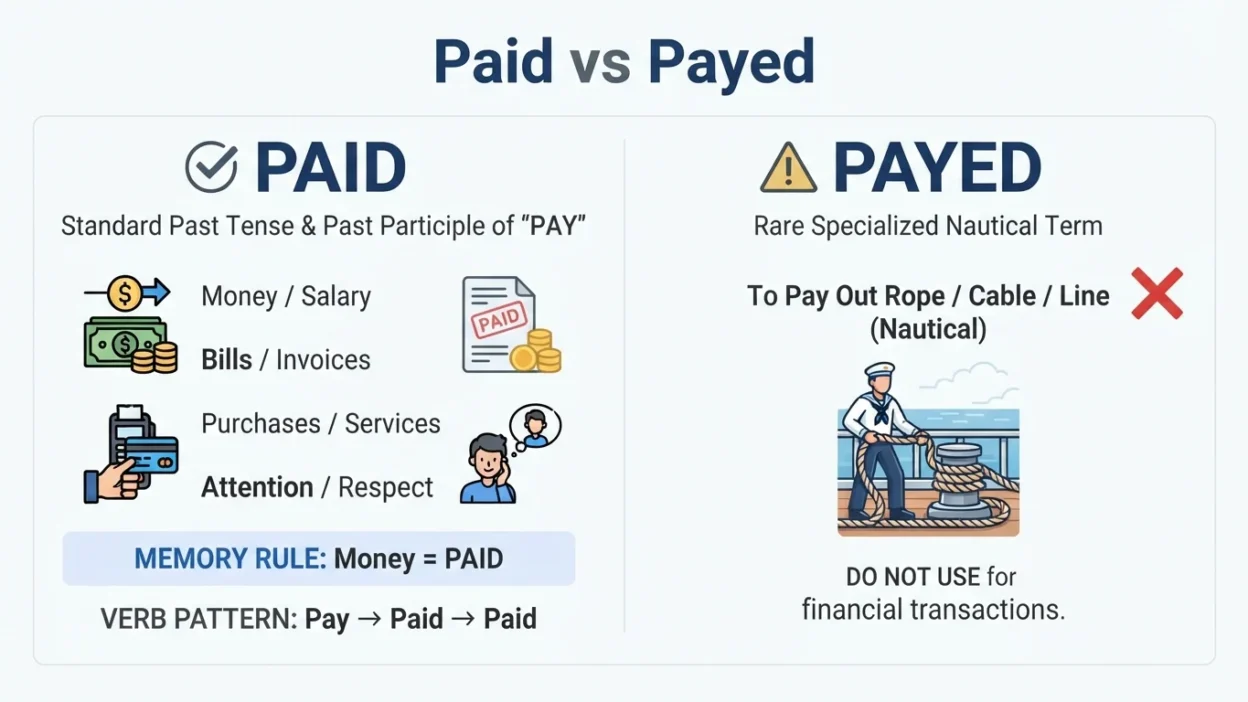
Paid and payed look like two forms of the same verb, but they are not normally interchangeable. The confusion comes from the fact that paid is the standard past tense and past participle of pay, while payed has a much more limited use.
In everyday English, especially when talking about money, bills, salaries, purchases, or debts, paid is the correct word. For example, we say, “I paid the bill,” not “I payed the bill.”
Quick Answer
Paid is the standard past tense and past participle of pay when talking about money or payment.
Payed is a rare technical form used mainly in nautical contexts, especially when referring to letting out or loosening rope, cable, or similar material.
Easy rule: Money → paid. Nautical rope/cable → sometimes payed.
Why Do People Confuse Paid and Payed?
The confusion is understandable because many regular English verbs form their past tense by adding -ed:
- play → played
- walk → walked
- work → worked
- clean → cleaned
Someone might therefore assume:
pay → payed
But pay is an irregular verb when it means to give money.
Its main forms are:
pay → paid → paid
So:
I pay the bill every month.
I paid the bill yesterday.
I have paid the bill already.
What Does “Paid” Mean?
Paid is the past tense and past participle of pay when referring to giving money, settling a debt, compensating someone, or providing payment.
Examples
- I paid the bill yesterday.
- She paid for the meal.
- He paid his employees on Friday.
- We have paid the rent.
- They paid $100 for the tickets.
Common expressions with “paid”
You will often see paid in phrases such as:
- paid in cash
- paid in full
- paid for
- paid the bill
- paid the rent
- paid a fee
- paid a debt
- paid a salary
- paid attention
For example:
She paid attention during the lecture.
Here, paid is part of the expression pay attention and does not refer directly to money.
What Does “Payed” Mean?
Payed is a real but rare word. It is mainly used in specialized nautical language.
In this context, payed can refer to letting out, slackening, or paying out a rope, cable, or line.
For example:
The sailors payed out the rope.
This is a specialized use that most English speakers will rarely encounter.
In ordinary writing, payed is usually a mistake when the intended meaning is financial payment.
Paid vs Payed: Comparison Table
| Word | Main Meaning | Commonness | Example |
|---|---|---|---|
| Paid | Past tense/past participle of pay; gave money or fulfilled a payment | Very common | I paid the bill. |
| Payed | Specialized nautical form involving rope, cable, or line | Very rare | The crew payed out the line. |
When to Use “Paid”
Use paid when talking about:
1. Money
She paid the cashier.
2. Bills
I paid my electricity bill.
3. Debts
He finally paid his debt.
4. Salaries
The company paid its employees.
5. Prices
We paid $50 for dinner.
6. Attention
Please pay attention.
Past tense:
She paid attention to the instructions.
7. Compliments
He paid her a compliment.
8. Respect
They paid their respects.
In all these ordinary uses, paid is the correct form.
When to Use “Payed”
Use payed only when you are dealing with its specialized nautical meaning.
For example:
The crew payed out the anchor line.
However, even in technical writing, you should check the terminology appropriate to your specific nautical context because related forms such as paid out are also widely used.
For general English learners, the safest rule is:
If money is involved, use PAID.
Paid vs Payed Examples
Correct: Paid
- I paid the bill yesterday.
- She paid for the groceries.
- We paid the rent on time.
- He paid his debt.
- They paid $200 for the tickets.
- The company paid its workers.
- She paid attention to the teacher.
- He paid a large fee.
- I have already paid for the order.
- They paid their respects to the family.
Specialized: Payed
- The sailors payed out the rope.
- The crew payed out the cable during the operation.
For normal financial situations, replacing payed with paid is the correct choice.
Common Mistakes
Mistake 1: “I payed the bill.”
❌ I payed the bill.
✅ I paid the bill.
Because this is a financial payment, use paid.
Mistake 2: “She payed for dinner.”
❌ She payed for dinner.
✅ She paid for dinner.
Mistake 3: Assuming every verb ending in “y” takes “-ed”
English has many irregular verbs, and pay is one of them.
pay → paid
not:
pay → payed
Paid vs Pay
Remember that pay is the base form, while paid is the past form.
Present
I pay my bills every month.
Past
I paid my bill yesterday.
Present perfect
I have paid my bill.
Future
I will pay the bill tomorrow.
Notice that will is followed by the base form:
will pay ✅
not:
will paid ❌
Paid vs Payed in American and British English
There is no major American-versus-British difference when pay means giving money.
Both American and British English use:
pay → paid → paid
For example:
She paid the bill.
Payed remains a specialized and uncommon form, particularly associated with nautical terminology.
So whether you are writing American or British English, use paid for ordinary financial situations.
Paid vs Payed vs Payed Out
One area that can cause additional confusion is the phrase pay out.
When talking about giving money:
The company paid out the insurance claim.
When talking about letting out a rope or line in nautical language, you may encounter:
The crew payed out the line.
The context determines the spelling.
For ordinary financial writing, however, paid out is the form you need.
How to Choose the Right Word
Use this quick decision guide:
Are you talking about money?
→ Paid
Are you talking about a bill or debt?
→ Paid
Are you talking about salary or wages?
→ Paid
Are you talking about paying attention or paying respect?
→ Paid
Are you discussing a specialized nautical action involving a rope, cable, or line?
→ Payed may be appropriate.
The simplest rule
Money = PAID
This will be correct in almost every everyday situation.
Memory Trick
Here is an easy way to remember it:
PAID = PAYMENT
Both start with PA and relate to ordinary payment.
Think:
Payment → Paid
If you are talking about money, bills, salaries, purchases, or debts, choose paid.
Remember
Pay → Paid → Paid
Not:
Pay → Payed → Payed
Final Verdict
Paid is the correct and standard past tense and past participle of pay when you are talking about money, bills, debts, salaries, purchases, attention, respect, and similar everyday expressions.
Payed does exist, but it is rare and specialized, mainly appearing in nautical contexts involving the paying out or loosening of rope, cable, or line. For ordinary English, paid is overwhelmingly the correct choice.
If you are unsure, ask yourself: “Am I talking about money?” If the answer is yes, use paid.
FAQs
Is “payed” a correct word?
Yes, but payed is rare and specialized. It is mainly used in nautical contexts. For ordinary financial payment, paid is correct.
Is it “I paid” or “I payed”?
The correct form is:
I paid.
Is “payed for” correct?
No, not when you mean giving money for something. The correct phrase is:
paid for
For example:
She paid for the meal.
What is the past tense of pay?
The standard past tense is paid.
I paid the bill yesterday.
What is the past participle of pay?
The past participle is also paid.
I have paid the bill.
Why is “payed” sometimes used?
Payed survives as a specialized nautical term, particularly in expressions involving paying out rope, cable, or line.
Is “paid” American or British English?
Paid is standard in both American and British English.
What is the easiest way to remember paid vs payed?
Remember:
Money = Paid
If you are talking about payment, choose paid.
Conclusion
The difference between paid and payed is much easier once you know that paid is the normal past tense and past participle of pay. Use it whenever you are talking about money, bills, salaries, debts, purchases, attention, respect, or other common expressions.
Payed is not simply an alternative spelling of paid. It has a specialized nautical use and is uncommon in modern everyday English. For almost all normal writing and conversation, remember the simple rule: pay → paid → paid.

A creative writer with a deep interest in word usage and meaning.
He explores synonyms to enhance both academic and creative expression.
Zayn’s work aims to make language richer and more accessible for everyone.