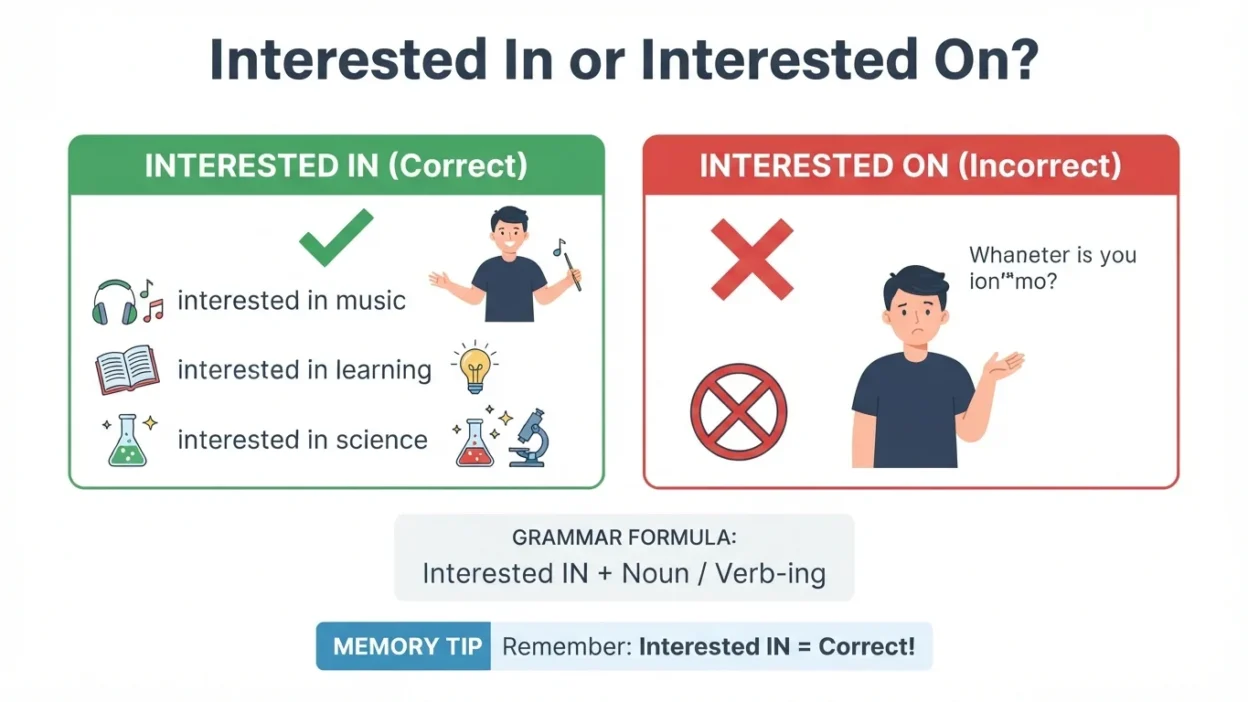
“Interested in” and “interested on” can easily be confused, especially by English learners. However, there is a simple rule to remember: when you want to say that someone likes, wants to learn about, or is curious about something, use interested in.
For example, you should say “I am interested in photography,” not “I am interested on photography.” The preposition in naturally follows the adjective interested when referring to a subject, activity, person, field, or idea.
Quick Answer
Interested in is the correct expression in standard English.
✅ I am interested in history.
✅ She is interested in learning Spanish.
❌ I am interested on history.
Easy rule: Always use interested in when you mean “having an interest in something.”
Why Do People Confuse “Interested In” and “Interested On”?
The confusion comes from the fact that English uses different prepositions with different adjectives.
For example:
- interested in
- focused on
- dependent on
- good at
- afraid of
Because on is common with words such as focused and dependent, learners sometimes mistakenly use it after interested.
But the standard collocation is:
interested in + noun / pronoun / -ing form
What Does “Interested In” Mean?
Interested in means having curiosity, attention, enthusiasm, or a desire to know more about something or someone.
Examples
- I am interested in science.
- She is interested in photography.
- He is interested in buying a new car.
- They are interested in your proposal.
- We are interested in learning more about the course.
- Are you interested in music?
The expression works with both things and people:
She is interested in him.
This can mean she has an interest in him personally, and depending on context, it can also suggest romantic interest.
What Does “Interested On” Mean?
Interested on is generally not correct when interested means curious about or attracted to a subject.
❌ I am interested on marketing.
✅ I am interested in marketing.
❌ She is interested on fashion.
✅ She is interested in fashion.
The problem is the preposition. In standard English, interested normally takes in, not on, for this meaning.
Interested In + Noun
You can use interested in before a noun.
Examples:
- interested in business
- interested in sports
- interested in technology
- interested in history
- interested in art
- interested in education
- interested in politics
- interested in literature
Example sentences
I am interested in technology.
She is interested in history.
They are interested in the project.
Interested In + Verb-ing
You can also use interested in before a gerund, which is a verb ending in -ing.
Examples:
- interested in learning
- interested in traveling
- interested in reading
- interested in writing
- interested in studying
- interested in working
- interested in improving
Examples
I am interested in learning English.
She is interested in studying abroad.
He is interested in starting a business.
A common mistake is to use the infinitive after interested in:
❌ I am interested in to learn English.
✅ I am interested in learning English.
Interested In vs Interested On: Comparison Table
| Expression | Correct? | Meaning | Example |
|---|---|---|---|
| Interested in | ✅ Yes | Having an interest in something | I am interested in art. |
| Interested on | ❌ Generally no | Not the standard collocation | I am interested on art. ❌ |
When to Use “Interested In”
Use interested in when talking about:
1. Subjects
She is interested in biology.
2. Hobbies
He is interested in photography.
3. Activities
They are interested in hiking.
4. Careers
I am interested in teaching.
5. Opportunities
She is interested in the job opportunity.
6. People
He is interested in her.
7. Ideas or topics
We are interested in your ideas.
Common Mistakes
Mistake 1: Interested on + noun
❌ I am interested on science.
✅ I am interested in science.
Mistake 2: Interested on + activity
❌ She is interested on learning English.
✅ She is interested in learning English.
Mistake 3: Interested in + infinitive
❌ He is interested in to study medicine.
✅ He is interested in studying medicine.
Remember that in is a preposition, so it is normally followed by a noun, pronoun, or gerund in this structure.
Interested In vs Interested By
Another expression worth knowing is interested by.
In most everyday situations, interested in is the natural choice:
I am interested in history.
Interested by can sometimes be used when something specifically causes or stimulates someone’s interest:
I was interested by the unusual results.
However, interested in is much more common for general interests and preferences.
Interested In vs Interesting
Do not confuse interested with interesting.
Interested describes how a person feels.
I am interested in astronomy.
Interesting describes something that creates interest.
Astronomy is interesting.
A useful pattern is:
Person → interested
Thing → interesting
For example:
She is interested in art because she finds it interesting.
Interested In vs Focused On
This is one reason people sometimes mistakenly say interested on.
The correct expressions are:
I am interested in the subject.
I am focused on the subject.
Both are correct, but they use different prepositions.
Interested in = having curiosity or enthusiasm about something.
Focused on = concentrating attention on something.
Compare
I am interested in learning French.
This means French attracts your attention or curiosity.
I am focused on learning French.
This means you are concentrating your efforts on learning French.
American vs British English
There is no important American-versus-British difference here.
Interested in is standard in both American English and British English.
The same basic structure is used in both varieties:
I am interested in music.
She is interested in studying medicine.
Are you interested in the position?
Interested on is not a standard alternative in either variety.
How to Remember “Interested In”
Use this simple memory trick:
Interested IN = Interest IN something
Think of in as showing that your attention or curiosity is directed into a subject.
interested in books
interested in science
interested in sports
interested in learning
If you see interested, the safest standard combination is:
interested in
10 Correct Examples
- I am interested in history.
- She is interested in learning French.
- He is interested in photography.
- Are you interested in this job?
- They are interested in buying a house.
- We are interested in your proposal.
- She is interested in science.
- He became interested in cooking.
- I have always been interested in literature.
- They are interested in improving their English.
Final Verdict
The correct expression is interested in. Use it when you want to say that someone has curiosity, enthusiasm, attention, or concern about a person, subject, activity, idea, or opportunity.
Interested on is generally incorrect in standard English for this meaning. The easiest way to remember the rule is simply: interested in something, not interested on something.
Remember This
Interested IN = correct
I am interested in English.
Interested ON = generally incorrect
I am interested on English. ❌
FAQs
Is it interested in or interested on?
The correct expression is interested in.
She is interested in art.
Is “interested on” grammatically correct?
Generally, no. When interested means having curiosity or enthusiasm about something, standard English uses interested in.
Do we say “interested in learning” or “interested in learn”?
Say interested in learning.
I am interested in learning English.
Because in is a preposition, it is followed by the -ing form in this construction.
Is “interested in” used in American English?
Yes. Interested in is standard in American English.
Is “interested in” used in British English?
Yes. It is also standard in British English.
Can I say “I am interested in you”?
Yes. I am interested in you is grammatically correct. Depending on context, it can mean personal, professional, or romantic interest.
What preposition comes after interested?
The standard preposition is in:
interested in something
What is the difference between interested in and focused on?
Interested in means having curiosity or enthusiasm about something, while focused on means concentrating attention or effort on something.
Conclusion
The choice between interested in and interested on is straightforward: interested in is the correct standard expression. It is used to describe curiosity, enthusiasm, attention, or concern about a subject, person, activity, idea, or opportunity.
Although on is used with other adjectives and expressions, it does not normally follow interested in this meaning. So whenever you are writing or speaking about something that attracts your interest, remember the simple pattern: interested in + noun or interested in + verb-ing.

A creative writer with a deep interest in word usage and meaning.
He explores synonyms to enhance both academic and creative expression.
Zayn’s work aims to make language richer and more accessible for everyone.