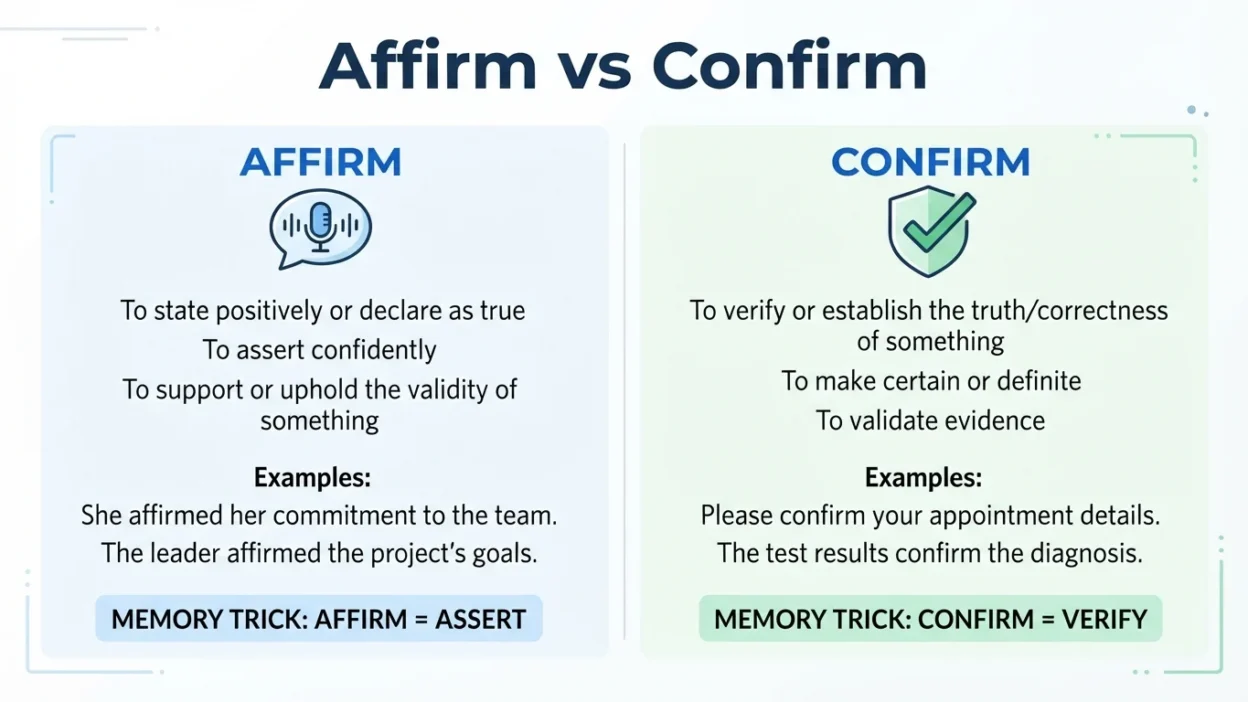
Affirm and confirm are closely related verbs, and both can involve saying that something is true. However, they are not always interchangeable. The main difference is that affirm usually means to state, declare, or strongly support something as true, while confirm means to verify that something is true, correct, or definite.
This distinction is useful in everyday conversations as well as academic, professional, legal, and formal writing. Once you understand whether you are making a statement or verifying information, choosing between affirm and confirm becomes much easier.
Quick Answer
Affirm means to state something positively, declare it to be true, or express strong support for it. Confirm means to establish that something is true, correct, or definite, often by checking evidence or receiving additional information.
Easy rule: Affirm = state or support. Confirm = verify or establish.
Why Do People Confuse Affirm and Confirm?
The confusion happens because both words can be used when someone says that something is true.
For example:
- She affirmed that she was telling the truth.
- She confirmed that she was telling the truth.
Both sentences can be grammatically correct, but the emphasis is slightly different.
Affirm focuses more on the act of asserting or declaring something.
Confirm focuses more on verification or establishing certainty.
Think of it this way:
Affirm: “I state that this is true.”
Confirm: “I verify that this is true.”
What Does “Affirm” Mean?
Affirm is a verb meaning to state something firmly, declare that something is true, or express strong support for an idea, belief, decision, or principle.
It can also mean to validate or uphold something, especially in formal or legal contexts.
Examples of Affirm
- She affirmed her commitment to the project.
- He affirmed that the statement was accurate.
- The witness affirmed that he had seen the event.
- She affirmed her belief in equal rights.
- The court affirmed the earlier decision.
Common uses of “affirm”
Affirm is often used with:
- beliefs
- opinions
- commitments
- decisions
- principles
- statements
- rights
- support
For example:
The organization affirmed its commitment to improving education.
Here, affirmed emphasizes a strong declaration or expression of commitment.
What Does “Confirm” Mean?
Confirm is a verb meaning to establish that something is true, accurate, correct, or definite.
It often involves checking information, receiving evidence, or verifying something that was already suspected or believed.
Examples of Confirm
- Please confirm your email address.
- The manager confirmed the meeting time.
- The test confirmed the diagnosis.
- She confirmed that she would attend.
- The company confirmed the report.
Common uses of “confirm”
Confirm frequently appears with:
- appointments
- reservations
- dates
- times
- information
- details
- facts
- reports
- bookings
- suspicions
- arrangements
For example:
Please confirm your appointment by Friday.
The goal is to make sure the appointment is definite.
Affirm vs Confirm: Comparison Table
| Word | Main Meaning | Main Focus | Example |
|---|---|---|---|
| Affirm | State or declare something positively | Assertion, support, belief | She affirmed her commitment. |
| Confirm | Establish that something is true or correct | Verification, certainty | She confirmed the appointment. |
The Key Difference Between Affirm and Confirm
The easiest way to understand the difference is to focus on assertion vs verification.
Affirm = Assertion
When you affirm something, you make a positive statement about it.
He affirmed his loyalty to the company.
He is expressing or declaring his loyalty.
Confirm = Verification
When you confirm something, you establish that it is correct or true.
He confirmed the meeting time.
He is verifying the information.
Compare These Examples
She affirmed her belief in the plan.
This emphasizes her belief and support.
She confirmed that the plan would begin Monday.
This emphasizes verification of the information.
When to Use “Affirm”
Use affirm when someone:
- makes a strong declaration
- states something positively
- expresses a belief
- shows support
- reinforces a commitment
- upholds a principle or decision
Examples
The leader affirmed his commitment to transparency.
She affirmed that the information was accurate.
The student affirmed her willingness to participate.
The court affirmed the previous ruling.
In formal writing, affirm can sound stronger and more deliberate than simply saying say or state.
When to Use “Confirm”
Use confirm when someone:
- verifies information
- checks a fact
- establishes certainty
- validates a previous suspicion
- makes an arrangement definite
- verifies an appointment or booking
Examples
Please confirm your attendance.
The doctor confirmed the results.
The hotel confirmed our reservation.
The company confirmed the news.
Can you confirm the address?
In these situations, confirm is the natural choice because the focus is on verification.
Affirm vs Confirm in Sentences
Here are examples that show the difference clearly.
Affirm
- She affirmed her support for the proposal.
- He affirmed his commitment to the team.
- The witness affirmed that the statement was true.
- She affirmed her belief in the principle.
- The court affirmed the lower court’s decision.
Confirm
- Please confirm your attendance.
- The manager confirmed the meeting time.
- The test confirmed the results.
- She confirmed that she had received the email.
- The airline confirmed the booking.
Can “Affirm” and “Confirm” Be Used Interchangeably?
Sometimes, yes, particularly when someone is stating that something is true.
For example:
She affirmed that the information was correct.
She confirmed that the information was correct.
Both can work, but the nuance changes.
Affirmed emphasizes her assertion.
Confirmed emphasizes her verification.
In other situations, only one word sounds natural.
For example:
Please confirm your reservation. ✅
Please affirm your reservation. ❌
Here, confirm is the normal word because you are asking someone to verify an arrangement.
Similarly:
She affirmed her commitment to the cause. ✅
She confirmed her commitment to the cause.
The second sentence is possible, but it sounds more like she verified or stated that the commitment existed rather than emphasizing her strong support.
Common Mistakes
Mistake 1: Using “affirm” for appointments
❌ Please affirm your appointment.
✅ Please confirm your appointment.
Mistake 2: Using “confirm” when emphasizing a belief
❌ She confirmed her belief in the principle.
This is not necessarily grammatically wrong, but affirmed is often more natural when the focus is on strong support.
✅ She affirmed her belief in the principle.
Mistake 3: Thinking both words mean exactly the same thing
Although they overlap, their central meanings differ:
- Affirm → declare, assert, support
- Confirm → verify, establish, validate
Memory Trick
Use this simple memory trick:
AFFIRM = ASSERT
Both involve making a positive statement.
Affirm → Assert
CONFIRM = CHECK
Think of confirming something as checking whether it is correct.
Confirm → Check
So remember:
AFFIRM = “I state it.”
CONFIRM = “I verify it.”
Affirm vs Confirm in Formal and Legal English
Both words are common in formal English, but they can have specialized meanings.
Affirm can mean to uphold a decision, especially in legal language.
The appellate court affirmed the lower court’s judgment.
Confirm can mean to formally establish or validate something.
The committee confirmed the appointment.
This is why the distinction matters in professional and academic writing.
American vs British English
There is no major American-versus-British spelling difference between affirm and confirm.
Both words are standard in American English and British English.
Their basic meanings and common usage are also largely the same in both varieties.
You can therefore use:
- affirm for stating, declaring, or strongly supporting something
- confirm for verifying or establishing something
regardless of whether you are writing for an American or British audience.
Affirm vs Confirm vs Validate
These three words can overlap, but they have different typical uses.
Affirm → state or support something positively.
Confirm → verify that something is true or correct.
Validate → establish that something is legitimate, acceptable, or accurate.
For example:
She affirmed her commitment.
She confirmed the appointment.
The test validated the results.
Choosing the most precise verb makes your writing clearer and more professional.
How to Choose the Right Word
Ask yourself one simple question:
Am I stating/supporting something, or am I verifying it?
If you are declaring, asserting, or expressing strong support, choose affirm.
If you are checking, verifying, or establishing certainty, choose confirm.
Quick guide
- State a belief → affirm
- Express commitment → affirm
- Support a principle → affirm
- Uphold a decision → affirm
- Verify a fact → confirm
- Verify an appointment → confirm
- Verify a reservation → confirm
- Establish information as true → confirm
Final Verdict
Affirm and confirm are related but not identical. Affirm focuses on making a positive declaration, expressing support, or asserting that something is true. Confirm focuses on checking, verifying, or establishing that something is true, accurate, or definite.
The easiest way to remember the distinction is “affirm = assert” and “confirm = verify.” If you are declaring a belief or commitment, affirm is often the better choice. If you are checking information or making an arrangement definite, confirm is usually the natural choice.
FAQs
Is affirm the same as confirm?
Not exactly. Affirm usually means to state or declare something positively, while confirm usually means to verify or establish that something is true or correct.
What is an example of affirm?
She affirmed her commitment to helping the community.
Here, affirmed means she strongly declared her commitment.
What is an example of confirm?
Please confirm your appointment.
Here, confirm means to verify that the appointment is correct or definite.
Can you affirm a fact?
Yes. You can affirm a fact when you are stating or asserting that it is true.
Can you confirm a belief?
Yes, but affirm is often more natural when the focus is on expressing or supporting the belief. Confirm is more natural when you are verifying information about the belief.
Should I say “confirm your attendance” or “affirm your attendance”?
Confirm your attendance is the natural expression. It means to let someone know that you will attend.
What is the difference between affirm and assert?
Both can mean to state something confidently. Affirm often carries a sense of positive confirmation or support, while assert emphasizes making a confident statement or claim.
What is the opposite of confirm?
Depending on the context, possible opposites include deny, dispute, contradict, or invalidate.
Conclusion
The difference between affirm and confirm becomes clear when you focus on the purpose behind the action. Affirm is about declaring, asserting, supporting, or upholding something. Confirm is about verifying, checking, or establishing that something is true, correct, or definite.
When you need to verify a reservation, appointment, fact, date, or piece of information, choose confirm. When you want to express a belief, commitment, principle, or strong declaration, affirm is often the better choice. Remember: affirm = assert; confirm = verify.

A passionate linguist who specializes in word relationships and vocabulary building.
He has spent years studying synonyms and semantic patterns across languages.
Arman writes to make language learning simple, precise, and engaging.