“Have fun” and “enjoy” are both used to talk about pleasure and having a good time, but they are not always used in the same way. English learners often wonder whether they can replace one with the other in every sentence.
The good news is that the difference is fairly simple. Have fun usually means to spend time happily or enjoy yourself, especially during an activity, event, trip, or social occasion. Enjoy is more flexible and can mean taking pleasure in something, appreciating an experience, or finding something pleasant.
Quick Answer
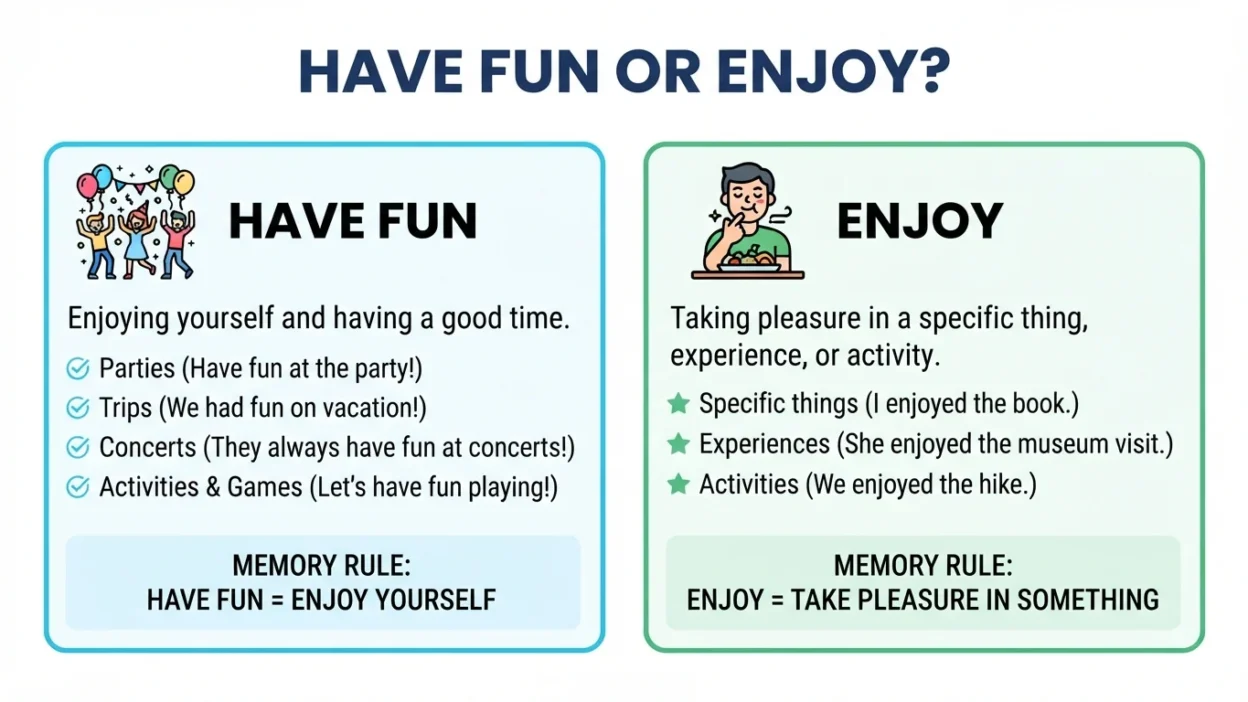
Have fun means to enjoy yourself and have a good time.
Enjoy means to take pleasure in or get satisfaction from something.
Easy rule:
Have fun = enjoy yourself.
Enjoy = take pleasure in something.
For example:
Have fun at the party!
I really enjoyed the party.
Both are correct, but they are used differently.
Why Do People Confuse “Have Fun” and “Enjoy”?
The confusion exists because both expressions are connected with pleasure.
You can often use either expression when talking generally about a pleasant experience:
We had fun at the beach.
We enjoyed our day at the beach.
However, their grammar is different.
Have fun is an expression that normally means enjoy yourself.
Enjoy is a verb that usually needs an object or uses a reflexive pronoun when you mean “have a good time.”
Compare:
We had fun at the concert.
We enjoyed the concert.
But:
We enjoyed ourselves at the concert.
What Does “Have Fun” Mean?
Have fun is an informal expression meaning to enjoy yourself, have a pleasant time, or experience happiness during an activity or event.
It is extremely common in everyday English.
Examples
- Have fun at the party!
- We had fun at the beach.
- I hope you have fun on your trip.
- The children had fun playing outside.
- Did you have fun last night?
- Have fun at the concert!
It can also be used as a friendly wish before someone leaves.
“I’m going to a concert tonight.”
“Have fun!”
Here, have fun means something like “I hope you enjoy yourself.”
What Does “Enjoy” Mean?
Enjoy is a verb meaning to take pleasure in, appreciate, or get satisfaction from something.
It can be used with many different things.
Examples
- I enjoy music.
- She enjoys reading.
- We enjoyed the movie.
- He enjoyed his vacation.
- They enjoyed the meal.
- I really enjoy working with children.
Unlike have fun, enjoy can describe both temporary experiences and general preferences.
For example:
I enjoy reading.
This means reading is something you generally like.
Have Fun vs Enjoy: Comparison Table
| Expression | Main Meaning | Typical Use | Example |
|---|---|---|---|
| Have fun | Enjoy yourself; have a good time | Activities, events, trips, social situations | Have fun at the party! |
| Enjoy | Take pleasure in something | Experiences, activities, things, food, hobbies | I enjoyed the party. |
“Have Fun” as a Wish
One of the biggest differences is that have fun is commonly used as a friendly wish.
You can say:
Have fun!
Have fun at the party!
Have fun on your trip!
Have fun tonight!
You generally cannot replace these naturally with simply:
Enjoy!
Although Enjoy! is possible in some situations, it usually needs context and often means “enjoy this particular thing.”
For example, if you hand someone a meal, you can say:
Enjoy!
This means “I hope you like your meal.”
But if your friend is going to a party, the natural expression is:
Have fun!
“Enjoy” Needs a Clear Context
Enjoy can be followed by a noun:
I enjoyed the movie.
It can also be followed by a gerund:
I enjoy watching movies.
Or a reflexive pronoun:
We enjoyed ourselves.
A common mistake is to use enjoy without the appropriate structure.
❌ I enjoyed.
This can sound incomplete when you mean that you had a good time.
Better:
✅ I enjoyed the party.
✅ I enjoyed my vacation.
✅ I enjoyed myself.
Have Fun vs Enjoy Yourself
These two expressions are particularly close in meaning.
Have fun!
Enjoy yourself!
Both can mean “have a good time.”
However, have fun is usually more casual and conversational.
Enjoy yourself can sound slightly more formal or deliberate.
Examples
Have fun at the wedding!
Enjoy yourself at the wedding!
Both are correct, but the first sounds more casual and natural in everyday conversation.
Have Fun vs Enjoy: Examples
Have Fun
- Have fun at the party!
- We had fun at the beach.
- I hope you have fun on your vacation.
- The children had fun at the park.
- Did you have fun yesterday?
- Have fun at the concert!
- We had a lot of fun during the trip.
- She had fun dancing with her friends.
Enjoy
- I enjoyed the movie.
- She enjoys reading novels.
- We enjoyed our vacation.
- He enjoys playing football.
- They enjoyed the delicious meal.
- I really enjoyed talking with you.
- She enjoys spending time with her family.
- Did you enjoy the concert?
Can You Say “Enjoy!” Instead of “Have Fun!”?
Sometimes, but not always.
Enjoy! is often used when the thing being enjoyed is obvious from the context.
For example:
“I’m going to eat this cake.”
“Enjoy!”
Or:
“I’m watching a new movie tonight.”
“Enjoy!”
But when someone is going to a party, trip, or social event, Have fun! is usually more natural.
“I’m going to a party.”
“Have fun!”
Can You Say “Enjoy the Party” and “Have Fun at the Party”?
Yes. Both are correct.
Enjoy the party!
This focuses on enjoying the party itself.
Have fun at the party!
This focuses on having a good time while attending the party.
There is very little practical difference in many everyday situations.
Common Mistakes
Mistake 1: Using “enjoy” without an object
❌ I enjoyed at the party.
✅ I enjoyed the party.
Or:
✅ I enjoyed myself at the party.
Mistake 2: Using “have fun” with an object
❌ I had fun the movie.
✅ I enjoyed the movie.
Or:
✅ I had fun watching the movie.
Mistake 3: Saying “Enjoy yourself” incorrectly
❌ Enjoy you at the party.
✅ Enjoy yourself at the party.
The reflexive pronoun changes depending on the subject:
- I → myself
- you → yourself
- he → himself
- she → herself
- we → ourselves
- they → themselves
Have Fun vs Enjoy Yourself: Grammar
The structures are worth remembering.
Have fun + place/activity
Have fun at the party.
Have fun on your trip.
We had fun at the beach.
Enjoy + noun
I enjoyed the movie.
She enjoyed the dinner.
They enjoyed the concert.
Enjoy + verb-ing
I enjoy reading.
She enjoys dancing.
They enjoy traveling.
Enjoy + reflexive pronoun
We enjoyed ourselves.
He enjoyed himself.
She enjoyed herself.
Have Fun or Enjoy a Trip?
Both can be correct, but they have different structures.
Have fun on your trip!
This is a friendly wish.
Enjoy your trip!
This is also a friendly wish and is very natural.
You can also say:
I had fun on my trip.
I enjoyed my trip.
Both sentences mean that the trip was a pleasant experience.
Have Fun or Enjoy a Movie?
Use enjoy when talking about the movie as the object:
I enjoyed the movie.
You can also say:
I had fun watching the movie.
But:
❌ I had fun the movie.
The structure have fun + noun does not work in the same way as enjoy + noun.
American vs British English
There is no significant difference between American and British English in the basic use of have fun and enjoy.
Both expressions are standard in both varieties.
You may hear:
Have fun!
Enjoy yourself!
Enjoy your vacation!
Enjoy your holiday!
The vocabulary surrounding them may vary slightly. For example, vacation is more common in American English, while holiday is commonly used in British English.
Have Fun vs Enjoy: Easy Memory Trick
Use this simple trick:
HAVE FUN = HAVE A GOOD TIME
Have fun at the party!
Think: “Enjoy yourself.”
ENJOY = LIKE / TAKE PLEASURE IN
I enjoyed the party.
Think: “I liked the experience.”
Another easy rule:
Have fun at an activity.
Enjoy an activity or thing.
For example:
Have fun at the party.
Enjoy the party.
Related Expressions
Instead of have fun, you can sometimes say:
- have a good time
- enjoy yourself
- have a great time
- have a wonderful time
- have a blast
- have an enjoyable time
Instead of enjoy, depending on the context, you can use:
- like
- appreciate
- love
- relish
- savor
- take pleasure in
These alternatives are not perfect synonyms in every situation, but they can help you vary your vocabulary.
Final Verdict
Have fun and enjoy are both correct expressions, but their grammar and emphasis are different. Have fun means to enjoy yourself or have a good time, especially during an event, activity, trip, or social occasion. Enjoy means to take pleasure in something and can be used with nouns, activities, and gerunds.
The easiest rule is: have fun = enjoy yourself, while enjoy = take pleasure in something. So say “Have fun at the party!” but “I enjoyed the party.”
FAQs
Is “have fun” the same as “enjoy”?
They are very similar, but not exactly the same. Have fun means to enjoy yourself or have a good time, while enjoy usually means to take pleasure in a particular thing or activity.
Is it “Have fun” or “Enjoy” at a party?
Both can work, but Have fun! is a very natural casual expression when wishing someone a good time at a party.
You can also say:
Enjoy the party!
Can I say “Enjoy yourself” instead of “Have fun”?
Yes. Enjoy yourself and have fun can both mean “have a good time.”
Is “I enjoyed” grammatically correct?
It can be correct in some contexts, but it often needs an object or reflexive pronoun.
I enjoyed the movie.
I enjoyed myself.
Is “I had fun the movie” correct?
No.
Say:
I enjoyed the movie.
Or:
I had fun watching the movie.
Can I say “Enjoy your trip”?
Yes. Enjoy your trip! is completely natural.
Can I say “Have fun your trip”?
No. Say:
Have fun on your trip!
or
Enjoy your trip!
What is the difference between “have fun” and “have a good time”?
They are very similar. Both mean to enjoy yourself. Have fun is particularly common in casual everyday English.
Conclusion
The difference between have fun and enjoy is mainly about grammar and focus. Have fun is an expression meaning “enjoy yourself” or “have a good time,” and it is especially common when wishing someone well before an enjoyable activity or event. Enjoy is a more flexible verb that usually takes a noun, gerund, or reflexive pronoun.
Remember the simple pattern: Have fun at the party; enjoy the party. Have fun on your trip; enjoy your trip. Once you understand these structures, you can use both expressions naturally and confidently.

An expert in English grammar and expressive writing techniques.
She focuses on helping readers expand their vocabulary with clarity.
Elina believes the right word can transform ordinary writing into powerful communication.