If you have ever wondered whether “infront” or “in front” is correct, you are not alone. These two forms look very similar, but only one is standard in modern English. The correct spelling is “in front” — written as two separate words.
“Infront” is generally considered a misspelling when you mean the location or position of something. Although people sometimes write it as one word, standard English uses the two-word form in front.
Quick Answer: Infront or In Front?
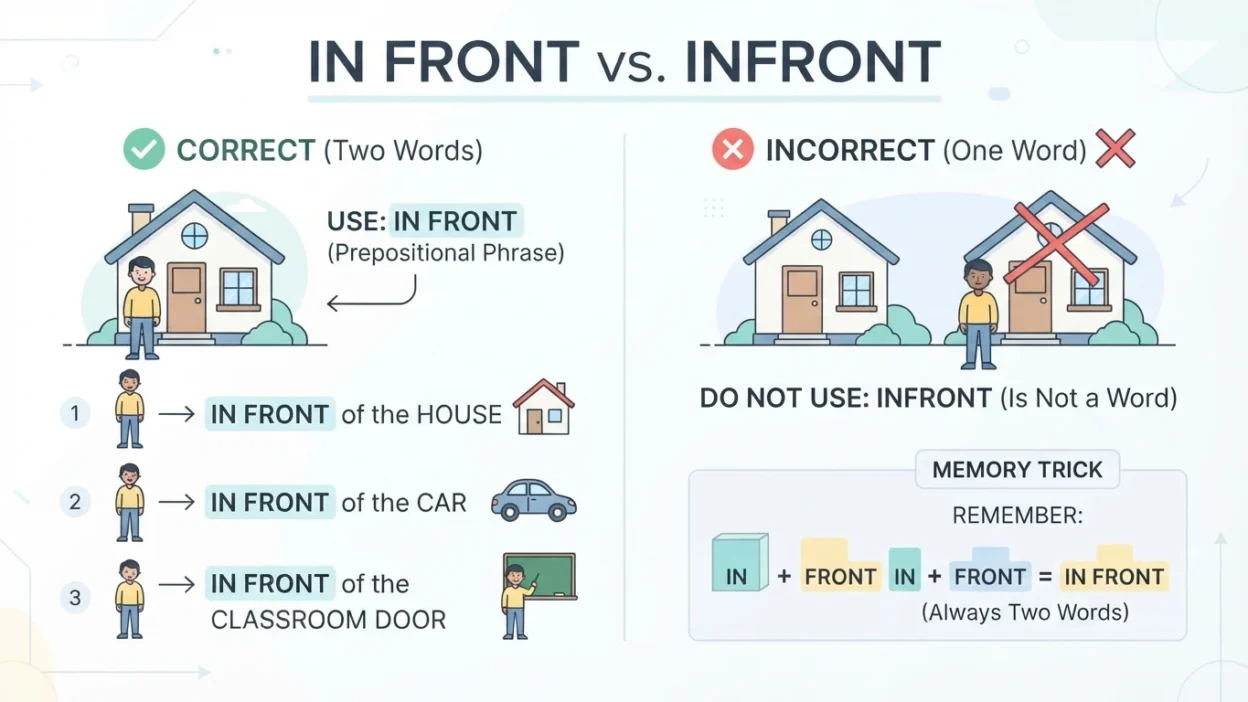
In front is the correct standard spelling. It is written as two separate words and means “ahead of,” “before,” or “at the forward side of something.” Infront is generally incorrect in standard English.
Correct: The car is parked in front of the house.
Incorrect: The car is parked infront of the house.
Why Do People Confuse “Infront” and “In Front”?
The confusion happens because English contains many words that are written as one word even though they began as phrases. For example, inside, outside, and underneath are single words.
However, in front has not become a standard single word. It remains a two-word phrase.
Another reason for the confusion is pronunciation. When people say “in front” quickly, the words can sound closely connected. This can make it tempting to write them together.
For formal writing, academic work, professional communication, websites, and everyday standard English, always use in front.
What Does “In Front” Mean?
In front is a phrase that describes a position or location ahead of something or someone.
It can also describe being before something in a sequence or being visible to an audience.
Examples
- The children are playing in front of the school.
- She stood in front of the mirror.
- There is a garden in front of our house.
- He was waiting in front of the restaurant.
- The teacher stood in front of the students.
The phrase is especially common with “of”:
in front of + person/place/thing
For example:
- in front of me
- in front of the house
- in front of the camera
- in front of the audience
“In Front” as a Prepositional Phrase
Grammatically, in front of is commonly used as a prepositional phrase that indicates position.
For example:
The bicycle is in front of the garage.
Here, “in front of the garage” tells us where the bicycle is located.
It can also be used figuratively:
She spoke confidently in front of everyone.
In this sentence, it refers to being before or before the presence of an audience.
Infront vs In Front: Comparison Table
| Form | Correct? | Meaning | Example |
|---|---|---|---|
| in front | ✅ Yes | Ahead of or before something | The bus is in front of the school. |
| infront | ❌ Generally no | Not standard in this meaning | Avoid infront in standard writing. |
The key point is simple: “in front” is always written as two words when it means ahead of or before something.
When Should You Use “In Front”?
Use in front when you are describing a physical position.
1. A Location
My car is in front of the building.
2. A Position Relative to Someone
He was standing in front of me.
3. A Position Before Something
Our team finished in front of theirs.
4. Before an Audience
She was nervous speaking in front of a large crowd.
5. Before a Camera
He smiled in front of the camera.
10 Examples of “In Front” in Sentences
- The teacher is standing in front of the class.
- We met in front of the library.
- Please wait in front of the office.
- There is a large tree in front of my house.
- He parked his car in front of the gate.
- She was sitting in front of me.
- The children performed in front of their parents.
- Don’t stand in front of the television.
- A taxi stopped in front of the hotel.
- He gave a speech in front of hundreds of people.
Common Mistake: “Infront Of”
One of the most common spelling mistakes is writing:
infront of
This is incorrect in standard English.
The correct form is:
in front of
Incorrect:
She stood infront of the door.
Correct:
She stood in front of the door.
Remember that in and front stay separate.
Is “Infront” Ever Correct?
In ordinary modern English, infront is not the standard spelling of the phrase meaning “ahead of” or “before.”
You may occasionally see infront in usernames, informal online writing, brand names, or other proper-name contexts. Such uses do not make it the standard spelling of the English phrase.
If you are writing an essay, article, email, school assignment, professional document, or website content, use in front.
In Front vs Before
Although in front of and before can sometimes express a similar idea, they are not always interchangeable.
In front of usually focuses on position or location:
The car is in front of the house.
Before can refer to time, order, or position:
Please arrive before noon.
So, when you are talking about physical location, in front of is often the natural choice.
In Front vs Ahead
Ahead can also mean that something is farther forward.
For example:
- The car ahead of us stopped suddenly.
- She walked ahead of the group.
But in front of is especially useful when describing the position of one object or person relative to another:
- The shop is in front of the bank.
- He stood in front of the door.
American vs British English
There is no major American vs British English spelling difference here.
Both American and British English use:
in front
not:
infront
So whether you are writing for an American or British audience, the standard form remains the same.
How to Remember the Correct Spelling
A simple memory trick can help:
Think: “IN + FRONT”
There are two separate words:
IN + FRONT = IN FRONT
You can remember it as:
“I am IN the space at the FRONT.”
This makes it easier to remember that the phrase should not be joined together.
Similar Expressions
Here are some useful expressions related to in front:
- in front of — ahead of something or someone
- ahead of — farther forward
- before — earlier in time or position
- at the front — located at the forward part
- out front — in a forward or prominent position
- in the foreground — positioned toward the front of a scene
These expressions are related, but they are not always interchangeable.
Frequently Asked Questions
Is “infront” one word?
No. Infront is not the standard spelling when you mean “ahead of” or “before.” The correct form is in front.
Is “in front of” correct?
Yes. In front of is the standard expression used to describe a position ahead of someone or something.
Which is correct: “infront” or “in front”?
In front is correct. It should be written as two words.
Why is “infront” incorrect?
“Infront” combines two words that are conventionally kept separate in standard English. The standard phrase is in front.
Is “in front” hyphenated?
Usually, no. Write in front as two words.
However, when a phrase is used as a compound modifier before a noun, style can vary depending on the construction. For example, “in-front positioning” is uncommon; it is usually better to rewrite the sentence for clarity rather than force a hyphenated form.
Is “in front” the same in British and American English?
Yes. Both varieties use in front as the standard form.
Can I use “infront” in formal writing?
No. Avoid infront in formal, academic, professional, and SEO writing. Use in front instead.
Final Verdict: Infront or In Front?
The correct spelling is in front. It is a two-word phrase used to describe something that is ahead of, before, or at the forward position of another person or thing.
Infront is generally a spelling mistake in standard English. If you are unsure, remember the simple rule: IN + FRONT = IN FRONT.
Whether you are writing an email, school assignment, blog post, professional article, or social media caption, choose in front. This small spelling detail can make your writing more accurate and polished.
Remember This
In front = correct ✅
Infront = incorrect in standard English ❌
The easiest memory trick is “IN + FRONT”. Keep the two words separate, and you will almost always get it right.
Conclusion
Choosing between infront or in front is simple once you know the standard rule. In front is the correct form in modern standard English, while infront should generally be avoided. The phrase commonly appears as in front of, especially when describing the location of a person, object, or place.
For clear and professional English, always write in front as two separate words. Remembering this rule will help you avoid a common spelling mistake in academic, professional, and everyday writing.

A creative writer with a deep interest in word usage and meaning.
He explores synonyms to enhance both academic and creative expression.
Zayn’s work aims to make language richer and more accessible for everyone.