Grateful and greatful are commonly confused because they look almost identical. However, only one is the standard spelling in modern English. If you want to express thankfulness or appreciation, the correct word is grateful.
Greatful is a common spelling mistake. Although it may seem logical because the word great appears to be inside it, standard English uses grateful, with grate rather than great.
Quick Answer
Grateful is the correct spelling. Greatful is incorrect in standard English.
Grateful means feeling or showing appreciation and thankfulness.
I am grateful for your help. ✅
I am greatful for your help. ❌
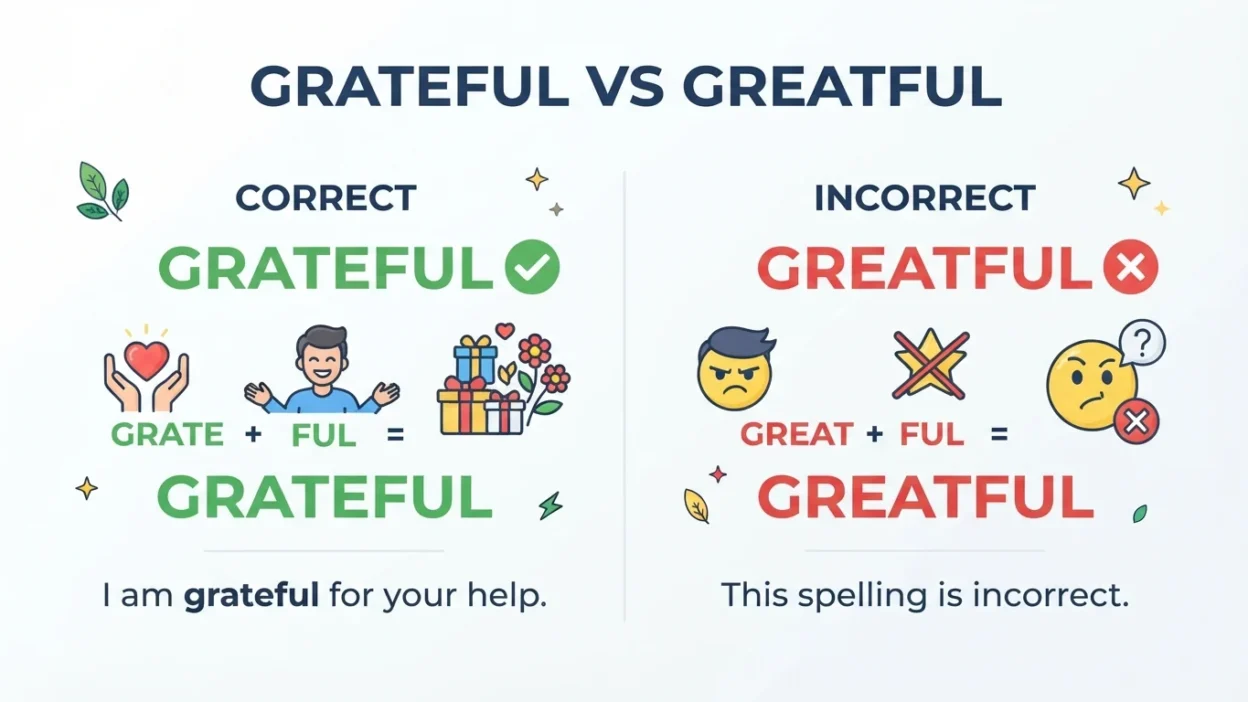
Easy rule: Remember GRATE + FUL = GRATEFUL.
Why Do People Confuse Grateful and Greatful?
The confusion comes from the pronunciation and the familiar word great.
When people hear grateful, they may naturally spell it as greatful because great is a common English word.
However, grateful is historically connected to grate, meaning pleasing or thankful in this word family, not the adjective great.
The correct spelling is:
grate + ful = grateful
Not:
great + ful = greatful
What Does “Grateful” Mean?
Grateful is an adjective that means feeling thankful or appreciative because of something someone has done or something positive that has happened.
Examples
- I am grateful for your support.
- She was grateful for the opportunity.
- We are grateful to everyone who helped us.
- He felt grateful for his family’s support.
- They are deeply grateful for your kindness.
The word can describe appreciation for:
- help
- kindness
- support
- opportunities
- gifts
- friendship
- advice
- experiences
- good fortune
What Does “Greatful” Mean?
Greatful is generally considered an incorrect spelling of grateful in standard English.
It is easy to understand why people make this mistake:
great + ful → greatful
But English does not form this word that way.
The standard spelling is:
grateful
So write:
I am grateful for your kindness. ✅
Not:
I am greatful for your kindness. ❌
Grateful vs Greatful: Comparison Table
| Word | Correct? | Meaning | Example |
|---|---|---|---|
| Grateful | ✅ Yes | Thankful or appreciative | I am grateful for your help. |
| Greatful | ❌ No | Common misspelling of grateful | I am greatful for your help. ❌ |
When to Use “Grateful”
Use grateful when you want to express sincere appreciation or thankfulness.
Grateful for
Use grateful for when you are thankful for something.
I am grateful for your advice.
She is grateful for the opportunity.
We are grateful for your support.
Grateful to
Use grateful to when identifying the person you are thankful to.
I am grateful to my parents.
She is grateful to her teacher.
We are grateful to everyone who helped us.
Grateful to someone for something
You can combine both structures:
I am grateful to you for your kindness.
This is a very common and natural construction.
Grateful vs Thankful
Grateful and thankful are close synonyms, but there can be a slight difference in emphasis.
Grateful often suggests a deeper sense of appreciation.
I am grateful for everything you have done for me.
Thankful can be used for appreciation, but it can also express relief.
I am thankful that everyone arrived safely.
Both words are correct, and the best choice depends on the context.
Grateful vs Appreciative
Grateful and appreciative are also closely related.
Grateful usually emphasizes thankfulness for something received or experienced.
She was grateful for his help.
Appreciative can emphasize recognizing the value or quality of something.
We are appreciative of your continued support.
In many situations, both words can work naturally.
Common Mistakes
Mistake 1: Writing “greatful”
❌ I am greatful for your help.
✅ I am grateful for your help.
Mistake 2: Thinking “great” is the root
It is tempting to think:
great + ful = greatful
But that is not the standard spelling.
Remember:
grate + ful = grateful
Mistake 3: Forgetting the second “a”
The correct word contains:
grate + ful
So it is spelled:
G-R-A-T-E-F-U-L
10 Correct Examples with “Grateful”
- I am grateful for your help.
- She is grateful to her parents.
- We are grateful for this opportunity.
- He felt grateful for their kindness.
- They were grateful to the volunteers.
- I am deeply grateful for your support.
- She was grateful to receive the award.
- We are incredibly grateful for everything you have done.
- He remained grateful throughout his career.
- I will always be grateful for your advice.
Grateful in Formal and Professional Writing
Grateful is completely appropriate in formal, professional, and academic communication.
For example:
We are grateful for your continued support.
I am grateful for the opportunity to work with your team.
We are deeply grateful to everyone who contributed to the project.
In professional emails, grateful can communicate appreciation in a warm but polished way.
American vs British English
There is no spelling difference between American and British English.
Both use:
grateful ✅
And both consider:
greatful ❌
a misspelling in standard English.
Whether you are writing for an American or British audience, always use grateful when you mean thankful or appreciative.
Memory Trick
Here is the easiest way to remember the spelling:
GRATE + FUL = GRATEFUL
Think:
GRATE + FUL
Not:
GREAT + FUL
You can also remember this sentence:
I am GRATEFUL, not GREATFUL.
The word grateful has grate at the beginning.
How to Choose the Correct Spelling
If you want to say that you are thankful or appreciative, choose:
GRATEFUL ✅
If you see:
GREATFUL ❌
correct it to:
GRATEFUL ✅
Quick checklist
- Thankful → grateful
- Appreciative → grateful
- Expressing thanks → grateful
- Standard spelling → grateful
- Greatful → incorrect
Final Verdict
Grateful is the only standard spelling when you mean thankful or appreciative. Greatful is a common misspelling caused by the temptation to combine great with -ful.
The best way to remember the correct spelling is GRATE + FUL = GRATEFUL. Whenever you want to express appreciation, write grateful, not greatful.
FAQs
Is “greatful” a correct spelling?
No. Greatful is generally considered a misspelling. The correct spelling is grateful.
Is it “grateful” or “greatful”?
Grateful is correct.
I am grateful for your help. ✅
What does grateful mean?
Grateful means feeling or expressing thankfulness and appreciation for something someone has done or something positive that has happened.
What is the easiest way to remember grateful?
Remember:
GRATE + FUL = GRATEFUL
Do not spell it as greatful.
Should I say “grateful for” or “grateful to”?
Both are correct.
Use grateful for for the thing you appreciate:
I am grateful for your help.
Use grateful to for the person:
I am grateful to you.
You can also use both:
I am grateful to you for your help.
Is grateful formal or informal?
Grateful works in both everyday and formal English. It is especially common in polite, professional, and heartfelt expressions of appreciation.
Is grateful the same in American and British English?
Yes. Grateful is spelled the same in both American and British English.
What is the difference between grateful and thankful?
Both mean appreciative or thankful. Grateful can sometimes suggest a deeper or more deliberate sense of appreciation, while thankful can also express relief.
Conclusion
The correct spelling is grateful, not greatful. Although greatful may look logical because of the word great, it is not the standard spelling used in modern English.
Whenever you want to express appreciation, remember the simple formula: GRATE + FUL = GRATEFUL. Whether you are writing an email, essay, social media post, or professional message, grateful is the spelling you should use.

An expert in English grammar and expressive writing techniques.
She focuses on helping readers expand their vocabulary with clarity.
Elina believes the right word can transform ordinary writing into powerful communication.