Are you confused about whether “to bad” or “too bad” is correct? You are not alone. These two expressions sound almost identical when spoken, but they have completely different grammatical functions.
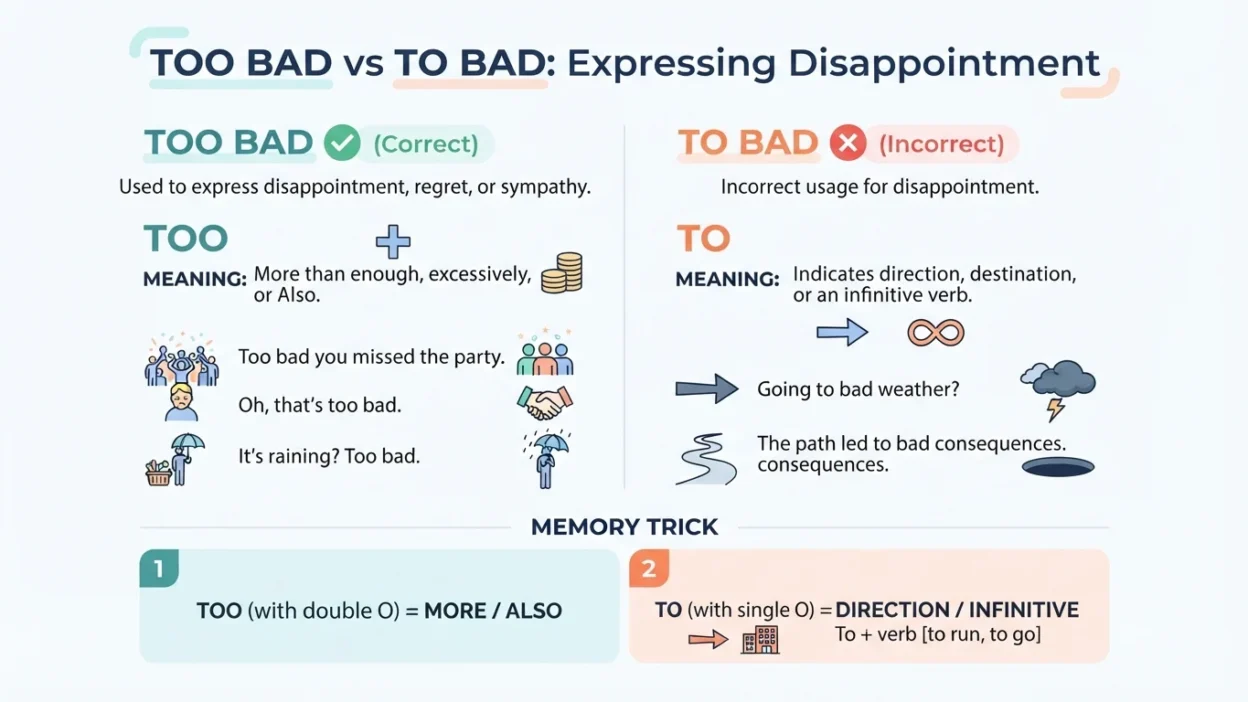
The correct expression is “too bad” when you mean something unfortunate, disappointing, or regrettable. “To bad” is generally incorrect when used with this meaning.
Understanding the difference is easy once you know how to and too work in English. This guide explains the meaning, grammar, examples, common mistakes, and a simple memory trick to help you remember the correct form.
Quick Answer: To Bad or Too Bad?
Too bad is correct when you mean unfortunate, disappointing, or regrettable.
Correct: Too bad you missed the bus.
Incorrect: To bad you missed the bus.
Here, too means “to an excessive degree” or forms the common expression too bad, while to is normally used for direction, movement, or as part of an infinitive.
What Does “Too Bad” Mean?
Too bad is an informal expression that can mean:
- unfortunate
- disappointing
- regrettable
- unfortunate that something happened
For example:
It’s too bad that you couldn’t come.
This means that it is unfortunate or disappointing that you could not come.
The expression is very common in everyday English.
More Examples
- Too bad you couldn’t stay longer.
- It’s too bad that the event was canceled.
- Too bad we missed the last train.
- That’s too bad. I hope things get better.
- It’s too bad she wasn’t able to attend.
What Does “To” Mean?
To is a very common English word with several grammatical uses.
It can indicate direction or movement:
- I am going to school.
- She walked to the store.
- We traveled to London.
It can also be used before a verb to form an infinitive:
- I want to learn.
- He needs to study.
- They decided to leave.
Because to and too sound alike in many varieties of English, they are frequently confused in writing.
To Bad vs Too Bad: Comparison Table
| Form | Correct? | Meaning | Example |
|---|---|---|---|
| too bad | ✅ Yes | Unfortunate or disappointing | Too bad you couldn’t come. |
| to bad | ❌ Usually incorrect | Not the standard expression | To bad you couldn’t come. |
The important rule is simple:
When expressing disappointment or regret, use “too bad.”
Why Do People Confuse “To” and “Too”?
The main reason is pronunciation. To and too are homophones in standard English, meaning they are pronounced the same way even though they have different spellings and meanings.
Compare:
- to → direction or infinitive marker
- too → also, or excessively
For example:
I went to the store.
Here, to indicates direction.
But:
The store was too crowded.
Here, too means excessively.
And:
Too bad the store was closed.
Here, too bad is an expression of disappointment.
When Should You Use “Too Bad”?
Use too bad when you want to say that something is unfortunate or disappointing.
1. When Something Unfortunate Happens
Too bad you missed the concert.
2. When Someone Cannot Attend
It’s too bad that Sarah couldn’t join us.
3. When Something Does Not Work Out
Too bad our plans didn’t work out.
4. As a Short Response
“I can’t come tonight.”
“Oh, that’s too bad.”
This is a very natural conversational use.
“Too Bad” Can Have Different Tones
Although too bad often expresses genuine sympathy or disappointment, its tone depends heavily on context.
Sympathetic
That’s too bad. I hope you feel better soon.
Here, the speaker is showing concern.
Disappointed
It’s too bad we couldn’t finish the project.
The speaker genuinely regrets the situation.
Sarcastic or Unsympathetic
You forgot your umbrella? Too bad!
Depending on the speaker’s tone, this can sound dismissive or even sarcastic.
So, the meaning of too bad is influenced by the situation and tone of voice.
10 Examples of “Too Bad”
- Too bad you couldn’t come to the party.
- It’s too bad that the game was canceled.
- Too bad we missed the train.
- That’s too bad. I know you were excited.
- It’s too bad she had to leave early.
- Too bad the weather wasn’t better.
- That’s too bad, but we can try again tomorrow.
- It’s too bad that the restaurant was closed.
- Too bad you didn’t get a chance to meet him.
- It’s too bad our plans changed at the last minute.
Common Mistakes
Mistake 1: Writing “To Bad”
❌ To bad you missed the show.
✅ Too bad you missed the show.
When expressing disappointment, always use too bad.
Mistake 2: Confusing “Too” With “To”
Remember that too can mean also or excessively.
Examples:
- I want to come too. → also
- It is too expensive. → excessively
- That’s too bad. → unfortunate/disappointing
Meanwhile, to is often used for direction or before a verb:
- Go to work.
- I want to sleep.
“Too Bad” vs “So Bad”
These expressions can look similar, but their meanings are different.
Too Bad
Too bad can mean unfortunate or disappointing.
It’s too bad that you missed the event.
So Bad
So bad can mean “very bad” or, in some contexts, “very much.”
The weather was so bad that we stayed home.
I wanted to see the movie so badly.
Don’t automatically replace one with the other.
“Too Bad” vs “Very Bad”
Too bad and very bad are not always interchangeable.
Very bad simply describes a high degree of badness:
The traffic was very bad.
Too bad can describe something that is unfortunate:
It’s too bad that the flight was canceled.
However, too bad can also mean excessively bad depending on context:
The damage wasn’t too bad.
Here, it means the damage was not excessively serious.
Is “Too Bad” Formal or Informal?
Too bad is common and natural in everyday English, especially in conversation.
For highly formal writing, you may choose alternatives such as:
- unfortunately
- regrettably
- it is unfortunate that
- it is regrettable that
For example:
Informal:
It’s too bad that the meeting was canceled.
More formal:
It is unfortunate that the meeting was canceled.
Both can be correct; the best choice depends on your audience and tone.
American vs British English
There is no significant American vs British spelling difference between to bad and too bad.
Both American and British English use too bad when expressing disappointment or describing something as excessively bad.
For example:
That’s too bad.
is standard in both varieties.
Easy Memory Trick
Here is a simple way to remember the difference:
TOO = MORE
Think of too as having an extra O because it can mean more than necessary or also.
- too expensive
- too difficult
- too much
- I want one too.
So:
TOO BAD = unfortunate / disappointing
TO = Direction or Verb
Think:
- go to school
- travel to work
- want to eat
- need to study
Therefore:
TO BAD ❌
TOO BAD ✅
Frequently Asked Questions
Is “to bad” correct?
Not when you mean “unfortunate” or “disappointing.” The correct expression is too bad.
Is it “too bad” or “to bad”?
Use too bad when expressing disappointment, regret, or an unfortunate situation.
What does “too bad” mean?
Too bad commonly means unfortunate, disappointing, or regrettable. It can also mean “excessively bad” in some contexts.
Is “that’s too bad” correct?
Yes. That’s too bad is a common expression used to show disappointment or sympathy.
Is “too bad” formal English?
It is standard English but generally more conversational or informal. In formal writing, unfortunately or it is unfortunate that may be more appropriate.
Can “too bad” be sarcastic?
Yes. Depending on tone and context, too bad can express genuine sympathy or sarcasm.
Is “to bad” ever correct?
The sequence to bad can theoretically occur when to and bad have separate grammatical roles in an unusual sentence, but it is not the standard spelling of the expression meaning “unfortunate.” For that expression, use too bad.
Final Verdict: To Bad or Too Bad?
The correct expression is too bad when you mean unfortunate, disappointing, or regrettable.
To bad is generally a spelling mistake when used in this expression.
Remember:
Too bad = correct ✅
To bad = incorrect for this expression ❌
If you are saying that something unfortunate happened, choose too bad.
Remember This
TOO = more / also
TO = direction / infinitive
So when you say:
“That’s too bad.”
you are using too, not to.
A quick memory trick is:
TOO has an extra O → TOO BAD is the correct expression.
Conclusion
The difference between to bad and too bad is small in spelling but important in grammar. Too bad is the correct expression when you want to describe something as unfortunate, disappointing, or regrettable. It is widely used in everyday American and British English.
On the other hand, to is generally used to show direction or before a verb, such as to school, to work, or to learn. Once you remember that too can mean “more” or “also,” it becomes much easier to choose the correct spelling.

An expert in English grammar and expressive writing techniques.
She focuses on helping readers expand their vocabulary with clarity.
Elina believes the right word can transform ordinary writing into powerful communication.