If you are writing a business email, company policy, report, job description, or professional article, you may wonder whether the correct form is “company-wide” or “companywide.” Both forms appear in English, which can make this spelling choice confusing.
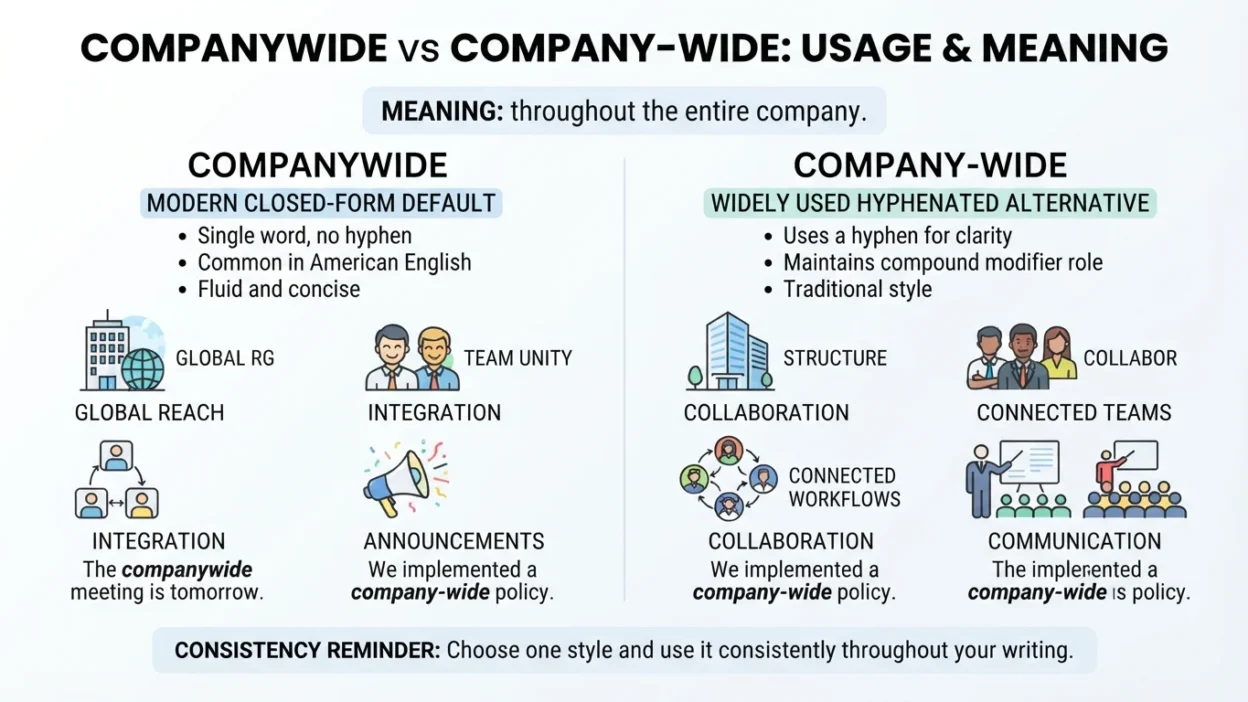
In modern English, companywide is generally the preferred closed compound when the word functions as an adjective or adverb meaning “throughout the entire company.” However, company-wide is also widely used, particularly in professional writing and styles that prefer a hyphen for clarity. The important point is to choose one form and use it consistently within the same document.
Quick Answer
Companywide and company-wide are both used and generally understood to mean “throughout the entire company.” The closed form companywide is increasingly common and is preferred by many modern style guides, while company-wide remains an accepted and widely used alternative. For most modern business writing, companywide is a strong default.
Why People Confuse It
The confusion comes from the suffix -wide.
English commonly uses -wide to mean “extending throughout or covering an entire area, group, or system.”
Examples include:
- nationwide
- worldwide
- citywide
- industrywide
- organizationwide
- companywide
Some writers use a hyphen because company-wide is immediately easy to read as company + wide. Others use the closed form companywide, following the tendency for familiar compounds to become one word over time.
As a result, you may encounter both spellings in professional communication.
Companywide
Companywide is an adjective or adverb meaning throughout the entire company or involving the whole company.
Examples
- The company introduced a companywide training program.
- We are implementing a companywide policy.
- The announcement was shared companywide.
- A companywide meeting will be held next Monday.
- The new system will be adopted companywide.
Simple Meaning
Think:
Companywide = throughout the whole company
For example:
The new policy applies companywide.
This means:
The new policy applies throughout the entire company.
Company-Wide
Company-wide has the same basic meaning: throughout the entire company.
Examples
- The company launched a company-wide training program.
- We need a company-wide approach to the problem.
- The announcement was distributed company-wide.
- A company-wide meeting is scheduled for Friday.
- The organization introduced a company-wide policy.
The hyphen makes the compound structure visually explicit.
Although company-wide remains common and understandable, many modern writing styles increasingly favor the closed form companywide.
Comparison Table
| Form | Meaning | Usage | Recommendation |
|---|---|---|---|
| Companywide | Throughout the entire company | Modern business and general writing | ✅ Strong default |
| Company-wide | Throughout the entire company | Common professional usage | ✅ Accepted alternative |
| Company wide | Throughout the entire company | Sometimes seen, but less standard as a compound modifier | ⚠️ Usually avoid |
| Company wide as separate words | Can be grammatical in certain constructions | Depends on sentence structure | Context-dependent |
When to Use Each
Use “Companywide” as Your Modern Default
If you are writing a general business document and do not have a specific house style, companywide is a practical choice.
Examples:
The change will be implemented companywide.
We are conducting a companywide survey.
The policy applies companywide.
This closed spelling is concise and increasingly familiar to readers.
Use “Company-Wide” When Your Style Guide Requires or Prefers Hyphens
Some organizations, publishers, and style systems retain the hyphenated form.
For example:
The company launched a company-wide initiative.
There is nothing inherently unclear about this spelling.
If your workplace or publication consistently uses company-wide, maintaining that style is more important than switching forms from document to document.
Avoid Unnecessary Inconsistency
Do not write:
The company launched a companywide program and later announced a company-wide initiative.
Unless there is a specific reason, choose one style and maintain it throughout the document.
Consistency improves professional readability.
Examples of Companywide
Here are more examples to help you understand the word:
- The new policy will be implemented companywide.
- Management announced a companywide restructuring.
- Employees must complete the companywide training course.
- The survey was distributed companywide.
- The software update will be available companywide next month.
- The organization introduced a companywide communication strategy.
- A companywide meeting was held to discuss the changes.
- The new safety standards apply companywide.
- The campaign was promoted companywide.
- The company adopted a companywide customer-service policy.
Examples of Company-Wide
The hyphenated form works in the same contexts:
- The company launched a company-wide training program.
- We need a company-wide solution.
- The company-wide policy will take effect next month.
- Management announced a company-wide initiative.
- The survey was conducted company-wide.
- Employees received a company-wide announcement.
- The organization introduced company-wide standards.
- The new procedure will be applied company-wide.
- A company-wide meeting is scheduled for Friday.
- The changes will affect employees company-wide.
Common Mistakes
Mistake 1: Assuming Only One Form Exists
It is not accurate to assume that one spelling is always the only possible form.
Both companywide and company-wide are established in real-world English usage.
Mistake 2: Writing “Company Wide” Automatically
When the expression functions as a compound adjective, the closed or hyphenated form is generally clearer.
Prefer:
The companywide policy was announced yesterday.
or:
The company-wide policy was announced yesterday.
Rather than:
The company wide policy was announced yesterday.
Mistake 3: Switching Between Forms
Consistency matters.
If you choose companywide, use it throughout your document.
If your organization’s style uses company-wide, maintain that form.
Mistake 4: Confusing “Companywide” With “Company-Wide” in Meaning
There is no meaningful difference in meaning between these two forms.
Both communicate the idea of something extending across the entire company.
Memory Trick
Remember:
COMPANY + WIDE = THE WHOLE COMPANY
If something affects the entire company, you can describe it as:
companywide
For example:
A companywide policy
means:
A policy affecting the whole company.
You can also remember the pattern:
nationwide → companywide → organizationwide → industrywide
These compounds often appear as one word in modern English.
American vs British English
There is no major difference in meaning between American and British English here.
Both American English and British English use companywide and company-wide.
However, spelling preferences can vary between dictionaries, publishers, organizations, and individual style guides. Modern usage increasingly supports the closed form companywide, while the hyphenated company-wide remains common.
If you are writing for a particular publication, employer, university, or website, follow its preferred style.
Similar Words
The -wide suffix is used with many words to describe something covering an entire group, place, or system.
Nationwide
Throughout an entire nation.
The program was launched nationwide.
Worldwide
Throughout the world.
The product is available worldwide.
Citywide
Throughout an entire city.
The city introduced a citywide recycling program.
Organizationwide
Throughout an entire organization.
The organization implemented an organizationwide policy.
Industrywide
Throughout an entire industry.
The change could have industrywide effects.
Department-wide
Throughout an entire department.
The manager announced a department-wide training session.
Notice that not every -wide compound has exactly the same spelling preference. Some are traditionally closed, while others may commonly retain a hyphen.
Is Companywide One Word?
Yes. Companywide is an established closed compound and is commonly used to mean throughout the entire company.
Example:
The new rules apply companywide.
It is especially useful in modern business writing because it is concise and easy to recognize.
Is Company-Wide Wrong?
No. Company-wide is also widely used and is generally understood as correct.
For example:
The company introduced a company-wide policy.
The hyphenated form can be appropriate depending on the style guide or editorial preference.
Should I Write “Companywide” or “Company-Wide” on a Resume?
Either can work, but companywide is a clean modern choice.
For example:
Led a companywide employee engagement initiative.
or:
Developed a companywide training program.
The most important consideration is consistency with the rest of your resume and the terminology used by the organization.
Final Verdict
Companywide and company-wide have the same basic meaning: throughout the entire company.
For modern general and business writing, companywide is a strong default because the closed compound is widely established and increasingly preferred. However, company-wide remains a legitimate and widely used alternative, especially where a style guide favors hyphenation.
If you are unsure, choose companywide, unless your employer, publisher, or style guide specifically prefers company-wide.
Frequently Asked Questions
Is “companywide” one word?
Yes. Companywide is a standard closed compound meaning throughout the entire company.
Is “company-wide” correct?
Yes. Company-wide is a widely used hyphenated form with the same meaning as companywide.
Which is more correct: companywide or company-wide?
Both are used, but companywide is generally a strong modern default. The preferred form can depend on the relevant style guide.
Should I use a hyphen in companywide?
Not necessarily. The closed form companywide is widely accepted. Use company-wide if your style guide or organization prefers the hyphenated form.
Is “company wide” two words correct?
When used as a compound modifier meaning “throughout the company,” companywide or company-wide is generally clearer. The two-word form may be appropriate only when company and wide function independently in a particular sentence.
What does companywide mean?
Companywide means affecting, involving, or extending throughout the entire company.
Is companywide formal?
Yes. Companywide is suitable for professional, business, academic, and formal writing.
Conclusion
The choice between companywide and company-wide is mostly a matter of spelling convention and style rather than meaning. Both forms communicate the same basic idea: something that affects, involves, or extends throughout an entire company. The closed form companywide is increasingly common and makes a strong default for modern business writing.
If your company, publication, or style guide prefers company-wide, there is no need to change it simply because another source uses the closed form. The most important rule is to remain consistent. For a clean modern default, use companywide; when following a style that favors hyphens, use company-wide.
Remember This
Companywide = throughout the entire company
✅ companywide — modern closed form
✅ company-wide — widely used hyphenated form
⚠️ company wide — generally avoid when it is intended as a compound modifier
Best default: companywide

A passionate linguist who specializes in word relationships and vocabulary building.
He has spent years studying synonyms and semantic patterns across languages.
Arman writes to make language learning simple, precise, and engaging.