If you have ever used a website, app, form, spreadsheet, or computer program, you may have seen instructions telling you to “unselect” or “deselect” an item. Both words are understandable, but you may wonder whether one is more correct or more natural in standard English.
The good news is that both “unselect” and “deselect” are used in English, especially in technology and user-interface contexts. However, deselect is generally the more established and widely preferred term when you mean removing a selection that has already been made. Unselect is also used, particularly in software interfaces and everyday technical instructions, but it can sound less formal or less conventional depending on the context.
Quick Answer
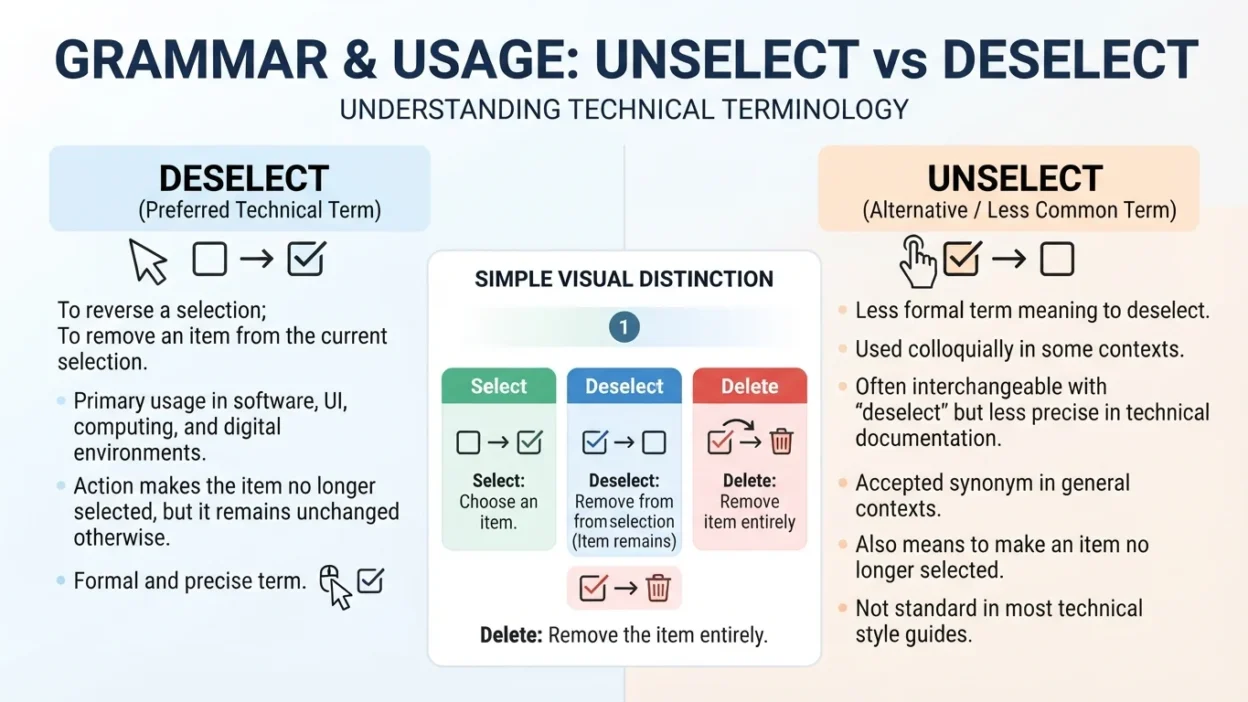
Deselect is generally the preferred word when you mean remove an existing selection. Unselect is also used, especially in software and interface instructions, and is understandable in most contexts. For formal technical writing, deselect is usually the safer choice. Example: “Click the item again to deselect it.”
Why People Confuse It
The confusion comes from the prefixes un- and de-.
Both prefixes can communicate the idea of reversing an action.
For example:
- lock → unlock
- wrap → unwrap
- activate → deactivate
- select → deselect
Because un- commonly creates the opposite of a verb, it is natural for people to form unselect from select.
However, English does not always form reversals with un-. In technical language, de- is frequently used to describe removing or reversing a previous action.
That is why deselect is especially common in computing and user-interface terminology.
Deselect
Deselect means to remove a selection from something that was previously selected.
It is particularly common in:
- computer software
- websites
- mobile applications
- menus
- checkboxes
- forms
- graphic-design programs
- spreadsheets
- file managers
Examples
- Click the checkbox again to deselect the option.
- You can deselect any files you don’t want to upload.
- Press Escape to deselect the object.
- The user accidentally deselected the wrong item.
- Select all the files, then deselect the ones you don’t need.
Simple Meaning
Think:
Deselect = remove a selection
If you selected something and then change your mind, you deselect it.
Unselect
Unselect also means to remove a selection.
It is used in software documentation, technical instructions, and general conversation, although deselect is often more conventional.
Examples
- Unselect the items you don’t want.
- Click the box to unselect the option.
- You can unselect a file by clicking it again.
- Unselect all unnecessary options before continuing.
- The program lets users unselect previously chosen items.
The word is easy to understand because un- often means to reverse an action.
However, when writing formal technical documentation, deselect is usually the more established choice.
Comparison Table
| Word | Meaning | Common Context | Formal/Technical Preference |
|---|---|---|---|
| Deselect | Remove an existing selection | Software, apps, websites, forms | ✅ Generally preferred |
| Unselect | Remove an existing selection | Software and everyday technical use | ✅ Used, but less conventional |
| Select | Choose an item | General and technical contexts | ✅ Standard |
| Clear | Remove information or a selection, depending on context | Forms, fields, interfaces | ✅ Context-dependent |
When to Use Each
Use “Deselect” for Formal or Technical Writing
If you are writing:
- software documentation
- user guides
- help articles
- technical instructions
- product documentation
- UX/UI content
deselect is generally the better choice.
Example:
To remove an item from your selection, deselect the checkbox.
This sounds natural and professional.
Use “Unselect” in Informal or Interface Contexts
Unselect can be used when the context is casual or when a particular application or interface uses that terminology.
Example:
Just unselect the options you don’t need.
The meaning is clear, and many readers will understand it immediately.
Follow the Interface’s Own Terminology
If you are writing instructions for a specific application, consistency matters.
If the application’s buttons, menus, or documentation consistently use unselect, following that terminology can make your instructions easier for users to understand.
Deselect vs Unselect: Examples
Here are practical examples showing how both words work.
Examples With Deselect
- Deselect the checkbox if you do not want email notifications.
- Click the selected item again to deselect it.
- You can deselect multiple files before uploading them.
- Press Escape to deselect the object.
- Deselect any options that do not apply to you.
- The user accidentally deselected the file.
Examples With Unselect
- Unselect the options you don’t need.
- Click the button again to unselect the item.
- You can unselect a previously chosen answer.
- Unselect all unnecessary files before submitting the form.
- The user unselected the wrong option.
- Click the checkbox to unselect it.
These sentences are understandable, but in polished technical writing, deselect will usually sound more conventional.
Common Mistakes
Mistake 1: Thinking “Unselect” Is Always Wrong
❌ Unselect is never a word.
This is too strong. Unselect is used in English, particularly in computing and interface-related contexts.
However, deselect is generally the more established choice for formal technical usage.
Mistake 2: Using “Deselect” When You Mean Delete
Deselect does not mean delete.
Compare:
Deselect the file.
This means the file is no longer selected.
Delete the file.
This means the file is removed or erased.
Deselecting something does not normally remove it.
Mistake 3: Confusing Deselect With Uninstall
These words describe completely different actions.
- deselect = remove a selection
- uninstall = remove software from a device
Example:
Deselect the application before continuing.
This does not mean uninstall the application.
Mistake 4: Using “Uncheck” in Every Situation
Uncheck is appropriate for a checkbox, but deselect has a broader meaning.
For example:
Uncheck the box.
But:
Deselect the image.
You can select and deselect many kinds of interface objects, not just checkboxes.
Memory Trick
Use this easy rule:
SELECT → DESELECT
Think of the pair as opposites:
select → deselect
You select something when you choose it.
You deselect something when you remove it from the current selection.
For example:
Select the file → Deselect the file.
You can also remember:
DESELECT = DELETE THE SELECTION, NOT THE ITEM
Deselecting does not usually delete the object. It simply removes its selected status.
American vs British English
There is no major American-versus-British distinction between deselect and unselect.
Both varieties of English can use these terms, especially in computing and technology.
However, deselect is generally the more established technical term and is widely understood in international software contexts.
The same applies to related forms:
- deselect
- deselected
- deselecting
Examples:
The option was deselected.
Click the item before deselecting it.
Similar Words
Several words are related to deselect, but they do not always mean exactly the same thing.
Select
To choose something.
Select the file you want to upload.
Deselect
To remove something from a current selection.
Deselect the files you don’t need.
Uncheck
To remove the checkmark from a checkbox.
Uncheck the notification box.
Clear
To remove information, entries, or selections depending on the interface.
Click Clear to remove the entered text.
Remove
To take something out of a list, group, or collection.
Remove the item from your cart.
Delete
To erase or permanently remove something.
Delete the file.
Remember that these words are related but not interchangeable in every situation.
Deselect vs Unselect in User Interface Writing
If you are creating instructions for an app or website, deselect is often the clearest professional choice.
For example:
Select the photos you want to upload.
Then:
Deselect any photos you don’t want to include.
This creates a clear pair:
Select → Deselect
Another example:
Select the checkbox to enable notifications.
Deselect the checkbox to disable notifications.
For user-interface documentation, consistency and clarity are more important than forcing a particular word in every situation.
Is “Unselect” Grammatically Correct?
Yes, unselect can function as a verb meaning to remove a selection.
However, its frequency and acceptability can vary by context and style. In modern technology-related English, it is understandable and used, but deselect is generally more conventional.
So if you are asking:
Which should I use in formal technical writing?
Choose:
✅ Deselect
If you are asking:
Is “unselect” understandable and used?
Yes.
Final Verdict
Both “deselect” and “unselect” can be used to mean removing a selection, but “deselect” is generally the preferred and more established choice, especially in formal technical and user-interface writing.
Use deselect when you want the most conventional professional wording:
Deselect the option.
Unselect is also understandable and appears in software and informal technical contexts:
Unselect the option.
The key distinction is that neither word normally means delete. To deselect something is simply to remove its selected status.
Frequently Asked Questions
Is “unselect” a correct word?
Yes. Unselect is used as a verb meaning to remove a selection, particularly in computing and interface contexts. However, deselect is generally more conventional.
Is “deselect” better than “unselect”?
For formal technical writing and software documentation, deselect is generally the safer and more established choice. The choice can also depend on the terminology used by a particular software product.
What does deselect mean?
Deselect means to remove an item from a group of selected items or to remove its selected status.
Does deselect mean delete?
No. Deselect means to stop selecting something. Delete means to remove or erase something.
Can I say “unselect this option”?
Yes. Unselect this option is understandable and used in technical contexts. Deselect this option is generally the more conventional alternative.
What is the opposite of select?
The most common technical opposite of select is deselect.
Example:
Select the file.
Deselect the file.
Should I use “unselect” or “deselect” in academic writing?
If you are discussing software or user interfaces, deselect is generally the better choice because it is more established in formal technical terminology.
Conclusion
The choice between unselect and deselect is mainly about usage and context rather than a simple right-versus-wrong spelling rule. Both words can communicate the idea of removing an existing selection, but deselect is the more conventional choice in formal technical writing, software documentation, and user-interface instructions.
When you want a polished and professional expression, use select → deselect as your standard pair. Use unselect when it matches the terminology of a particular interface or when the context is informal. And remember that deselecting is not deleting: it simply means that the item is no longer selected.
Remember This
SELECT = choose something
DESELECT = remove it from the selection
UNSELECT = understandable alternative, but less conventional
DELETE = remove/erase the item
Best Choice for Formal Writing
✅ Please deselect the option.
Also Used
✅ Please unselect the option.
Avoid Confusing It With
❌ Deselect = delete
They are different actions.

A passionate linguist who specializes in word relationships and vocabulary building.
He has spent years studying synonyms and semantic patterns across languages.
Arman writes to make language learning simple, precise, and engaging.