Have you ever typed “imput” instead of “input” and wondered whether both spellings are correct? You are not alone. Because the word is often pronounced quickly in everyday speech, many people accidentally add an m and write imput. This mistake is especially common when typing emails, assignments, reports, or technical content.
The correct spelling in standard English is input. The spelling imput is generally considered incorrect. Input can work as both a noun and a verb, and it is widely used when talking about information, data, opinions, or something entered into a system. In this guide, we will explain the difference between input and imput, show you practical examples, discuss common mistakes, and give you an easy memory trick so you never confuse them again.
Quick Answer
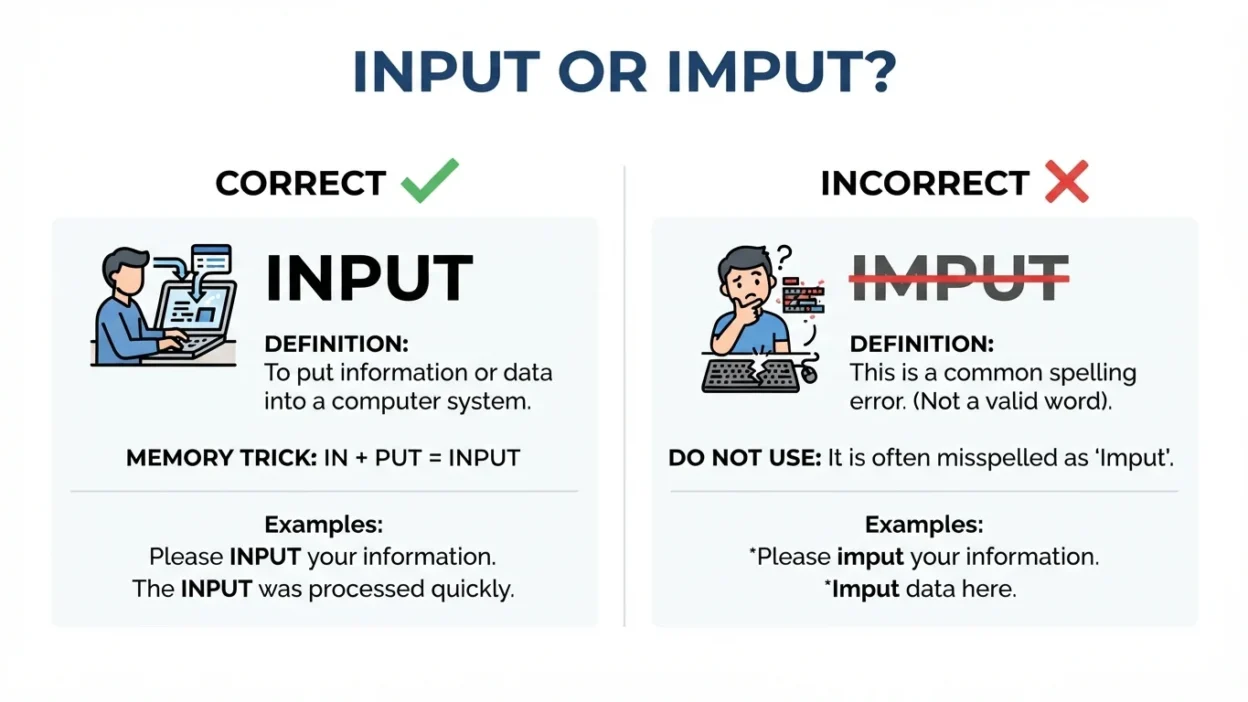
Input is the correct spelling. ✅ Imput is a common misspelling. ❌
Input can mean information or data provided to a person, system, or process, or the act of entering that information. For example: “Please input your password.” Remember: IN + PUT = INPUT.
Why People Confuse Input and Imput
The main reason people confuse these words is pronunciation.
When people say input quickly, the final sound of n can blend with the following p sound. This can make the word sound somewhat like imput, leading people to spell it that way.
Another reason is that English contains many words beginning with im-, such as:
- important
- impossible
- improve
- impact
- impress
Because imput may look familiar, some writers assume it is a legitimate spelling.
However, the standard English spelling is always input.
Input: Meaning and Usage
Input is a standard English word that can be used as both a noun and a verb.
Input as a Noun
As a noun, input can mean information, ideas, opinions, or data that someone provides.
Examples:
- We appreciate your input on this project.
- The manager asked for input from the employees.
- Your input helped us make the final decision.
- The computer processes the input from the user.
In these examples, input refers to something provided to a person, group, machine, or system.
Input as a Verb
As a verb, input means to enter information into a computer, system, form, or other process.
Examples:
- Please input your username.
- She input the data into the database.
- The technician input the information manually.
In modern everyday English, enter is also frequently used instead of input, especially when referring to typing information into a computer.
Imput: Is It a Word?
In standard modern English, imput is generally treated as an incorrect spelling of input.
If you are writing:
- an essay
- an email
- a school assignment
- a business report
- a website
- a technical document
- an application
- a professional message
use input, not imput.
Incorrect
❌ Please imput your information.
Correct
✅ Please input your information.
Input or Imput: Comparison Table
| Word | Correct? | Meaning | Example |
|---|---|---|---|
| Input | ✅ Yes | Information provided or entered | Please input your details. |
| Imput | ❌ No | Common misspelling of input | Please imput your details. |
The simplest rule is:
Input = correct
Imput = incorrect
When to Use Input
Use input when you are talking about information, data, opinions, or something entered into a system.
1. Information or Opinion
- I would appreciate your input.
- We need everyone’s input before making a decision.
Here, input means an opinion, suggestion, or contribution.
2. Computer Data
- The system requires user input.
- Enter your input into the designated field.
Here, input refers to information entered into a computer or system.
3. A Contribution to a Process
- Her input was valuable during the discussion.
- The team provided input on the new strategy.
Here, input means a contribution, idea, or perspective.
4. Entering Information
- Input the code into the application.
- The employee input the customer’s information.
Here, input is functioning as a verb.
Input or Imput: Examples
Here are more examples to help you understand the correct usage.
- ✅ Please input your email address.
- ❌ Please imput your email address.
- ✅ We need your input before we finalize the plan.
- ❌ We need your imput before we finalize the plan.
- ✅ The software collects input from users.
- ❌ The software collects imput from users.
- ✅ Her input improved the project.
- ❌ Her imput improved the project.
- ✅ You must input the correct password.
- ❌ You must imput the correct password.
- ✅ The manager requested input from the staff.
- ❌ The manager requested imput from the staff.
Notice that the correct spelling remains input whether the word is being used as a noun or a verb.
Common Mistakes with Input
Mistake 1: Writing “Imput”
❌ I need your imput.
✅ I need your input.
This is the most common spelling mistake.
Mistake 2: Confusing Input With Enter
The words can overlap in some contexts, but they are not always interchangeable.
For example:
- Input your information. ✅
- Enter your information. ✅
Both can work when referring to putting information into a system.
However, input can also mean an opinion or contribution:
- I appreciate your input.
You cannot naturally replace this with “I appreciate your enter.”
Mistake 3: Assuming the Pronunciation Determines the Spelling
English spelling does not always perfectly match pronunciation. Even if input sounds slightly different when spoken quickly, its spelling remains input.
Memory Trick: IN + PUT
The easiest way to remember the spelling is:
IN + PUT = INPUT
Think of it literally:
You PUT information IN.
So:
✅ IN + PUT → INPUT
Not:
❌ IM + PUT → IMPUT
Whenever you are unsure, remember that the word contains in at the beginning.
American vs. British English
There is no meaningful spelling difference between American and British English for this word.
Both varieties use:
Input ✅
The incorrect spelling imput should not be used in standard American or British English.
For example:
- American English: We need your input.
- British English: We need your input.
The spelling is the same.
Similar Words to Input
Depending on the context, several words can have a related meaning.
When “Input” Means an Opinion
You might use:
- feedback
- advice
- suggestion
- contribution
- opinion
- perspective
- comment
Example:
We need your input.
Possible alternatives:
We need your feedback.
We would appreciate your opinion.
When “Input” Means Entering Data
You might use:
- enter
- type
- provide
- submit
- upload
For example:
Input your information into the form.
You could also say:
Enter your information into the form.
Input as a Noun vs. Verb
Understanding its grammatical role can make the word even easier to use.
| Use | Meaning | Example |
|---|---|---|
| Noun | Information or contribution | Thanks for your input. |
| Noun | Data entered into a system | The system processes user input. |
| Verb | Enter information | Input the data carefully. |
So, input is versatile and can function in different grammatical roles.
Is “Inputted” Correct?
This is another interesting question.
The verb input has commonly been used with the past-tense and past-participle forms input and inputted.
For example:
- She input the data yesterday.
- She inputted the data yesterday.
Inputted is established usage, particularly in technical contexts. However, many writers prefer input as the past form because it is concise.
For formal writing, you can often avoid uncertainty by using entered:
She entered the data yesterday.
Final Verdict
If you are choosing between input and imput, use input.
Input is the standard spelling and can be used as both a noun and a verb. It can refer to information, opinions, contributions, or data entered into a system.
Imput is generally a spelling error and should be avoided in standard English.
The easiest way to remember the difference is IN + PUT = INPUT. If you mean information that is provided or something that is entered into a system, input is the spelling you need.
FAQs About Input or Imput
1. Is “input” or “imput” correct?
Input is correct. Imput is a common misspelling and should not be used in standard English.
2. What does input mean?
Input can mean information, data, an opinion, or a contribution provided to a person, system, or process. It can also mean entering information into a system.
3. Is “imput” a real English word?
In ordinary modern English, imput is generally considered an incorrect spelling of input.
4. Is input a noun or a verb?
Input can be both a noun and a verb.
As a noun: Your input was helpful.
As a verb: Please input the information.
5. How do you remember the spelling of input?
Remember IN + PUT = INPUT. Think of putting information in.
6. Is “inputted” grammatically correct?
Yes. Inputted is an established past-tense and past-participle form of the verb input. Input is also used as a past form, particularly in technical contexts.
7. Is input spelled differently in British English?
No. Input is spelled the same in both American and British English.
8. Can input mean feedback?
Yes. When someone asks for your input, they may be asking for your opinion, feedback, ideas, or contribution.
Conclusion
The difference between input and imput is simple: input is the correct spelling, while imput is generally a misspelling. The word input is widely used in everyday, academic, professional, business, and technical English. It can describe information or opinions provided by someone, as well as data entered into a system.
Whenever you find yourself unsure, use the simple memory trick IN + PUT = INPUT. Whether you are talking about computer data, someone’s opinion, or entering information into a form, input is the spelling to choose.
Remember This
Input ✅ = Correct spelling
Imput ❌ = Incorrect spelling
Easy trick: IN + PUT = INPUT

A creative writer with a deep interest in word usage and meaning.
He explores synonyms to enhance both academic and creative expression.
Zayn’s work aims to make language richer and more accessible for everyone.