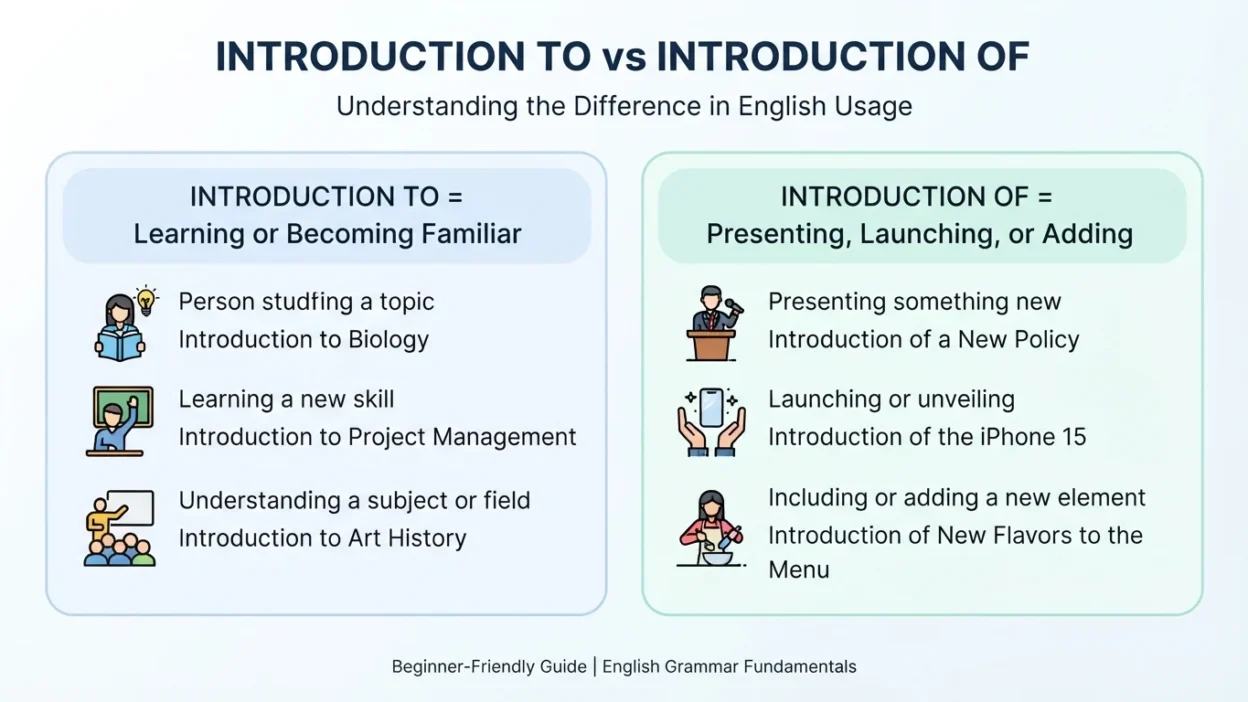
Choosing between “introduction to” and “introduction of” can be confusing because both expressions are grammatically correct. The difference depends on what you are introducing and what role the phrase plays in the sentence. Knowing this distinction can make your English sound more natural and precise.
In general, “introduction to” is used when someone is being introduced to a subject, topic, skill, place, or experience. “Introduction of” is usually used when a person, product, idea, system, or concept is formally presented or brought into use. Understanding this simple difference will help you choose the right expression in academic, professional, and everyday English.
Quick Answer
Use “introduction to” when talking about becoming familiar with something.
- An introduction to English grammar
- An introduction to photography
- An introduction to the topic
Use “introduction of” when something or someone is formally presented, launched, or brought into a situation.
- The introduction of a new policy
- The introduction of a new product
- The introduction of the speaker
Easy rule:
Introduction to = becoming familiar with something
Introduction of = presenting or bringing something in
Why Do People Confuse “Introduction To” and “Introduction Of”?
The confusion happens because both phrases contain the noun introduction, and both can refer to presenting something.
However, the preposition changes the relationship between the words.
Consider these examples:
This course provides an introduction to biology.
Here, biology is the subject that learners are becoming familiar with.
Now compare:
The introduction of a new biology course was announced yesterday.
Here, the course itself is something that has been newly introduced or launched.
The key question is:
Are you becoming familiar with something, or is something being presented or introduced?
What Does “Introduction To” Mean?
“Introduction to” means an initial explanation, experience, or exposure to a particular subject or area.
It is especially common when talking about learning.
Examples
- This book is an introduction to psychology.
- She took an introduction to Spanish course.
- The workshop provides an introduction to digital marketing.
- This article offers an introduction to SEO.
- He gave me an introduction to the basics of photography.
In these examples, the person is becoming familiar with a topic or skill.
Common Patterns
You will often see:
- introduction to English
- introduction to science
- introduction to programming
- introduction to philosophy
- introduction to business
- introduction to mathematics
- introduction to a subject
- introduction to a new skill
- introduction to a concept
What Does “Introduction Of” Mean?
“Introduction of” is generally used when something is formally presented, launched, added, or brought into use.
It often appears in formal, academic, business, government, and news writing.
Examples
- The introduction of a new policy caused debate.
- The company announced the introduction of a new product.
- The introduction of technology changed the workplace.
- The introduction of online classes made education more accessible.
- The government supported the introduction of new regulations.
In each example, something is being introduced into a situation or system.
Comparison Table
| Phrase | Main Meaning | Common Use | Example |
|---|---|---|---|
| Introduction to | Becoming familiar with something | Education and learning | An introduction to biology |
| Introduction of | Presenting, launching, or adding something | Formal announcements and changes | The introduction of a new law |
The simplest distinction
Introduction to → the subject you are learning about
Introduction of → the thing being introduced
When to Use “Introduction To”
Use “introduction to” when you are talking about:
1. A Subject
This is an introduction to economics.
2. A Skill
The class provides an introduction to creative writing.
3. A Field of Study
The textbook is an introduction to computer science.
4. A Concept
The article gives readers an introduction to artificial intelligence.
5. An Experience
The internship was my introduction to professional journalism.
That last example is especially useful because “introduction to” can describe someone’s first experience with something.
When to Use “Introduction Of”
Use “introduction of” when something is being newly presented, launched, implemented, or added.
1. New Products
The introduction of the new smartphone attracted attention.
2. New Rules
The introduction of stricter rules changed the process.
3. New Policies
The introduction of the policy created several challenges.
4. New Technology
The introduction of automation improved productivity.
5. New Ideas
The introduction of the new theory changed the discussion.
Introduction To vs Introduction Of: Examples
Here are more examples to make the difference clear:
- The course is an introduction to computer programming.
→ The course teaches the basics of programming. - The introduction of computer programming into the curriculum was widely welcomed.
→ Programming was newly added to the curriculum. - She wrote an introduction to modern literature.
→ Her writing explains the basics of modern literature. - The introduction of modern literature into the curriculum expanded the program.
→ Modern literature was newly added. - This guide provides an introduction to financial planning.
- The introduction of new financial regulations affected businesses.
- His first job was his introduction to the corporate world.
- The introduction of remote work changed the company culture.
- The book offers an introduction to philosophy.
- The introduction of a new philosophy course attracted many students.
- The lecture serves as an introduction to the subject.
- The introduction of the new system improved efficiency.
Common Mistakes
Mistake 1: Using “of” for a learning topic
❌ An introduction of biology
✅ An introduction to biology
When you mean a basic explanation of a subject, use to.
Mistake 2: Using “to” for a newly implemented system
❌ The introduction to a new policy caused confusion.
If you mean the policy was newly implemented, say:
✅ The introduction of a new policy caused confusion.
Mistake 3: Confusing “introduction” with “introduce”
Remember that introduction is a noun, while introduce is a verb.
- The teacher introduced the topic.
- The lesson was an introduction to the topic.
- The company announced the introduction of a new product.
Memory Trick
Use this simple trick:
TO = Toward Learning
Think:
Introduction TO = moving toward understanding something.
Introduction to mathematics
Introduction to English
Introduction to photography
OF = Something Being Offered
Think:
Introduction OF = something is being presented, added, or launched.
Introduction of a new product
Introduction of a new policy
Introduction of a new system
So remember:
TO → topic you become familiar with
OF → thing being introduced
American vs British English
There is no major American vs. British English difference in the basic use of these expressions.
Both American and British English commonly use:
- an introduction to English
- an introduction to science
- the introduction of a new law
- the introduction of a new product
The distinction is based mainly on meaning and context, not regional spelling or grammar.
Similar Expressions
Several related expressions can also help you understand the difference.
Introduction to
Similar expressions include:
- basic overview of
- beginner’s guide to
- basic explanation of
- first look at
- orientation to
- overview of
Example:
This is an introduction to photography.
You could also say:
This is a beginner’s guide to photography.
Introduction of
Similar expressions include:
- launch of
- presentation of
- implementation of
- arrival of
- adoption of
- addition of
Example:
The introduction of the new system improved efficiency.
Depending on the context, you could say:
The implementation of the new system improved efficiency.
How to Choose the Right Phrase
Ask yourself one question:
What comes after “introduction”?
If it is the subject, field, skill, or experience someone is learning about, use to.
an introduction to chemistry
an introduction to marketing
an introduction to public speaking
If it is the thing being newly presented, launched, added, or implemented, use of.
the introduction of a new product
the introduction of a new law
the introduction of a new system
This rule works in most everyday and formal situations.
FAQs
Is “introduction to” correct?
Yes. “Introduction to” is correct when referring to a subject, skill, concept, field, or experience that someone is becoming familiar with.
Is “introduction of” correct?
Yes. “Introduction of” is correct when something is being formally presented, launched, added, or implemented.
Should I say “introduction to English” or “introduction of English”?
Usually, say “introduction to English” when referring to learning or becoming familiar with the English language.
This course is an introduction to English.
Should I say “introduction to a new policy” or “introduction of a new policy”?
If the policy itself is being newly implemented, use “introduction of a new policy.”
The introduction of a new policy changed the procedure.
Is “an introduction of” grammatically correct?
Yes, but it is less common in some contexts. It is appropriate when referring to the act of presenting or bringing something into use.
Is “introduction to” more common than “introduction of”?
It depends on the context. “Introduction to” is extremely common in educational contexts, while “introduction of” is common when discussing new products, policies, systems, technologies, or changes.
Can both phrases appear in one sentence?
Yes.
The introduction of the new course included an introduction to basic programming.
The first phrase refers to launching the course, while the second refers to learning programming.
Final Verdict
Both “introduction to” and “introduction of” are grammatically correct, but they communicate different ideas. Use “introduction to” when someone is being given basic knowledge or first experience of a subject, skill, concept, or field. Use “introduction of” when something is being presented, launched, added, or implemented.
The easiest way to remember the difference is “to” = learning about something and “of” = something being introduced. Once you focus on this relationship, choosing between the two becomes much easier in academic, professional, and everyday writing.
Remember This
Introduction to = becoming familiar with something
An introduction to grammar.
Introduction of = presenting or bringing something new
The introduction of a new grammar course.
When in doubt, ask: “Am I learning about it, or is it being introduced?”
If you are learning about it, choose to. If it is being presented or added, choose of.

A passionate linguist who specializes in word relationships and vocabulary building.
He has spent years studying synonyms and semantic patterns across languages.
Arman writes to make language learning simple, precise, and engaging.