Have you ever wondered whether you should write “to fast” or “too fast”? These two phrases sound almost identical when spoken, which makes them easy to confuse. However, they have different meanings and grammatical functions. Knowing the difference can help you avoid a common English mistake in texts, emails, assignments, and professional writing.
The correct phrase depends on what you want to say. In most sentences where you mean “faster than is appropriate” or “at an excessive speed,” the correct phrase is too fast. The word too means “more than necessary” or “excessively.” On the other hand, to is normally used as a preposition or infinitive marker, so to fast can be correct when fast is being used as a verb, meaning “to avoid food for a period of time.”
Quick Answer
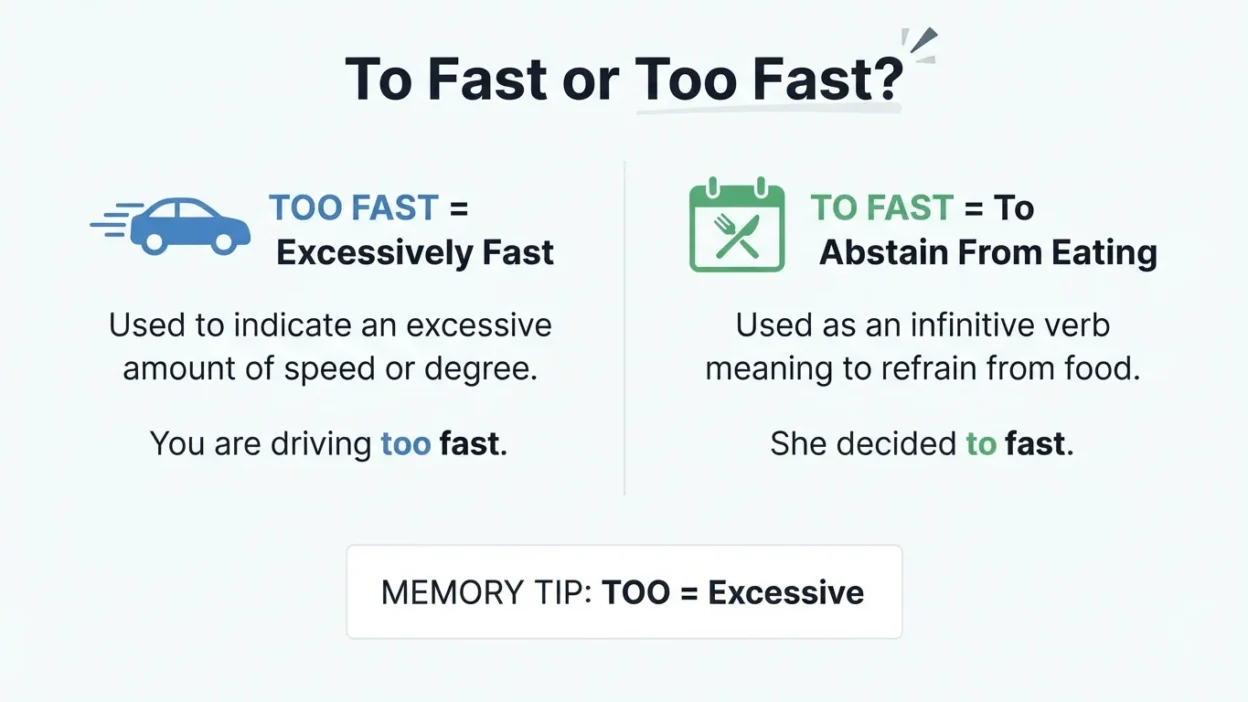
Too fast is correct when you mean “at an excessive speed” or “faster than appropriate.”
Example: You are driving too fast.
To fast can also be grammatically correct, but it has a completely different meaning. Here, fast is a verb meaning to abstain from eating. Example: They decided to fast for a day.
Why People Confuse “To Fast” and “Too Fast”
The main reason people confuse these phrases is pronunciation. To and too can sound the same in ordinary speech.
However, their meanings are different.
- To usually indicates direction, purpose, or an infinitive verb.
- Too usually means “also” or “excessively.”
Compare:
- You are driving too fast. → excessively fast
- They decided to fast. → decided to abstain from food
The spelling changes the meaning of the entire phrase.
What Does “Too Fast” Mean?
Too fast means faster than is suitable, safe, comfortable, or necessary.
Here, too is an adverb meaning “more than desired” or “excessively,” while fast describes speed.
Examples
- You are walking too fast.
- The car was going too fast.
- He speaks too fast for me to understand.
- The lesson is moving too fast.
In each sentence, too fast indicates that something is happening at an excessive speed.
“Too Fast” Can Describe More Than Physical Speed
The phrase does not always refer to driving or movement.
It can describe:
- speaking
- learning
- changing
- progressing
- developing
- moving
- happening
For example:
The relationship is moving too fast.
Here, too fast refers to the pace of the relationship rather than physical speed.
What Does “To Fast” Mean?
To fast is a grammatically correct phrase when fast is being used as a verb.
As a verb, fast means to deliberately avoid eating for a period of time.
For example:
- She decided to fast tomorrow.
- He plans to fast during the day.
- They agreed to fast for twenty-four hours.
In these sentences, to introduces the verb fast.
So, to fast does not mean “excessively fast.” It means to abstain from food.
To Fast vs. Too Fast: Comparison Table
| Phrase | Correct? | Meaning | Example |
|---|---|---|---|
| Too fast | ✅ | Excessively fast | You are driving too fast. |
| To fast | ✅ | To abstain from eating | She decided to fast. |
| To fast | ❌ for excessive speed | Not the correct phrase for this meaning | You are driving to fast. |
| Too fast | ❌ for fasting | Does not mean to abstain from food | I plan too fast tomorrow. |
The key point is that both “to fast” and “too fast” can be grammatically correct, but they express completely different ideas.
When to Use “Too Fast”
Use too fast when something happens at a speed or pace that is greater than appropriate.
Physical Movement
- The cyclist was going too fast.
- Don’t run too fast.
Speaking
- You speak too fast.
- The teacher explained the topic too fast.
Progress or Change
- Everything is happening too fast.
- Technology is changing too fast.
Emotional or Social Situations
- I think we’re moving too fast.
Here, the phrase refers to the pace of a situation.
When to Use “To Fast”
Use to fast when fast is a verb meaning to abstain from eating.
Examples:
- I want to fast tomorrow.
- She chose to fast before the event.
- They decided to fast for a specific period.
- He needs time to fast and reflect.
The structure is:
to + verb
Because fast can function as a verb, to fast is grammatically possible.
10+ Examples of “To Fast” and “Too Fast”
Examples with “Too Fast”
- You are driving too fast.
- She talks too fast.
- The children are growing too fast.
- He ran too fast and fell.
- The movie moved too fast for me.
- This computer processes the information too fast for the old software.
- The water is flowing too fast.
- Things are changing too fast.
- The teacher is speaking too fast.
- The car was traveling too fast.
Examples with “To Fast”
- She decided to fast for a day.
- He plans to fast tomorrow.
- They chose to fast together.
- I need to fast before the procedure.
The context makes the intended meaning clear.
Common Mistakes
Mistake 1: Using “To Fast” for Excessive Speed
❌ You are driving to fast.
✅ You are driving too fast.
If you mean excessively fast, always use too.
Mistake 2: Using “Too Fast” for Fasting
❌ I am planning too fast tomorrow.
✅ I am planning to fast tomorrow.
When fast means “not eat,” use to fast.
Mistake 3: Confusing “Too” With “To”
This is one of the most common homophone mistakes in English.
Remember:
to → direction, purpose, or infinitive
too → also or excessively
Examples:
- I want to learn.
- She went to school.
- You are walking too fast.
- I want one too.
Memory Trick
Use this simple trick:
TOO = MORE THAN ENOUGH
If you can replace too with excessively or more than necessary, use too.
- You are going too fast.
- You are going excessively fast.
If fast means not eating, use to fast.
- I plan to fast tomorrow.
Another useful reminder:
TOO = extra
The word too has an extra o because it can indicate something extra or excessive.
American vs. British English
There is no major spelling difference between American and British English for these phrases.
Both varieties use:
- too fast = excessively fast
- to fast = to abstain from eating
For example:
American English:
You’re driving too fast.
British English:
You’re driving too fast.
The distinction between to and too remains the same.
Similar Expressions
If you mean too fast, you can use several alternatives depending on the context:
- excessively fast
- very quickly
- at excessive speed
- too quickly
- faster than necessary
- faster than expected
- at a rapid pace
For example:
He is driving too fast.
Could become:
He is driving at an excessive speed.
For to fast, related expressions include:
- abstain from food
- go without food
- refrain from eating
- observe a fast
- undergo fasting
The best alternative depends on the context.
How to Remember the Difference
Ask yourself one simple question:
Do I mean “excessively fast” or “not eating”?
If you mean excessively fast:
✅ too fast
If you mean not eating:
✅ to fast
Quick Formula
Too fast = excessive speed or pace
To fast = to abstain from food
This distinction works in most everyday situations.
Final Verdict
Both to fast and too fast can be correct, but they are used for completely different meanings.
Use too fast when you mean that something is happening at an excessive speed or pace:
The car is going too fast.
Use to fast when fast is a verb meaning to abstain from eating:
She decided to fast.
So, if you’re trying to say someone is moving, speaking, driving, or progressing at an excessive speed, too fast is the correct choice.
FAQs About “To Fast or Too Fast”
1. Is it “to fast” or “too fast”?
Both can be correct, depending on the meaning. Too fast means excessively fast, while to fast means to abstain from eating.
2. Is “You are going to fast” correct?
If you mean someone is moving excessively quickly, no. Write:
You are going too fast.
However, “You are going to fast” could theoretically mean someone is going somewhere in order to fast, depending on the context.
3. Is “I want to fast” correct?
Yes. I want to fast means you want to abstain from eating.
4. Is “She talks too fast” correct?
Yes. She talks too fast means she speaks faster than is comfortable or easy to understand.
5. What is the difference between “to” and “too”?
To is commonly used for direction, purpose, or before a verb. Too can mean “also” or “excessively.”
Examples:
- I want to go to school.
- I want to learn.
- You are moving too fast.
- I want to come too.
6. Is “too fast” grammatically correct?
Yes. Too fast is grammatically correct when describing excessive speed or pace.
7. What does “to fast” mean?
To fast means to abstain from eating. It contains to, the infinitive marker, followed by the verb fast.
8. How can I remember “too fast”?
Think TOO = excessive. If something is faster than it should be, use too fast.
Conclusion
The choice between to fast and too fast depends entirely on meaning. Too fast describes excessive speed or pace, while to fast uses fast as a verb meaning to abstain from eating. Although the two phrases sound alike, their meanings and grammatical functions are different.
For everyday writing, remember the simple rule: if someone is driving, running, talking, moving, or progressing excessively quickly, write too fast. If someone intends not to eat for a period of time, write to fast. This small distinction can make your English clearer and more accurate.
Remember This
Too fast ✅ = excessively fast
To fast ✅ = to abstain from eating
Example:
You’re driving too fast.
Example:
She decided to fast.

An expert in English grammar and expressive writing techniques.
She focuses on helping readers expand their vocabulary with clarity.
Elina believes the right word can transform ordinary writing into powerful communication.