Have you ever typed “mine as well” or “mind as well” when you actually meant “might as well”? These phrases can be confusing because they sound similar in fast, casual speech. However, when you are trying to express the idea of “why not?”, only one of them is the standard expression: might as well.
The phrase might as well is extremely common in everyday English. We use it when an action seems reasonable because there is little reason not to do it, or because a particular situation makes the action convenient or sensible. Mine as well and mind as well are generally spelling mistakes when used with this meaning. In this guide, you’ll learn exactly when to use each phrase, see plenty of examples, understand the grammar behind might as well, and discover an easy memory trick.
Quick Answer
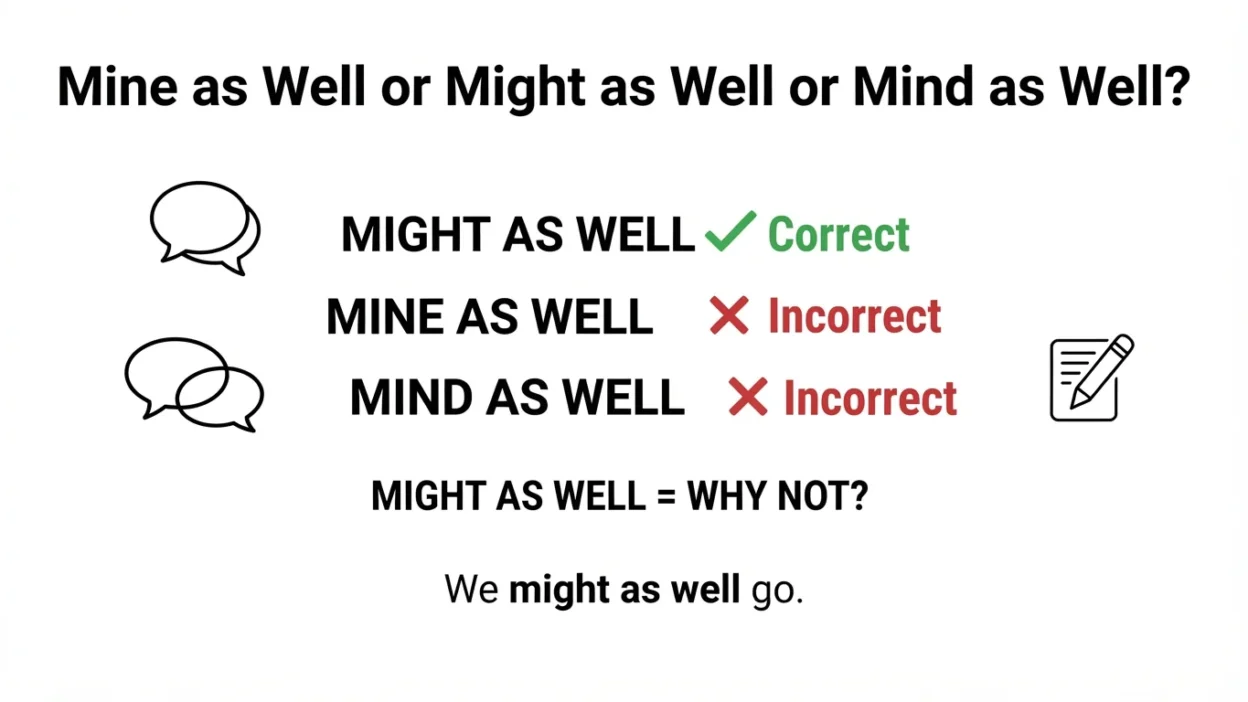
Might as well is the correct expression when you mean “why not?”, “it would be reasonable to”, or “there is no reason not to.”
- Might as well ✅ — correct
- Mine as well ❌ — incorrect when this expression is intended
- Mind as well ❌ — incorrect when this expression is intended
Example: We’re already here, so we might as well stay for dinner.
Why People Confuse “Mine,” “Might,” and “Mind”
The confusion usually comes from pronunciation.
In casual conversation, people may pronounce might as well quickly, causing the sounds to blend together. To a listener, the phrase can sometimes sound like “mind as well” or “mine as well.”
This is especially common when English is learned through conversation rather than through reading.
However, pronunciation should not determine the spelling. When you write the expression, the standard form is:
MIGHT AS WELL
The phrase has a fixed structure, so changing might to mine or mind changes the word and usually makes the expression incorrect.
Might as Well: Meaning and Usage
Might as well is a common English expression used to say that something is a reasonable choice under the circumstances.
It often carries the idea:
- Why not?
- There is no reason not to.
- It would be sensible.
- Since we’re already doing this, we can do that too.
- This is probably the best practical option.
Example
We’re already at the mall, so we might as well buy the groceries.
The speaker is saying that because they are already at the mall, buying groceries is a reasonable thing to do.
Another example:
It’s raining, so we might as well stay home.
The speaker sees staying home as a sensible option given the circumstances.
What Does “Might as Well” Mean?
The exact meaning depends on context, but it commonly expresses a practical or somewhat reluctant decision.
For example:
We’re going to be late anyway, so we might as well take a taxi.
The speaker has decided that taking a taxi makes sense because they are already running late.
It does not necessarily mean the speaker is excited about the action. Sometimes might as well suggests acceptance of a situation.
Compare:
Let’s go to the beach!
→ Enthusiastic suggestion.
It’s already sunny, so we might as well go to the beach.
→ Practical suggestion based on the situation.
Mine as Well: Is It Correct?
Mine as well is not the standard expression when you mean “why not?”
For example:
❌ We’re already here, so we mine as well stay.
The correct sentence is:
✅ We’re already here, so we might as well stay.
But Is “Mine” a Real Word?
Yes. Mine is a perfectly valid English word, but it has different meanings.
It can be a possessive pronoun:
That book is mine.
It can also refer to a place where minerals are extracted:
The workers entered the mine.
So mine itself is not incorrect. The problem is using it in the fixed expression “mine as well” when you actually mean “might as well.”
Mind as Well: Is It Correct?
Mind as well is also not the standard expression meaning “why not?”
For example:
❌ We might be late, so we mind as well leave now.
Correct:
✅ We might be late, so we might as well leave now.
Is “Mind” a Real Word?
Yes. Mind is a common English word and can function as both a noun and a verb.
For example:
- My mind is tired.
- Do you mind if I sit here?
- Please mind the step.
But mind as well is not the standard fixed phrase used to express a practical suggestion.
Mine as Well vs. Might as Well vs. Mind as Well
| Phrase | Correct for “why not?” | Meaning |
|---|---|---|
| Might as well | ✅ Yes | It would be reasonable to do something |
| Mine as well | ❌ No | Usually a misspelling of “might as well” |
| Mind as well | ❌ No | Usually a misspelling of “might as well” |
The answer is simple:
MIGHT AS WELL = correct expression
When to Use “Might as Well”
There are several common situations where might as well is useful.
1. When There Is No Reason Not to Do Something
We have plenty of time, so we might as well walk.
Walking seems reasonable because there is no urgent need to use another form of transportation.
2. When You Are Already Somewhere
We’re already downtown, so we might as well visit the museum.
The speaker is suggesting another activity because they are already in the area.
3. When a Situation Makes Something Practical
The weather is beautiful, so we might as well eat outside.
The good weather provides a practical reason for the suggestion.
4. When Accepting an Inevitable Situation
We’re going to have to wait anyway, so we might as well sit down.
The speaker accepts that waiting is unavoidable and suggests making the best of the situation.
5. When Making a Casual Suggestion
If you’re going to the store, you might as well get some milk.
This is a casual way of suggesting an additional action.
15 Examples of “Might as Well”
- We’re already here, so we might as well stay.
- It’s too late to go out, so we might as well watch a movie.
- You might as well take an umbrella.
- Since we’re waiting, we might as well have some coffee.
- The store is closing soon, so we might as well hurry.
- We’re already cooking, so we might as well make dessert.
- If you’re going upstairs, you might as well bring my bag.
- There’s no bus for an hour, so we might as well walk.
- Since you have the day off, you might as well relax.
- We’re already discussing the project, so we might as well finish it.
- It’s raining heavily, so we might as well stay inside.
- If we’re going to clean the kitchen, we might as well clean the dining room too.
- The movie has already started, so we might as well watch it.
- We have some extra time, so we might as well explore the city.
- You’re already awake, so you might as well have breakfast.
Common Mistakes
Mistake 1: Writing “Mine as Well”
❌ We might be late, so we mine as well leave.
✅ We might be late, so we might as well leave.
Mistake 2: Writing “Mind as Well”
❌ It’s raining, so we mind as well stay home.
✅ It’s raining, so we might as well stay home.
Mistake 3: Writing “Might Aswell”
❌ We might aswell go.
✅ We might as well go.
As well is normally written as two separate words.
Mistake 4: Thinking “Might” Means Uncertainty Only
Many learners know might as a modal verb expressing possibility:
It might rain tomorrow.
But might as well is a special expression. It commonly communicates a practical suggestion or decision.
It might rain, so we might as well take an umbrella.
The first might expresses possibility. The second appears in the fixed expression might as well.
Memory Trick
Here’s the easiest way to remember it:
“Might as well” = “Why not?”
Whenever you can replace the phrase with “why not?”, might as well is probably the expression you need.
Example:
We’re already here. Why not stay?
→ We’re already here. We might as well stay.
Another memory trick:
MIGHT = MAYBE A GOOD IDEA
Think:
“There is no reason not to, so I might as well do it.”
Might as Well vs. May as Well
You may sometimes hear may as well, but might as well is the much more common standard expression in modern everyday English.
For example:
- We might as well leave now.
- You might as well tell him the truth.
In some contexts, may as well can occur, but might as well is the safest and most natural choice for ordinary writing when expressing this idea.
Might as Well vs. Should
These expressions can sometimes be similar, but they are not identical.
Might as Well
Suggests that something is practical or reasonable given the situation.
We’re already here, so we might as well stay.
Should
Usually expresses advice, expectation, or what is considered appropriate.
You should stay because it’s safer.
Might as well often has a more casual, situational feeling.
American vs. British English
Might as well is standard in both American and British English.
Examples:
American English:
We might as well order pizza.
British English:
We might as well order pizza.
The expression does not change significantly between the two varieties.
Similar Expressions
Depending on context, might as well can sometimes be replaced with:
- why not
- may as well
- it’s worth doing
- there’s no reason not to
- we could
- let’s
- it makes sense to
- we may as well
For example:
We might as well start now.
Possible alternatives include:
Why not start now?
There’s no reason not to start now.
It makes sense to start now.
The best alternative depends on the tone and context.
Is “Might as Well” Formal or Informal?
Might as well is common in everyday English and is generally conversational or neutral.
It can appear in:
- conversations
- emails
- casual writing
- workplace communication
- stories
- articles
- dialogue
For highly formal writing, you may sometimes prefer a more direct expression such as:
- It would be practical to…
- There is no reason not to…
- It would be reasonable to…
However, might as well is not grammatically incorrect or inherently unprofessional.
Final Verdict
When you want to say “why not?”, “there is no reason not to,” or “this would be a reasonable choice,” the correct expression is might as well.
Mine as well and mind as well are generally incorrect when they are intended to express this meaning. Although mine and mind are real English words, neither belongs in this standard fixed expression.
Remember the simple rule:
MIGHT AS WELL = WHY NOT?
So write:
✅ We might as well go.
Not:
❌ We mine as well go.
And not:
❌ We mind as well go.
FAQs About Mine as Well, Might as Well, and Mind as Well
1. Is it “mine as well” or “might as well”?
Might as well is correct when you mean “why not?” or “there is no reason not to.”
2. Is “mind as well” correct?
Not when you mean the common expression “might as well.” In that context, mind as well is a mistake.
3. What does “might as well” mean?
Might as well means that something seems reasonable or practical because there is little reason not to do it.
4. What is an example of “might as well”?
We’re already at the restaurant, so we might as well have dinner here.
5. Is “might as well” formal English?
It is standard English and very common in conversational and neutral writing. In highly formal contexts, alternatives such as “it would be reasonable to” may be preferred.
6. Can I say “may as well”?
Yes. May as well is also used, although might as well is extremely common in everyday English.
7. Why does “might as well” sound like “mind as well”?
In rapid casual speech, sounds can blend together. This can make might as well difficult to distinguish by ear, especially for English learners.
8. What is an easy way to remember “might as well”?
Remember:
MIGHT AS WELL = WHY NOT?
If you’re making a practical suggestion and mean “why not,” might as well is usually the phrase you need.
Conclusion
The correct expression for the meaning “why not?” is might as well. It is used when an action seems practical, reasonable, or worth doing given the circumstances. For example, “We’re already here, so we might as well stay” means that staying makes sense because they are already there.
Although mine and mind are both real English words, mine as well and mind as well are not standard replacements for this expression. If you hear something that sounds like either of them in casual conversation, the speaker most likely means might as well.
Remember This
Might as well ✅ = why not / there is no reason not to
Mine as well ❌ = incorrect for this expression
Mind as well ❌ = incorrect for this expression
Memory trick:
👉 MIGHT AS WELL = WHY NOT?

A creative writer with a deep interest in word usage and meaning.
He explores synonyms to enhance both academic and creative expression.
Zayn’s work aims to make language richer and more accessible for everyone.