Are you confused about whether to write “its self” or “itself”? You are not alone. These two forms look almost identical, but they do not normally serve the same grammatical purpose. In standard English, itself is the correct reflexive pronoun used to refer back to a thing, animal, organization, or situation previously mentioned.
The phrase “its self” is much less common. In most everyday sentences, using “its self” instead of “itself” is simply a spelling or grammar mistake. However, there are rare contexts where its functions as a possessive determiner and self functions as a separate noun. Understanding this small distinction can help you write more naturally and avoid a common English mistake.
Quick Answer: Its Self or Itself?
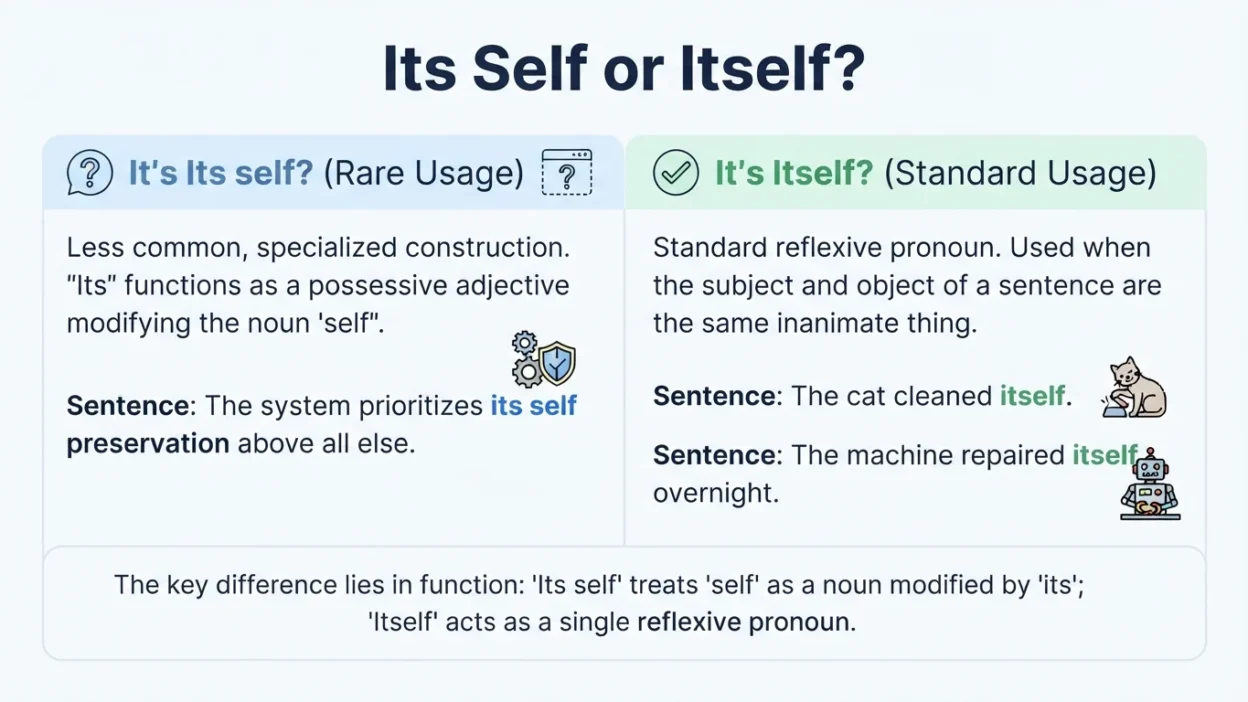
Itself is the standard and correct form when you need the reflexive pronoun. For example, “The cat cleaned itself.” Its self is normally incorrect in everyday English, although the two words can occasionally appear separately when “self” is being used as a noun. In most situations, choose itself.
Why Do People Confuse “Its Self” and “Itself”?
The confusion happens because its and itself are both related to the pronoun it.
The word its shows possession:
The company changed its policy.
The word itself is a reflexive pronoun:
The company changed itself.
Because “itself” can be mentally broken into “its + self,” some writers assume that the two-word form is acceptable whenever they want to refer back to “it.” In standard English, however, the reflexive pronoun is written as one word: itself.
What Does “Itself” Mean?
Itself is a reflexive pronoun. It usually refers back to a singular nonhuman noun or to something represented by it.
Examples
- The dog hurt itself.
- The door opened by itself.
- The computer restarted itself.
- The company itself announced the changes.
- The idea itself is interesting.
“Itself” can also be used for emphasis. In this case, it emphasizes the noun rather than showing a direct reflexive action.
Example
The house itself is beautiful.
Here, “itself” emphasizes the house.
What Does “Its Self” Mean?
Its self is not the normal spelling of the reflexive pronoun.
In ordinary English, you should not write:
❌ The machine repaired its self.
Instead, write:
✅ The machine repaired itself.
However, there can be rare situations where self is deliberately used as a separate noun and its is functioning as a possessive determiner.
For example, in philosophical, psychological, or highly abstract writing, a writer may discuss something’s “self” as a concept:
The system’s identity is different from its self.
Even here, the construction is unusual and often a clearer alternative can be found.
For everyday English, itself is almost always the form you need.
Its Self vs Itself: Comparison Table
| Feature | Itself | Its self |
|---|---|---|
| Standard everyday usage | ✅ Yes | ❌ Usually no |
| Grammatical role | Reflexive pronoun | Possessive + noun |
| Written as one word | ✅ Yes | ❌ Two words |
| Common in everyday English | Very common | Very rare |
| Example | The cat washed itself. | Rare specialized usage |
| Best choice for normal writing | ✅ Itself | ❌ Avoid |
When to Use “Itself”
Use itself when the word refers back to a singular thing or entity represented by it.
1. When the subject and object are the same
The dog scratched itself.
The dog is both doing the action and receiving the action.
2. For emphasis
The building itself is worth visiting.
Here, “itself” emphasizes the building.
3. After “by”
The door closed by itself.
This means the door closed without someone deliberately closing it.
4. To emphasize an idea or situation
The problem itself is not difficult.
The word “itself” emphasizes the problem.
Examples of “Itself” in Sentences
Here are several examples to make the difference easier to understand:
- The cat cleaned itself.
- The computer turned itself off.
- The door opened by itself.
- The machine can repair itself.
- The company itself confirmed the news.
- The problem will eventually solve itself.
- The bird injured itself.
- The phone restarted itself.
- The building itself is quite old.
- The software updates itself automatically.
- The box moved by itself.
- The organization itself released the statement.
Notice that itself is always written as one word in these normal constructions.
Common Mistakes
Mistake 1: Writing “its self” instead of “itself”
❌ The robot repaired its self.
✅ The robot repaired itself.
Mistake 2: Confusing “its” with “itself”
Its shows possession:
The dog wagged its tail.
Itself is reflexive or emphatic:
The dog cleaned itself.
Mistake 3: Using “it self”
❌ The machine fixed it self.
✅ The machine fixed itself.
There is no space in the standard reflexive pronoun.
“Its” vs “Itself”
Understanding its can make this rule much easier.
Its
Its is a possessive determiner. It tells us that something belongs to or is associated with “it.”
The company changed its name.
The tree lost its leaves.
Itself
Itself is a reflexive pronoun.
The company defended itself.
The tree seems to have healed itself.
A useful way to remember the difference is:
Its = belonging to it
Itself = referring back to it
Memory Trick
Use this simple trick:
IT + SELF = ITSELF
If you are referring back to “it,” especially when the subject and object are the same, use itself as one word.
For example:
The machine fixed itself.
Think:
It → itself
Not:
Its → self
Another useful trick:
Its = possession
Itself = reflexive/emphasis
American vs British English
There is no meaningful American-versus-British spelling difference here.
Both American English and British English use itself as the standard reflexive pronoun.
For example:
American English:
The computer restarted itself.
British English:
The computer restarted itself.
The same spelling and grammatical rule applies in both varieties.
Similar Words
“Itself” belongs to a group of reflexive pronouns in English.
| Pronoun | Example |
|---|---|
| Myself | I taught myself. |
| Yourself | You introduced yourself. |
| Himself | He blamed himself. |
| Herself | She prepared herself. |
| Itself | The machine repaired itself. |
| Ourselves | We organized ourselves. |
| Yourselves | You should prepare yourselves. |
| Themselves | They introduced themselves. |
These reflexive pronouns are normally written as single words.
Is “Its Self” Ever Correct?
In ordinary modern English, its self should generally be avoided when you mean the reflexive pronoun.
However, self can function as an independent noun in certain specialized contexts. A writer might intentionally discuss an object’s, system’s, or concept’s “self” as a separate abstract idea.
This is uncommon, though. If your sentence is ordinary everyday English, academic writing, business writing, or general content writing, itself will almost certainly be the appropriate choice.
Itself vs Its Self: Quick Examples
Compare these sentences:
❌ The animal injured its self.
✅ The animal injured itself.
❌ The computer restarted its self.
✅ The computer restarted itself.
❌ The company defended its self.
✅ The company defended itself.
But in a rare specialized construction:
The philosopher discussed the machine and its self as separate concepts.
Here, “its” modifies the noun “self,” so the words are intentionally separate. This is not the normal use of the reflexive pronoun.
Final Verdict: Its Self or Itself?
For almost all normal English writing, itself is the correct choice. It is the standard reflexive pronoun corresponding to “it” and is used when the action refers back to the subject or when emphasis is needed.
Its self is not the normal alternative spelling of “itself.” The two-word form can occur in rare, specialized constructions where self is being treated as a separate noun, but that is very different from ordinary reflexive usage.
FAQs
1. Is “its self” grammatically correct?
It can be grammatically possible in rare contexts where its modifies self as a separate noun. However, when you need the reflexive pronoun, the correct form is itself.
2. Is it “itself” or “its self”?
Use itself in normal English. For example: “The dog washed itself.”
3. Is “its self” a spelling mistake?
Usually, yes, when it is being used instead of the reflexive pronoun itself.
4. What is the difference between “its” and “itself”?
Its expresses possession, while itself is a reflexive pronoun or an emphatic pronoun.
- The dog wagged its tail.
- The dog cleaned itself.
5. Can “itself” be used for emphasis?
Yes. For example:
The book itself is fascinating.
Here, “itself” emphasizes the book.
6. Is “itself” one word?
Yes. The standard reflexive pronoun itself is written as one word.
7. What is the easiest way to remember “itself”?
Remember: it + self = itself. If you are using the reflexive pronoun, do not insert a space.
Conclusion
The difference between its self and itself is small in appearance but important in standard English grammar. Itself is the normal reflexive pronoun used when referring back to a singular nonhuman subject or when emphasizing something. Examples include “The cat cleaned itself” and “The house itself is beautiful.”
Although its self can appear in rare specialized writing when “self” is deliberately used as a separate noun, it is not the form you should normally use. For everyday writing, academic work, professional communication, and SEO content, remember the simple rule: its = possession, itself = reflexive or emphasis.
Remember This
Use “itself” as one word when you mean the reflexive pronoun.
- ✅ The machine repaired itself.
- ✅ The company announced the change itself.
- ❌ The machine repaired its self.
Its = possession.
Itself = reflexive/emphasis.

A passionate linguist who specializes in word relationships and vocabulary building.
He has spent years studying synonyms and semantic patterns across languages.
Arman writes to make language learning simple, precise, and engaging.