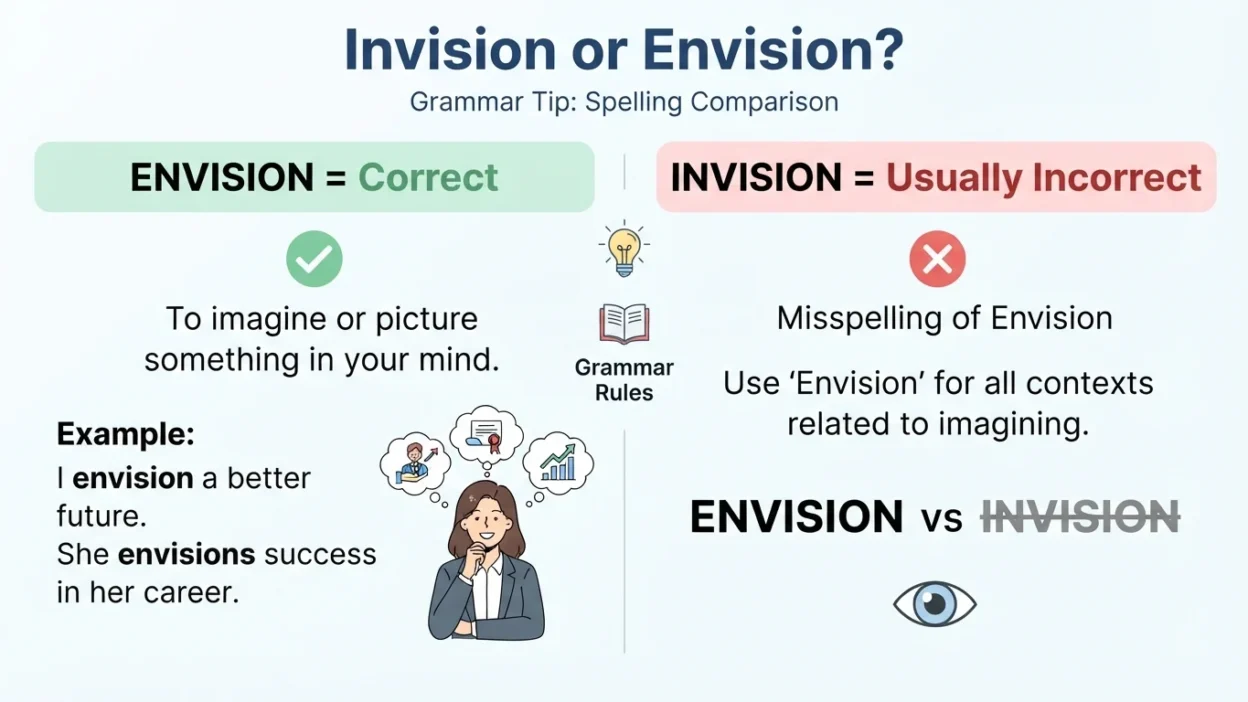
Have you ever wondered whether the correct word is “invision” or “envision”? This is a common spelling confusion because both words look and sound similar. However, in standard modern English, envision is the correct word when you mean to imagine, picture, or mentally see something that may happen in the future.
Invision is generally considered a misspelling when someone intends to use envision. It may occasionally appear as a proper name, brand, or specialized name, but it is not the standard English verb meaning “to imagine.” Knowing the difference is especially useful for students, ESL learners, writers, and anyone who wants to communicate clearly and professionally.
Quick Answer: Invision or Envision?
Envision is the correct standard English word when you mean “to imagine,” “to picture,” or “to foresee.” Invision is generally a misspelling of envision in this context. For example, write “I envision a successful future,” not “I invision a successful future.”
Why Do People Confuse “Invision” and “Envision”?
The confusion mainly comes from pronunciation and spelling patterns.
English contains many words beginning with in-, so it can feel natural to spell the word invision. However, the standard word is envision, which developed from the idea of forming a mental picture or vision of something.
People may also confuse it with related words such as:
- vision
- visual
- envision
- invisible
- envisioning
The key point is simple: when the verb means to imagine or picture something, the standard spelling is envision.
What Does “Envision” Mean?
Envision is a verb meaning to imagine, picture, or mentally see something, especially something that may happen in the future.
Examples
I envision a better future for the company.
She envisions herself working abroad someday.
Can you envision what the city will look like in ten years?
He envisioned a completely different approach.
The word is often used when talking about:
- future plans
- goals
- possibilities
- dreams
- careers
- businesses
- projects
- personal development
- imagined outcomes
Synonyms of Envision
Depending on the context, synonyms include:
- imagine
- picture
- visualize
- foresee
- conceive
- anticipate
- contemplate
- dream of
- see in your mind
For example:
I envision a successful career.
can also be expressed as:
I visualize a successful career.
or:
I imagine a successful career.
What Does “Invision” Mean?
In standard modern English, invision is generally not the correct spelling when you mean “to imagine” or “to picture.”
For example:
❌ I invision a successful future.
The standard form is:
✅ I envision a successful future.
However, Invision can sometimes appear as a proper name, brand name, company name, product name, or other specialized term. In those cases, it should not automatically be treated as an ordinary English spelling of envision.
Therefore, context matters when you see “Invision” capitalized as a name.
Invision vs Envision: Comparison Table
| Feature | Envision | Invision |
|---|---|---|
| Standard English verb | ✅ Yes | ❌ No |
| Meaning “to imagine” | ✅ Yes | ❌ No |
| Meaning “to picture mentally” | ✅ Yes | ❌ No |
| Common dictionary word | ✅ Yes | Generally no |
| Common spelling mistake | No | ✅ Often |
| Can appear as a proper name | Yes | Yes |
| Best choice in normal writing | ✅ Envision | ❌ Avoid |
When to Use “Envision”
Use envision when you want to say that someone imagines or pictures a possible situation, result, or future.
1. Talking about the future
I envision a future where technology makes education more accessible.
2. Describing a goal
She envisions herself becoming a successful writer.
3. Discussing a plan
The team envisioned a new way to solve the problem.
4. Imagining a possibility
Can you envision living in another country?
5. Talking about a business or project
The founder envisioned a global company.
6. Describing an imagined result
We envision significant improvements over the next few years.
Examples: Envision in Sentences
Here are more examples to help you understand the correct usage:
- I envision a peaceful future.
- She envisions herself as a successful entrepreneur.
- They envisioned a completely new approach.
- Can you envision the possibilities?
- He envisions building his own business.
- We envision a world with better access to education.
- The architect envisioned a modern building.
- I cannot envision living without my family.
- She envisioned how the finished project would look.
- The company envisions expanding internationally.
- He envisioned a career in medicine.
- They envision creating a more sustainable future.
Common Mistakes
Mistake 1: Writing “invision” instead of “envision”
❌ I invision myself succeeding.
✅ I envision myself succeeding.
Mistake 2: Adding an unnecessary “in-”
Because “in” is a common English prefix, people sometimes assume it belongs at the beginning of the word.
❌ We invision a better future.
✅ We envision a better future.
Mistake 3: Confusing “envision” with “vision”
These words are related but have different grammatical roles.
Vision is usually a noun:
She has a clear vision for the company.
Envision is a verb:
She envisions a successful company.
Mistake 4: Using “envision” when you mean “see”
“Envision” usually suggests imagining or mentally picturing something, rather than physically seeing it with your eyes.
I envision myself living near the ocean someday.
This means I imagine that possibility.
Envision vs Imagine
Because imagine and envision are similar, they can sometimes be used interchangeably.
Imagine
Imagine is broader and more common.
Imagine living on a tropical island.
Envision
Envision often sounds more deliberate and future-oriented.
I envision myself living on a tropical island.
In professional, business, academic, and planning contexts, envision is often useful when discussing a desired future or expected direction.
Envision vs Visualize
These words are also closely related.
Visualize often emphasizes creating a mental image.
Visualize yourself achieving your goal.
Envision can mean mentally picturing something, but it is also commonly used for plans, possibilities, and future outcomes.
We envision a stronger education system.
Both can be correct, depending on the context.
Memory Trick
Here is an easy way to remember the correct spelling:
EN + VISION = ENVISION
Think of vision.
If you want to say “imagine or picture something,” use:
EN + VISION → ENVISION
Remember:
Envision = imagine
Not:
❌ Invision = imagine
A simple memory sentence is:
“I can ENvision my future.”
American vs British English
There is no significant American-versus-British spelling difference for this word.
Both American English and British English use envision as the standard verb.
American English
I envision a successful future.
British English
I envision a successful future.
The spelling envision remains the standard form in both varieties.
British English also commonly uses envisage, which has a very similar meaning:
We envisage major changes in the coming years.
So you may encounter envisage more often in some British contexts, but envision is also an established English word.
Similar Words
Understanding related words can make the distinction easier.
| Word | Part of Speech | Meaning |
|---|---|---|
| Envision | Verb | Imagine or picture |
| Vision | Noun | An idea, image, or ability to see |
| Visualize | Verb | Create a mental image |
| Imagine | Verb | Form a mental picture or idea |
| Foresee | Verb | Anticipate something before it happens |
| Envisage | Verb | Imagine or consider a future possibility |
Examples
Envision:
I envision a better future.
Vision:
She has a clear vision for the project.
Visualize:
Visualize yourself reaching your goal.
Imagine:
Imagine living in another country.
Foresee:
We foresee several challenges.
Envisage:
They envisage significant changes.
Is “Invision” Ever Correct?
If you are writing a normal English sentence and want to express the meaning “imagine” or “picture,” use envision.
“Invision” may still appear as a proper name, brand, product, organization, or other specific name. In such cases, its capitalization and spelling depend on the name itself.
Therefore:
I envision a better future. ✅
But if Invision is the official name of something:
Invision may be correct as a proper name. ✅
This is different from using “invision” as an ordinary English verb.
Final Verdict: Invision or Envision?
When you mean “to imagine,” “to picture,” or “to mentally see a future possibility,” the correct standard English spelling is envision.
Invision should generally not be used as the ordinary English verb. If you encounter “Invision” as a capitalized name, however, it may be a proper name rather than a spelling mistake.
The easiest rule is:
Envision = imagine or picture something mentally.
So write:
✅ I envision a successful future.
Not:
❌ I invision a successful future.
FAQs
1. Is “invision” or “envision” correct?
Envision is the correct standard English word when you mean “to imagine” or “to picture.”
2. Is “invision” a word?
“Invision” is not normally used as the standard English verb meaning “imagine.” It may appear as a proper name or specialized name.
3. What does envision mean?
Envision means to imagine, picture, or mentally see something, especially a future possibility.
4. What is an example of envision?
I envision myself achieving my goals within the next few years.
5. Is envision the same as imagine?
They are similar. Imagine is broader, while envision often emphasizes mentally picturing a possibility, plan, or future outcome.
6. Is “envision” used in American English?
Yes. Envision is standard in American English.
7. What is the British English equivalent of envision?
British English also uses envision, but envisage is another common word with a similar meaning.
8. How do I remember the spelling of envision?
Think of vision: EN + VISION = ENVISION.
Conclusion
The correct choice between invision and envision is straightforward in standard English. When you want to say that someone imagines, pictures, or mentally sees a possible future or situation, use envision. For example, “She envisions a successful career” is correct, while “She invisions a successful career” is not standard English.
Remember that invision may occasionally appear as a proper name or brand, so capitalization and context can matter. But for ordinary English writing, the safe rule is simple: envision = imagine. Keeping this distinction in mind will help you avoid spelling errors in academic, professional, and everyday writing.
Remember This
EN + VISION = ENVISION
- ✅ Envision = imagine, picture, foresee
- ❌ Invision = generally incorrect as the ordinary verb
- ✅ I envision a better future.
- ❌ I invision a better future.

A creative writer with a deep interest in word usage and meaning.
He explores synonyms to enhance both academic and creative expression.
Zayn’s work aims to make language richer and more accessible for everyone.