Are you unsure whether to use “unregister” or “deregister”? Both words are real English verbs, and both can describe the process of removing someone or something from a registration. However, they are not always interchangeable. The better choice often depends on the type of registration, the context, and the variety of English being used.
In everyday English and many software or account-related contexts, unregister is commonly used to mean removing something from a list, system, service, or registration. Deregister is also standard, but it is especially common in formal, administrative, regulatory, educational, business, and technical contexts. Understanding the difference can help you choose the most natural word for your sentence.
Quick Answer: Unregister vs Deregister
Unregister and deregister can both mean to remove someone or something from a registration. Unregister is common in general, software, account, and event contexts, while deregister often sounds more formal or administrative. The exact preference depends on context and regional usage.
Why Do People Confuse “Unregister” and “Deregister”?
The confusion comes from the fact that both prefixes—un- and de-—can suggest reversing an action.
For example:
- register → unregister
- register → deregister
Both can communicate the idea of reversing or ending a registration.
However, English does not always treat prefixes as perfectly interchangeable. Some contexts strongly favor one word over the other.
For example:
Please unregister from the event.
sounds natural in many everyday contexts.
Meanwhile:
The company was deregistered from the official register.
has a more formal or administrative tone.
What Does “Unregister” Mean?
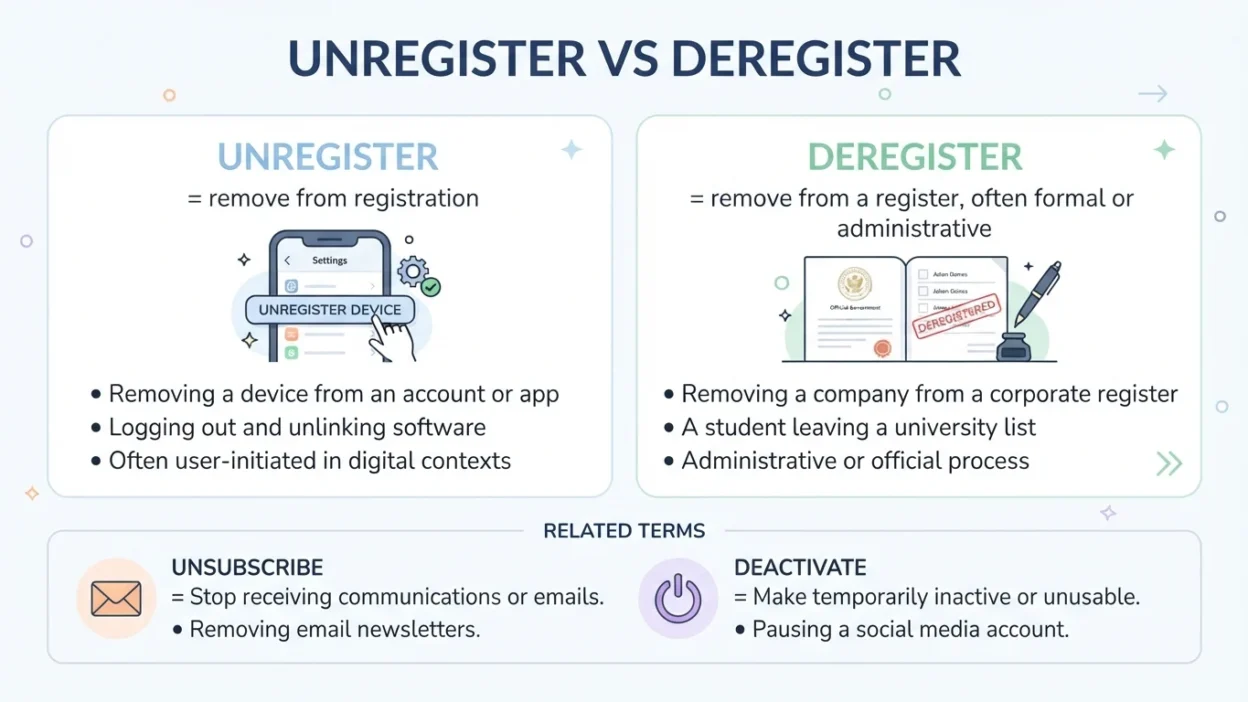
Unregister generally means to remove someone or something from a registration, list, service, system, event, or program.
It is especially common when the original registration was something a person or user actively completed.
Examples
I need to unregister for the workshop.
You can unregister your device from the account.
She decided to unregister from the course.
Click this button to unregister the application.
The word is particularly common in:
- software
- websites
- online accounts
- events
- courses
- memberships
- devices
- applications
- services
Unregister as a Technical Term
In computing, unregister can have a specific meaning: removing something from a system where it had previously been registered.
For example:
The administrator unregistered the device from the network.
or:
The program automatically unregisters the component when it is removed.
In technical documentation, unregister is therefore a useful and established term.
What Does “Deregister” Mean?
Deregister also means to remove a person, organization, object, or entity from an official registration or register.
It often has a more formal, institutional, or administrative feel.
Examples
The organization was deregistered after failing to meet the requirements.
Students must formally deregister from the program.
The company was deregistered from the official register.
You must notify the authority if you wish to deregister.
Deregister is frequently encountered in contexts involving:
- government records
- official registers
- businesses
- universities
- professional organizations
- tax systems
- legal or regulatory records
- formal memberships
- administrative procedures
Unregister vs Deregister: Comparison Table
| Feature | Unregister | Deregister |
|---|---|---|
| Basic meaning | Remove from registration | Remove from registration |
| Standard English | ✅ Yes | ✅ Yes |
| Common in software | ✅ Very common | Sometimes |
| Common in online services | ✅ Common | Less common |
| Formal/administrative contexts | Common | ✅ Very common |
| Official registers | Possible | ✅ Common |
| Events and appointments | ✅ Natural | Less common |
| Technical contexts | ✅ Common | Possible |
| Tone | General/neutral | Often more formal |
| Regional variation | Used widely | Especially common in some formal varieties of English |
When to Use “Unregister”
Use unregister when you are talking about reversing a registration in a general, online, software, event, or service-related context.
1. Online accounts
You can unregister your device from your account.
2. Events
I need to unregister from the conference.
3. Software
The application will unregister itself automatically.
4. Devices
The technician unregistered the old device.
5. Courses or programs
Students can unregister from the class before the deadline.
6. Services
I want to unregister from this service.
The exact preposition can vary depending on the construction. In some contexts, unregister from is natural; in others, unregister something is more appropriate.
When to Use “Deregister”
Use deregister when the context involves an official, formal, institutional, or administrative registration.
1. Official records
The company was deregistered from the official register.
2. Universities
Students who leave the program must deregister formally.
3. Government or regulatory systems
The business was deregistered by the relevant authority.
4. Professional registration
The practitioner chose to deregister from the professional body.
5. Formal administrative procedures
Applicants must complete the form before they can deregister.
The word can sound more official than unregister, although the distinction is not absolute.
Examples of “Unregister”
Here are some natural examples:
- I want to unregister my old phone.
- You can unregister from the event online.
- She decided to unregister for the course.
- The software automatically unregistered the device.
- Please unregister the application before removing it.
- He unregistered from the mailing service.
- Users can unregister their accounts through the settings page.
- The system allows administrators to unregister inactive devices.
- I accidentally registered twice, so I need to unregister one account.
- The application was unregistered from the system.
Examples of “Deregister”
Here are examples showing its more formal uses:
- The company was deregistered from the official register.
- Students must deregister before leaving the university.
- The organization decided to deregister its branch.
- The business was formally deregistered.
- Members can deregister from the program.
- The professional chose to deregister from the association.
- The authority may deregister organizations that no longer meet the requirements.
- The company submitted a request to deregister.
- The institution requires students to deregister formally.
- The organization was removed from the register after being deregistered.
Common Mistakes
Mistake 1: Assuming only one word is correct
It is incorrect to assume that unregister is always right or that deregister is always right.
Both are established verbs.
The context determines which one sounds more natural.
Mistake 2: Using “deregister” for casual online actions
For an everyday software or account action, unregister may sound more natural:
Please unregister the device.
Using deregister is not necessarily grammatically wrong, but it can sound more formal or technical depending on the context.
Mistake 3: Treating “unregister” as informal or incorrect
Unregister is a legitimate English verb. It is widely used, particularly in technology and online systems.
Mistake 4: Assuming “deregister” always means cancellation
Deregistering generally involves removing a registration, but the exact consequences depend on the organization or system.
Deregister does not automatically mean “delete everything.”
Unregister vs Unsubscribe
These words are sometimes confused.
Unregister
Means to remove someone or something from a registration.
I need to unregister from the course.
Unsubscribe
Usually means to stop receiving a subscription, mailing list, newsletter, or similar service.
I unsubscribed from the newsletter.
So:
Registration → unregister
Subscription → unsubscribe
Deregister vs Deactivate
These words also have different meanings.
Deregister
Means to remove from a registration or official register.
The device was deregistered from the system.
Deactivate
Usually means to make something inactive without necessarily removing its registration.
The account was deactivated.
An account can sometimes be deactivated without being completely deregistered.
Unregister vs Cancel
Cancel is broader.
I canceled my appointment.
This does not necessarily mean that your registration was removed from a database.
Unregister specifically focuses on reversing or removing a registration.
I unregistered from the event.
Therefore, use the word that matches the actual action being taken.
American vs British English
Both unregister and deregister are used in English, but their frequency can vary by region and context.
Unregister is particularly common in software, online services, and general user-facing contexts.
Deregister is frequently encountered in formal administrative, educational, professional, and regulatory contexts, particularly in British and other international varieties of English.
American English also uses deregister, especially in technical and administrative writing, so it is not exclusively British.
There is no universal rule that one word belongs only to American English and the other only to British English.
Which One Sounds More Formal?
In many contexts, deregister has a more formal or institutional tone.
Compare:
I want to unregister from the event.
with:
I want to deregister from the program.
The second sentence can sound more administrative.
However, unregister can also be perfectly appropriate in professional and technical writing. The best choice depends on the terminology used by the organization, software, or system you are describing.
Similar Words
Several words can describe related actions:
| Word | Meaning |
|---|---|
| Register | Officially record or enroll |
| Unregister | Remove from a registration |
| Deregister | Remove from a register or registration |
| Unsubscribe | Stop a subscription |
| Cancel | Stop or withdraw from something |
| Deactivate | Make inactive |
| Delete | Permanently remove data or an account |
| Withdraw | Formally leave or remove oneself |
Choosing the right word depends on what actually happens.
A Simple Way to Choose
Ask yourself:
Is this an app, website, device, event, or online service?
Unregister will often be natural.
Unregister the device.
Is this an official record, institution, organization, or administrative register?
Deregister will often be natural.
Deregister the organization.
Is it a newsletter or subscription?
Use unsubscribe.
Unsubscribe from the newsletter.
Are you simply stopping an account?
Depending on the system, deactivate or cancel may be more accurate.
Final Verdict: Unregister or Deregister?
Unregister and deregister are both correct English verbs. The main difference is usually context and register, rather than basic meaning.
Use unregister when talking about removing something from a registration, especially in software, online systems, events, devices, or user-facing services. Use deregister when the context is more formal, official, institutional, regulatory, or administrative.
Neither word is universally “more correct.” If a particular website, university, government agency, or software system uses one term officially, follow that terminology for consistency.
FAQs
1. Is “unregister” a real word?
Yes. Unregister is a standard English verb meaning to remove someone or something from a registration.
2. Is “deregister” a real word?
Yes. Deregister is also a standard English verb meaning to remove someone or something from a register or registration.
3. What is the difference between unregister and deregister?
Both can mean removing something from a registration. Unregister is common in general and technical contexts, while deregister often has a more formal or administrative tone.
4. Should I say “unregister” or “deregister” from a course?
Both may be used, but the institution’s terminology matters. Deregister is common in formal university or administrative contexts, while unregister may be more natural in general usage.
5. Is “unregister” used in software?
Yes. Unregister is widely used in computing to describe removing a component, device, service, or object from a system’s registration.
6. Is “deregister” more formal than “unregister”?
Often, yes. Deregister can have a more formal, institutional, or administrative tone, although the distinction is not absolute.
7. Does deregister mean delete?
Not necessarily. Deregister means to remove from a registration or register. It does not automatically mean that all related data has been deleted.
8. What is the opposite of register?
Depending on context, possible opposites include unregister and deregister. For subscriptions, unsubscribe is usually the appropriate term.
Conclusion
Unregister and deregister both describe the reversal or removal of a registration, but they tend to appear in different contexts. Unregister is especially common in technology, online platforms, devices, applications, events, and general user-facing situations. Deregister is often associated with formal records, institutions, professional bodies, universities, and administrative or regulatory processes.
The most useful rule is to consider the context rather than treating one word as universally correct. If you are removing a device or application from a system, unregister may be the natural choice. If an organization is being removed from an official register, deregister may be more appropriate. When an institution provides its own terminology, follow that terminology for clarity and consistency.
Remember This
Unregister = remove from a registration, often general or technical
Deregister = remove from a register or registration, often formal or administrative
- ✅ Unregister a device
- ✅ Unregister from an event
- ✅ Deregister a company
- ✅ Deregister from a formal program
- ✅ Unsubscribe from a newsletter
- ✅ Deactivate an account

A creative writer with a deep interest in word usage and meaning.
He explores synonyms to enhance both academic and creative expression.
Zayn’s work aims to make language richer and more accessible for everyone.