If you’re wondering whether the correct spelling is opened or openned, the answer is simple: opened is correct. Openned is a common spelling mistake caused by adding an extra n before the -ed ending. Although English has many verbs that double their final consonant, open does not follow that pattern.
Opened is the past tense and past participle of open. It can mean making something accessible, moving something so that it is no longer closed, beginning an event or business, or becoming available. Openned is not the standard spelling and should be avoided in formal writing, academic work, professional communication, and published content. Below, you’ll learn the spelling rule, examples, common mistakes, and an easy way to remember it.
Quick Answer
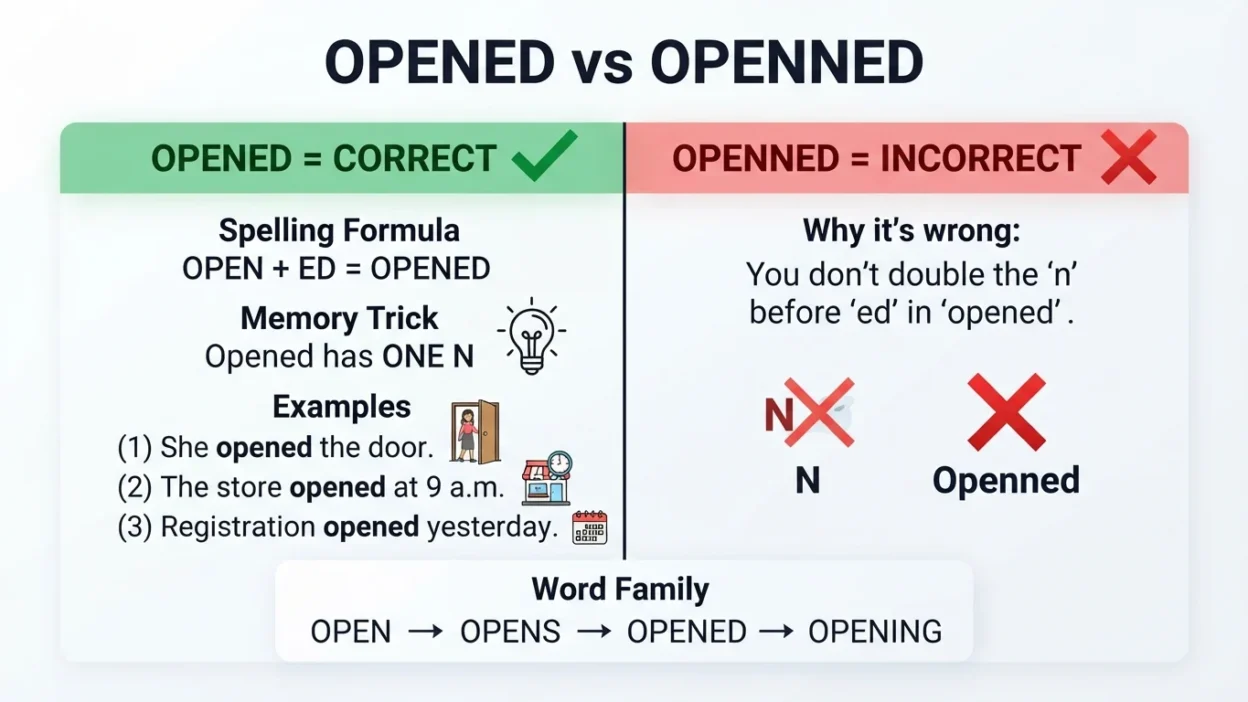
Opened is the correct spelling. Openned is incorrect. The verb open becomes opened when you add -ed. You do not double the final n.
Why People Confuse It
The confusion happens because English sometimes doubles a final consonant before adding -ed:
- stop → stopped
- plan → planned
- admit → admitted
This may make you think:
❌ open → openned
But open does not follow this pattern.
The correct form is:
✅ open → opened
The n remains single.
Opened: Meaning and Usage
Opened is the past tense and past participle of open.
It can have several meanings depending on context.
1. Made something no longer closed
She opened the door.
2. Made something accessible
He opened the box carefully.
3. Started a business or event
The store opened at 9 a.m.
4. Began something
The speaker opened the meeting with a short speech.
5. Became available
Registration opened yesterday.
Openned: Is It Correct?
No.
Openned is a misspelling of opened.
❌ The shop openned at eight.
✅ The shop opened at eight.
❌ She openned the window.
✅ She opened the window.
Always use opened in standard English.
Comparison Table
| Word | Correct? | Meaning | Example |
|---|---|---|---|
| Opened | ✅ Yes | Past tense of “open” | She opened the door. |
| Openned | ❌ No | Misspelling | Avoid this spelling. |
When to Use “Opened”
Use opened when talking about something that happened in the past involving opening, beginning, starting, or becoming available.
Physical objects
He opened the door.
She opened the package.
Businesses
The restaurant opened last year.
Events
The conference opened with a welcome speech.
Applications and opportunities
Applications opened on Monday.
Conversations
She opened the discussion by asking a question.
Examples: Opened vs Openned
- She opened the door.
- He opened the window.
- I opened the package carefully.
- The store opened at 9 a.m.
- They opened a new branch downtown.
- The meeting opened with a short presentation.
- Registration opened yesterday.
- She opened her email.
- He opened the book to the first page.
- The museum opened to the public last month.
- The manager opened the discussion.
- The company opened a new office.
Common Mistakes
Mistake 1: Adding an extra “n”
❌ openned
✅ opened
There is only one n before -ed.
Mistake 2: Applying the doubling rule incorrectly
Compare:
plan → planned
But:
open → opened
The final consonant isn’t automatically doubled simply because you’re adding -ed.
Mistake 3: Writing “openned” in formal content
Although readers can usually understand openned, it is still a spelling error.
For professional writing, always use:
opened
Memory Trick
Here’s the easiest way to remember it:
Open + ED = Opened
Simply add -ed:
OPEN + ED → OPENED
Don’t add another n.
Think:
The door opened with only ONE N.
You can also remember the word family:
- open
- opens
- opened
- opening
None of these forms requires nn.
American vs British English
There is no difference between American and British English in the spelling of opened.
Both use:
✅ opened
For example:
American English:
The store opened at 8 a.m.
British English:
The store opened at 8 a.m.
The incorrect spelling openned is not the standard form in either variety.
Similar Words
Open
The base form.
Please open the door.
Opens
The third-person singular present form.
The store opens at 9 a.m.
Opened
The past tense and past participle.
The store opened yesterday.
Opening
The present participle or gerund.
The store is opening soon.
Closed
The opposite of open.
The shop is closed today.
Unopened
Something that has not been opened.
The package remained unopened.
FAQs
Is it opened or openned?
Opened is correct. Openned is incorrect.
Why isn’t the N doubled in opened?
The verb open does not require consonant doubling when adding -ed. The standard form is simply opened.
Is “openned” a real word?
No, openned is not the standard English spelling. It is a common misspelling of opened.
Is “opened” past tense?
Yes. Opened is the simple past tense and past participle of open.
She opened the door.
Is “opening” correct?
Yes.
The shop is opening tomorrow.
Is opened spelled differently in British English?
No. Opened has the same spelling in American and British English.
How do I remember the spelling of opened?
Remember:
OPEN + ED = OPENED
Only one N is needed.
Final Verdict
The correct spelling is opened, not openned. The word opened is the past tense and past participle of open, and it can describe physically opening something, starting an event, launching a business, or making something available.
The easiest way to avoid this spelling mistake is to remember that open does not double its final consonant. Simply add -ed: open + ed = opened.
Remember This
✅ OPENED = Correct
❌ OPENNED = Incorrect
OPEN + ED = OPENED
Think:
Opened has ONE N.
Word family:
open → opens → opened → opening
Conclusion
The opened vs openned confusion is easy to solve once you know the correct spelling pattern. Opened is the only standard form you should use in modern English, whether you’re talking about opening a door, starting a business, beginning a meeting, or making registration available.
Don’t automatically double the final consonant when adding -ed. Some verbs do require doubling, but open does not. Whenever you’re unsure, return to the base word: OPEN + ED = OPENED. This simple rule will help you spell the word correctly in academic, professional, and everyday English.

A creative writer with a deep interest in word usage and meaning.
He explores synonyms to enhance both academic and creative expression.
Zayn’s work aims to make language richer and more accessible for everyone.