If you are wondering whether to say “Thank you both” or “Thanks to both of you,” you’re not alone. Both expressions are grammatically correct, but they are not always used in exactly the same way. The difference is mainly about how directly you are expressing gratitude and how the phrase fits into the sentence.
Thank you both is the most natural choice when you are directly thanking two people. For example, you might say, “Thank you both for helping me.” Thanks to both of you is also correct, but it can sound slightly more conversational and may emphasize the contribution of those two people. It can also appear in a sentence describing a positive result, such as “Thanks to both of you, we finished on time.” Understanding this small distinction will help you choose the most natural expression in emails, conversations, messages, and professional communication.
Quick Answer
“Thank you both” is the most direct and natural way to thank two people. “Thanks to both of you” is also correct and often emphasizes that two people deserve credit for something. Both expressions are appropriate depending on the sentence and context.
Why People Confuse Them
The confusion comes from the fact that both expressions communicate gratitude to two people.
Compare:
Thank you both for your help.
and
Thanks to both of you, we completed the project.
Both mention two people, but their grammatical roles are different.
Thank you both is a direct expression of gratitude.
Thanks to both of you can either express gratitude or mean that something happened because of their help or contribution.
The important difference is the structure of the sentence.
Thank You Both: Meaning and Usage
Thank you both is a direct way of expressing gratitude to two people.
Here, both refers to the two people being thanked.
Examples
Thank you both for coming.
Thank you both for your support.
Thank you both for helping me.
Thank you both so much.
This expression is natural in:
- Everyday conversations
- Emails
- Text messages
- Professional communication
- Speeches
- Social media
- Formal and informal situations
Is “Thank you both” grammatically correct?
Yes. It is completely correct.
You do not need to say:
Thank you to both.
The more natural expression when directly addressing the two people is:
Thank you both.
Thanks to Both of You: Meaning and Usage
Thanks to both of you can also be used to thank two people.
For example:
Thanks to both of you for your help.
However, this expression has another important use. Thanks to can mean because of or as a result of, especially when someone’s actions produced a positive result.
For example:
Thanks to both of you, we finished the project early.
Here, the meaning is approximately:
Because of both of you, we finished the project early.
This is slightly different from simply saying:
Thank you both for helping with the project.
The first sentence highlights the result of their contribution, while the second directly expresses gratitude.
Comparison Table
| Expression | Main Use | Tone | Example |
|---|---|---|---|
| Thank you both | Directly thanks two people | Natural, polite | Thank you both for helping me. |
| Thanks to both of you | Thanks two people or highlights their contribution | Conversational | Thanks to both of you, we succeeded. |
| Thank you to both of you | Directly thanks two people with extra emphasis | Slightly more formal/emphatic | Thank you to both of you for your support. |
When to Use Each
Use “Thank you both” for direct gratitude
If you are speaking directly to two people, this is usually the best choice.
Thank you both for your kindness.
Thank you both for being here.
Thank you both for your valuable advice.
It is short, natural, and polite.
Use “Thanks to both of you” when emphasizing their contribution
This works especially well when something happened because of their help.
Thanks to both of you, we were able to finish the work.
Thanks to both of you, the event was a success.
Thanks to both of you, I finally understood the problem.
Here, the phrase connects their actions to a specific outcome.
Use “Thank you to both of you” for extra emphasis
This is also grammatically correct.
Thank you to both of you for your continued support.
It can sound more deliberate or emphatic than “Thank you both.”
Examples: Thank You Both vs Thanks to Both of You
- Thank you both for your help.
- Thank you both for coming today.
- Thank you both for your kindness.
- Thank you both for supporting me.
- Thank you both so much for your advice.
- Thanks to both of you, we completed the project.
- Thanks to both of you, everything went smoothly.
- Thanks to both of you for helping me.
- Thanks to both of you, we found the solution.
- Thank you to both of you for your patience.
- Thank you both for making this possible.
- Thanks to both of you, I gained confidence.
All of these can be correct, but the intended meaning and sentence structure determine which expression works best.
Common Mistakes
Mistake 1: Thinking “thank you both” is incomplete
Some learners think they must say:
❌ Thank you to both.
But when directly thanking two people, the natural expression is:
✅ Thank you both.
You can also say:
✅ Thank you to both of you.
Mistake 2: Using “thanks to” only as a thank-you phrase
Remember that thanks to can also mean because of.
Compare:
Thanks to both of you for your help.
This expresses gratitude.
But:
Thanks to both of you, we won.
This emphasizes that their contribution helped produce the result.
Mistake 3: Saying “thank both of you”
This can be grammatically possible in a longer structure, but it is less natural as a standalone expression.
Instead of:
❌ Thank both of you for your help.
Say:
✅ Thank you both for your help.
or:
✅ I want to thank both of you for your help.
Mistake 4: Using “both” incorrectly
When you’re directly addressing two people, “Thank you both” is perfectly natural.
You don’t need to repeat the word you:
❌ Thank you both of you.
Better:
✅ Thank you both.
Or:
✅ Thank you to both of you.
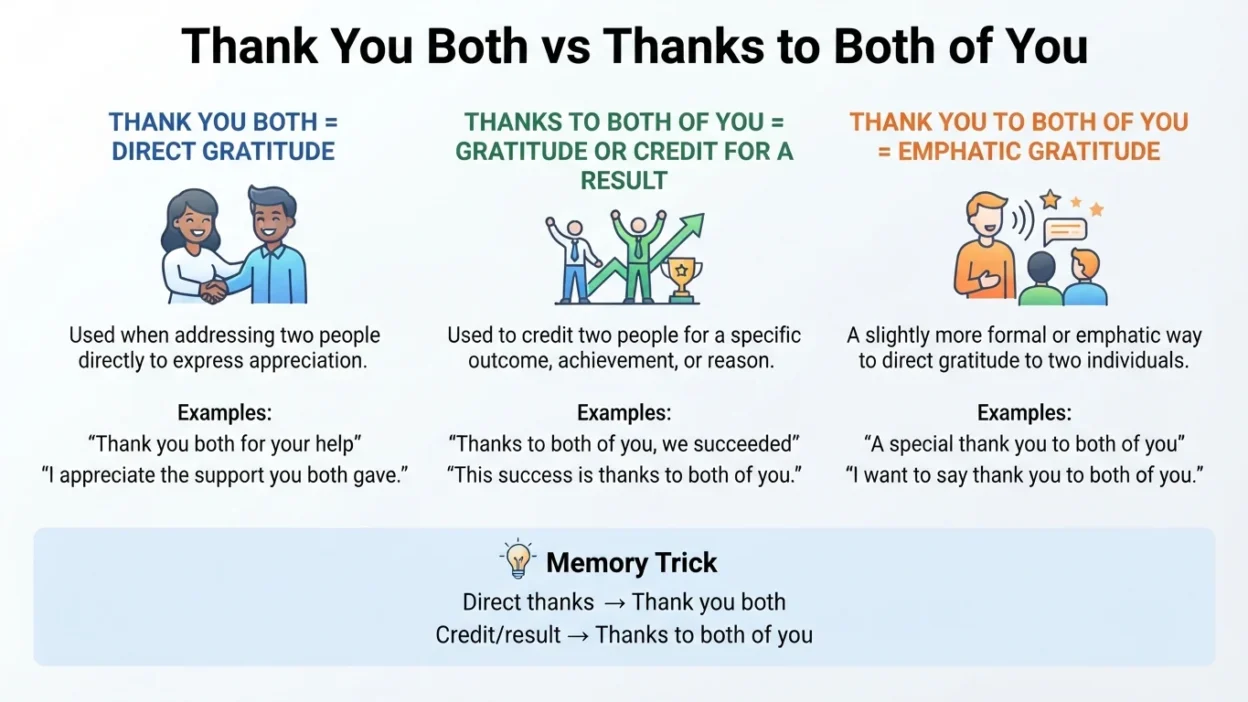
Memory Trick
Here’s the easiest way to remember the difference:
Thank You Both = Direct Thank-You
Think:
I am talking directly to two people.
Thank you both!
Thanks to Both of You = Credit or Cause
Think:
Something happened because of their help.
Thanks to both of you, we succeeded.
So remember:
Thank you both → gratitude
Thanks to both of you → gratitude or contribution/result
American vs British English
There is no significant difference between American and British English in the use of these expressions.
Both American and British speakers naturally use:
Thank you both for your help.
and:
Thanks to both of you for your help.
The choice depends more on context, tone, and sentence structure than on regional English.
In both varieties, “Thank you both” is particularly natural when directly addressing two people.
Similar Expressions
There are several other natural ways to thank two people.
Thank you both
Simple and natural.
Thank you both for your support.
Thank you to both of you
Slightly more emphatic.
Thank you to both of you for everything.
Thanks, both of you
Informal and conversational.
Thanks, both of you! I really appreciate it.
I appreciate you both
Warm and personal.
I really appreciate you both for being there.
I’m grateful to both of you
More heartfelt or formal.
I’m truly grateful to both of you.
Many thanks to both of you
Polite and slightly formal.
Many thanks to both of you for your assistance.
FAQs
Is “thank you both” correct?
Yes. Thank you both is grammatically correct and is one of the most natural ways to thank two people directly.
Is “thanks to both of you” correct?
Yes. It can directly express gratitude, and it can also emphasize that something happened because of the two people’s help or contribution.
Which is more natural: “thank you both” or “thanks to both of you”?
For a direct thank-you, thank you both is generally more natural and concise.
Can I say “thank you to both of you”?
Yes. Thank you to both of you is correct and can sound slightly more emphatic than thank you both.
Is “thanks to both of you” formal?
It can be used in both formal and informal contexts. However, when thanks to means “because of,” it may sound more conversational depending on the sentence.
Can I say “thank you both of you”?
No, not in standard usage as a direct expression.
Use:
✅ Thank you both.
or:
✅ Thank you to both of you.
Can “thanks to” mean “because of”?
Yes. For example:
Thanks to both of you, we completed the project.
This means the two people’s help contributed to the successful result.
Final Verdict
Both “Thank you both” and “Thanks to both of you” are correct, but “Thank you both” is usually the best choice when you simply want to thank two people directly. It is concise, natural, polite, and works in almost any situation.
Use “Thanks to both of you” when you want to thank two people or emphasize that their actions contributed to a particular result. If you want to emphasize the people even more, “Thank you to both of you” is also perfectly acceptable.
Remember This
Thank you both = direct gratitude
Thank you both for your help.
Thanks to both of you = gratitude or credit for a result
Thanks to both of you, we succeeded.
Thank you to both of you = emphatic/direct gratitude
Thank you to both of you for your support.
The easiest rule:
Just thanking two people? → “Thank you both.”
Giving them credit for a result? → “Thanks to both of you.”
Conclusion
Choosing between “Thank you both” and “Thanks to both of you” is mostly a matter of context rather than correctness. Both expressions are grammatically acceptable, but “Thank you both” is generally the simplest and most natural choice when you are directly expressing gratitude to two people.
When you want to highlight how their help contributed to an outcome, “Thanks to both of you” can be especially useful. And when you want a little more emphasis, “Thank you to both of you” is another natural option. Once you understand this small difference, you’ll be able to choose the right expression confidently in conversations, emails, messages, and professional writing.

A passionate linguist who specializes in word relationships and vocabulary building.
He has spent years studying synonyms and semantic patterns across languages.
Arman writes to make language learning simple, precise, and engaging.