The words too and to are among the most commonly confused words in English. They sound exactly the same in many varieties of English, but they have completely different meanings and grammatical functions. Because they are homophones, even experienced writers can occasionally mistype one for the other. Understanding when to use too and to will make your writing clearer and help you avoid one of the most common English grammar and spelling mistakes.
To is usually used as a preposition or as part of an infinitive, such as to eat, to study, or to learn. Too has two main meanings: it can mean also/as well, or it can mean more than is desirable or necessary, as in too expensive or too difficult. Once you recognize these different functions, choosing between too vs to becomes much easier.
Quick Answer
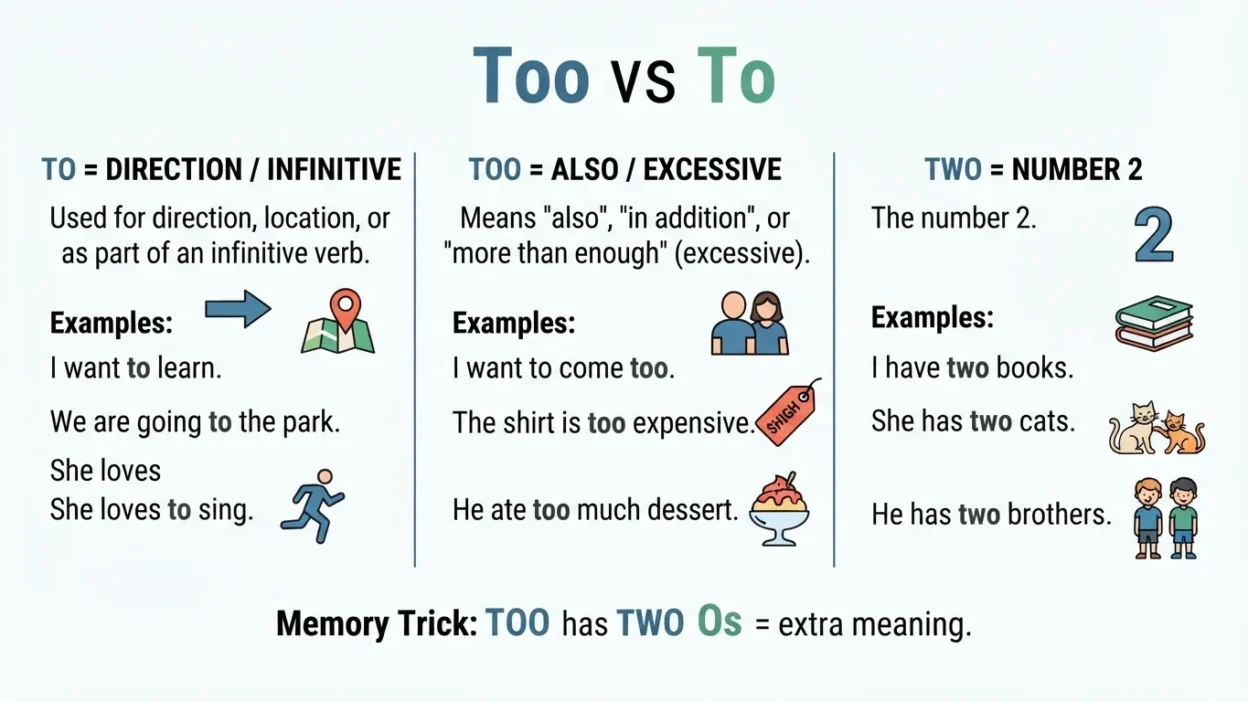
To is used for direction, relationships, and infinitive verbs, while too means also or more than necessary. For example, “I want to go too” uses both correctly: to go and too = also.
Why People Confuse Them
The biggest reason people confuse to and too is that they are pronounced the same in normal speech.
They are homophones—words that sound alike but have different meanings and spellings.
Compare:
- to → I want to leave.
- too → I want to leave too.
The extra o in too is your visual clue that it has an additional meaning.
A useful way to think about them is:
To = direction, connection, or verb
Too = also or excessively
To: Meaning and Usage
To is one of the most frequently used words in English. It has several grammatical functions, but two are especially important.
1. “To” before a verb
Use to before the base form of a verb to create an infinitive.
Examples:
- to eat
- to sleep
- to work
- to learn
- to write
- to understand
Example:
I want to learn English.
She needs to study tonight.
They decided to leave early.
2. “To” for direction or relationship
Use to when showing movement toward a place or a relationship between things.
I went to school.
She walked to the store.
Give the book to me.
He spoke to his teacher.
In these cases, to does not mean “also” or “excessively.”
Too: Meaning and Usage
Too has two main meanings.
1. Too = Also
When too means also, it indicates that something applies to another person or thing as well.
Examples:
I like coffee too.
She is coming too.
I want to go too.
He speaks Spanish too.
In these sentences, too can usually be replaced by also.
I like coffee too.
= I also like coffee.
2. Too = More Than Necessary
Too can also mean excessively or more than is desirable, appropriate, or necessary.
Examples:
The bag is too heavy.
This coffee is too hot.
The movie was too long.
He is driving too fast.
The question is too difficult.
Here, too suggests that something exceeds a desirable limit.
Comparison Table
| Word | Main Function | Meaning | Example |
|---|---|---|---|
| To | Preposition / infinitive marker | Direction, connection, or before a verb | I want to learn. |
| Too | Adverb | Also | I want to go too. |
| Too | Adverb | Excessively / more than necessary | It is too expensive. |
When to Use “To”
Use to when:
Showing movement
We went to the park.
Showing a recipient
Give this letter to Sarah.
Connecting people or things
She spoke to her manager.
Before an infinitive
I want to sleep.
He needs to work.
They decided to stay.
Expressing a range
The store is open from Monday to Friday.
When to Use “Too”
Use too when you mean also.
Can I come too?
You can replace it with also:
Can I come also?
Although the second version sounds less natural in everyday English, the meaning is clear.
Use too when something is excessive.
The shirt is too expensive.
The room is too small.
You’re walking too slowly.
Examples: Too vs To
- I want to learn English too.
- She went to the market too.
- I have to finish my homework.
- This bag is too heavy.
- He wants to come too.
- The water is too cold.
- We need to talk to the manager.
- She is too tired to work.
- I went to the restaurant, too.
- It is too late to call him.
- They decided to invite us too.
- The shoes are too expensive for me.
- He likes football too.
- I need to speak to you.
- She was too busy to attend.
Notice that a single sentence can contain both words:
I want to go to the party too.
The first to is connected to the verb go, while too means also.
Common Mistakes
Mistake 1: “I want too go”
❌ I want too go.
✅ I want to go.
Before a base verb, use to.
Mistake 2: “Me to”
❌ I like it to.
If you mean also, use:
✅ I like it too.
Mistake 3: “Too expensive to buy”
Some learners become confused when both words appear together.
But this is correct:
The car is too expensive to buy.
Here:
- too = excessively
- to buy = infinitive
Mistake 4: “To much”
❌ This is to much.
✅ This is too much.
Because too means more than necessary.
Mistake 5: “To many”
❌ There are to many people here.
✅ There are too many people here.
Use too many for an excessive number.
Memory Trick
Here’s an easy trick:
TO = One O
Think:
TO = movement or action
go to school
want to learn
TOO = Two Os
Think:
TOO has TWO Os.
It has an extra O because it has an extra meaning:
TOO = ALSO
or
TOO = EXCESSIVE
So remember:
Too has two Os and means “also” or “more than enough.”
American vs British English
There is no significant difference between American and British English in the spelling or basic usage of to and too.
Both varieties use:
I want to go too.
The pronunciation may vary slightly depending on the sentence and speaker, but the spelling and fundamental grammar rules remain the same.
Similar Words
Also
Also usually means too/as well.
I also like chocolate.
I like chocolate too.
As well
Another way to mean too/also, especially common in British English.
I like chocolate as well.
Excessively
A more formal word related to one meaning of too.
The price is excessively high.
Toward
Toward can sometimes express direction, similar to one use of to.
She walked toward the door.
However, toward and to are not always interchangeable.
Two
Two is the number 2.
I have two books.
This is another homophone that is often confused with to and too.
To vs Too vs Two
Don’t forget that there are actually three commonly confused words:
| Word | Meaning | Example |
|---|---|---|
| To | Direction / infinitive | I want to go. |
| Too | Also / excessively | I want to go too. |
| Two | Number 2 | I have two tickets. |
Easy memory trick
To = direction/action
Too = also/excessive
Two = number
FAQs
Is it “to” or “too”?
It depends on the meaning. Use to for direction, relationships, or before an infinitive. Use too for also or more than necessary.
Is “I want to go too” correct?
Yes. It correctly uses both words:
I want to go too.
The first to introduces the infinitive go, while too means also.
Is “too” always an adverb?
In standard modern English, too is primarily used as an adverb, especially meaning also or excessively.
How do I remember to vs too?
Remember that too has two Os. Think two Os = extra, which connects with its meanings also and excessively.
Is “too much” correct?
Yes.
There is too much sugar in this tea.
It means there is more sugar than desirable or necessary.
Is “to much” correct?
No, when you mean excessive quantity. The correct expression is:
✅ too much
What is the difference between “too” and “also”?
Both can mean also, but their position in a sentence can differ.
I also like tea.
I like tea too.
What is the difference between “to” and “two”?
To is used for direction or infinitives, while two is the number 2.
I went to the store.
I bought two apples.
Final Verdict
The difference between too vs to is simple once you focus on their functions. To is generally used for direction, relationships, or before a verb in the infinitive form. Too means also or more than necessary.
Remember that too has two Os. That extra o can remind you of its extra meanings: also and excessively. And don’t forget two, the number 2, which sounds the same but has a completely different meaning.
Remember This
TO
Use for:
- Direction → go to school
- Infinitive → want to learn
- Relationship → speak to me
TOO
Use for:
- Also → I want to come too.
- Excessively → It’s too expensive.
TWO
Use for:
- Number 2 → I have two books.
Easy rule:
TO = direction/action
TOO = also/excessive
TWO = number 2
Conclusion
Although to and too sound alike, they have different grammatical roles and meanings. To is one of the most important words in English and is used for direction, relationships, and infinitive verbs. Too is used when you mean also or when something is more than necessary or desirable.
The easiest way to avoid confusion is to ask yourself what you mean. If you’re talking about going somewhere or doing something, you probably need to. If you mean also or excessively, choose too. And if you’re talking about the number 2, use two. Once you learn this simple distinction, one of the most common English homophone mistakes becomes much easier to avoid.

A passionate linguist who specializes in word relationships and vocabulary building.
He has spent years studying synonyms and semantic patterns across languages.
Arman writes to make language learning simple, precise, and engaging.