If you are wondering whether the correct spelling is targeted or targetted, the answer depends slightly on English spelling conventions—but there is a clear standard form you should use. This is a common spelling confusion because verbs ending in -et can sometimes double their final consonant when forming the past tense or present participle.
The standard spelling is targeted in both American and British English. Targetted is generally considered an incorrect or nonstandard spelling in modern English. The word targeted means directed toward a particular person, group, goal, audience, or purpose. In this article, we’ll explain the difference, provide examples, discuss common mistakes, and give you an easy memory trick.
Quick Answer
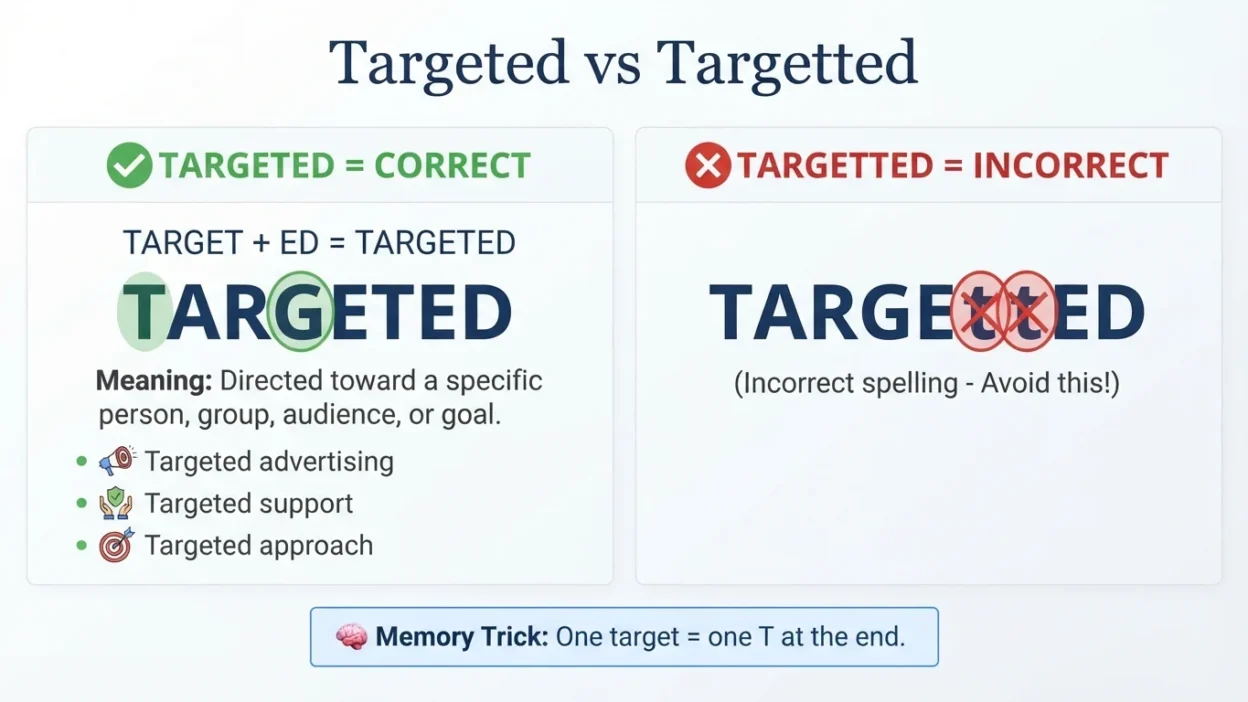
Targeted is the correct standard spelling. Targetted is generally considered incorrect. Use targeted when something is specifically directed toward a person, group, audience, goal, or objective.
Why People Confuse It
The confusion comes from the spelling rule for verbs ending in a consonant-vowel-consonant pattern.
For some short verbs, the final consonant doubles before adding -ed:
- stop → stopped
- plan → planned
- admit → admitted
This can make people think:
target → targetted
But target does not follow that doubling pattern.
The correct form is:
target → targeted
Not:
target → targetted
Targeted: Meaning and Usage
Targeted is the past tense and past participle of target. It can also function as an adjective.
It means directed toward a particular person, group, audience, place, problem, or objective.
For example:
The company launched a targeted advertising campaign.
This means the advertising was designed specifically for a particular audience.
Common contexts
You may see targeted in:
- Marketing
- Advertising
- Education
- Healthcare
- Business
- Cybersecurity
- Research
- Communication
- Politics
- Social media
Targetted: Is It Correct?
Targetted is generally considered a misspelling in modern standard English.
Use:
✅ targeted
Avoid:
❌ targetted
For example:
❌ The campaign targeted young customers with targetted ads.
✅ The campaign targeted young customers with targeted ads.
Comparison Table
| Word | Correct? | Meaning | Example |
|---|---|---|---|
| Targeted | ✅ Yes | Directed toward a specific person, group, or goal | The campaign targeted young adults. |
| Targetted | ❌ Generally incorrect | Nonstandard spelling of “targeted” | Avoid this spelling. |
When to Use “Targeted”
Use targeted when something is deliberately directed toward a specific target.
Targeted advertising
The company uses targeted advertising to reach specific customers.
Targeted marketing
The brand created a targeted marketing campaign.
Targeted audience
The content was designed for a targeted audience.
Targeted treatment
The researchers are developing targeted treatment approaches.
Targeted approach
We need a more targeted approach to solve the problem.
Targeted communication
The organization sent targeted communication to its members.
Examples: Targeted vs Targetted
- The advertisement targeted younger customers.
- The campaign used targeted advertising.
- The company developed a targeted marketing strategy.
- The message was targeted at a specific audience.
- The program provides targeted support for students.
- The researchers used a targeted approach.
- The organization launched a targeted campaign.
- The content was specifically targeted toward beginners.
- The company targeted customers in major cities.
- The government introduced targeted measures to address the issue.
- The training was targeted at new employees.
- The campaign successfully targeted its intended audience.
Common Mistakes
Mistake 1: Adding an extra “t”
❌ targetted
✅ targeted
There is only one t after the e:
target + ed = targeted
Mistake 2: Applying the wrong doubling rule
Compare:
plan → planned
stop → stopped
But:
target → targeted
The final t in target is not doubled.
Mistake 3: Confusing “targeted” with “targeting”
The correct forms are:
- target
- targets
- targeted
- targeting
Examples:
The company targeted students.
The company is targeting students.
Not:
❌ targetted
❌ targetting
Memory Trick
Here’s an easy way to remember it:
Target + ED = Targeted
Simply add -ed:
TARGET + ED → TARGETED
Don’t double the t.
You can remember:
One target, one T.
The word target already has its final t, and you don’t need another one when adding -ed.
Word family
Target → Targeted → Targeting → Targeting strategy
Notice that the spelling stays simple.
American vs British English
Unlike some words where American and British spelling differs, targeted is normally spelled the same way in both varieties of English.
American English
The campaign targeted young consumers.
British English
The campaign targeted young consumers.
Both use:
✅ targeted
The spelling targetted is not the standard form simply because British English is being used.
Similar Words
Here are several words related to targeted:
Focused
Directed attention toward something specific.
The team took a focused approach.
Directed
Aimed toward a particular person or purpose.
The campaign was directed at young adults.
Aimed
Intended for a particular purpose or audience.
The advertisement was aimed at students.
Specific
Clearly defined or particular.
We need a specific strategy.
Tailored
Designed specifically for a particular person or group.
The course offers tailored lessons for beginners.
Targeting
The present participle of target.
The company is targeting a younger audience.
FAQs
Is it targeted or targetted?
Targeted is the correct standard spelling. Targetted is generally incorrect.
Is targetted ever acceptable?
You may occasionally encounter targetted as a spelling variant or error, but targeted is the standard form and is the best choice for modern formal English.
Why isn’t the T doubled in targeted?
The verb target does not follow the spelling pattern that requires doubling the final consonant before -ed. The standard form is simply targeted.
Is “targetting” correct?
No, in standard English the correct spelling is targeting, with one t.
Is targeted the same in American and British English?
Yes. Targeted is the standard spelling in both American and British English.
What does targeted mean?
Targeted means directed toward a specific person, group, audience, goal, or problem.
What is the noun form of targeted?
The noun is target.
The company identified its target audience.
Final Verdict
The correct spelling is targeted, not targetted. Although doubling the final consonant is correct for some English verbs, target does not require an extra t when forming the past tense or past participle.
So remember:
✅ target → targeted
✅ target → targeting
❌ target → targetted
❌ target → targetting
Remember This
TARGET + ED = TARGETED
Think:
One target → one T at the end.
Correct:
Targeted
Incorrect:
Targetted
And remember that targeted is standard in both American and British English.
Conclusion
The targeted vs targetted confusion is easy to solve once you remember that target does not double its final t when adding -ed. The standard spelling is targeted, and it is used to describe something directed toward a specific person, group, audience, purpose, or objective.
Whether you’re writing about targeted advertising, targeted marketing, targeted support, or a targeted approach, always use targeted. If you’re unsure, simply remember the basic spelling rule: target + ed = targeted. This will help you avoid the common targetted mistake in academic, professional, and everyday English.

A passionate linguist who specializes in word relationships and vocabulary building.
He has spent years studying synonyms and semantic patterns across languages.
Arman writes to make language learning simple, precise, and engaging.