Bespeckled and bespectacled look and sound surprisingly similar, but they describe two very different things. Because both words begin with bespec- and contain similar letters, English learners and writers can easily mix them up. However, their meanings have nothing to do with each other.
Bespeckled describes something covered or marked with small spots, speckles, or scattered marks. Bespectacled, on the other hand, describes a person who is wearing eyeglasses. Knowing the difference is especially useful when describing people, objects, clothing, surfaces, or appearances. In this guide, we’ll explain both words in simple English, show clear examples, compare their meanings, and give you an easy memory trick so you never confuse them again.
Quick Answer
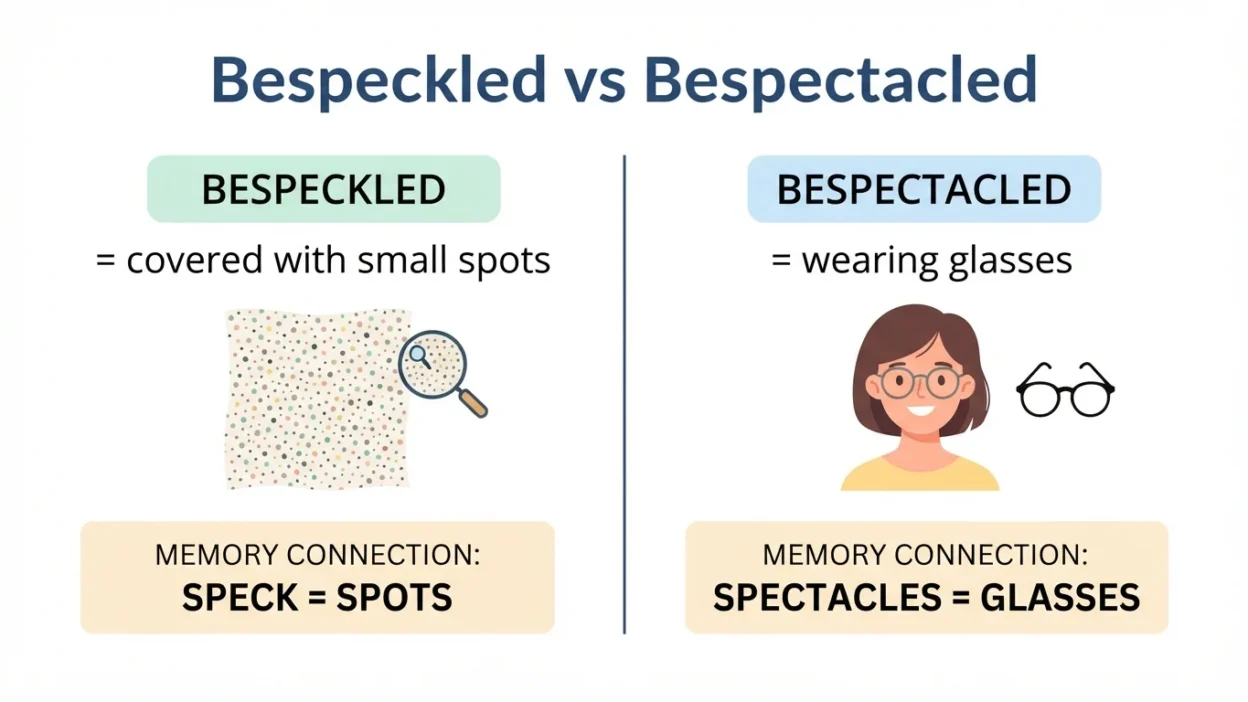
Bespeckled means covered with small spots, speckles, or marks.
Bespectacled means wearing glasses or spectacles.
Examples:
- The bespeckled fabric was covered with tiny dots.
- The bespectacled teacher entered the classroom.
Easy rule:
Bespeckled → spots
Bespectacled → spectacles (glasses)
Why Do People Confuse Bespeckled and Bespectacled?
The main reason is their similar spelling.
Both words begin with “bespec-”, but they come from different words:
- bespeckled comes from speckle
- bespectacled comes from spectacles
A speckle is a small spot or mark.
Spectacles is another word for eyeglasses.
Therefore:
Bespeckled = covered in speckles
Bespectacled = wearing spectacles
The easiest way to distinguish them is to focus on the word hidden inside each one.
What Does “Bespeckled” Mean?
Bespeckled is an adjective meaning covered with small spots, dots, or scattered marks.
The spots can be natural or accidental. The word can describe skin, clothing, paper, walls, leaves, surfaces, objects, and many other things.
Examples
Her face was bespeckled with freckles.
The old wall was bespeckled with dark stains.
The fabric was bespeckled with tiny blue dots.
The leaves were bespeckled with drops of rain.
His shirt was bespeckled with paint.
The word often creates a visual image of something having many small marks scattered across it.
What Does “Bespectacled” Mean?
Bespectacled is an adjective meaning wearing glasses.
It comes from spectacles, an older or more formal word for eyeglasses.
For example:
The bespectacled man was reading a newspaper.
This means:
The man was wearing glasses.
The word is often used when describing a person’s appearance.
Examples
- a bespectacled professor
- a bespectacled student
- a bespectacled writer
- a bespectacled scientist
- a bespectacled woman
- a bespectacled man
It can sound somewhat literary or descriptive compared with simply saying “wearing glasses.”
Comparison Table
| Word | Meaning | Comes From | Example |
|---|---|---|---|
| Bespeckled | Covered with small spots or marks | Speckle | The wall was bespeckled with stains. |
| Bespectacled | Wearing eyeglasses | Spectacles | The bespectacled professor smiled. |
| Speckled | Marked with small spots | Speckle | The bird had speckled feathers. |
| Spectacled | Wearing or associated with spectacles | Spectacles | The spectacled man entered the room. |
Bespeckled: Meaning and Usage
Use bespeckled when you are talking about spots, dots, marks, or scattered particles.
It can be followed by with when you want to identify what created the spots.
Common patterns
bespeckled with + noun
Examples:
- bespeckled with paint
- bespeckled with mud
- bespeckled with stars
- bespeckled with freckles
- bespeckled with dust
- bespeckled with stains
- bespeckled with snow
Example Sentences
- The artist’s hands were bespeckled with paint.
- The night sky was bespeckled with stars.
- Her face was bespeckled with freckles.
- The old book was bespeckled with dust.
- The white dress was bespeckled with tiny flowers.
- The window was bespeckled with raindrops.
- The wall was bespeckled with dark marks.
- The bird had bespeckled feathers.
- The road was bespeckled with puddles.
- His shoes were bespeckled with mud.
Bespectacled: Meaning and Usage
Use bespectacled when describing someone who wears glasses.
It is especially common in descriptive writing.
Common patterns
bespectacled + person
Examples:
- bespectacled man
- bespectacled woman
- bespectacled boy
- bespectacled girl
- bespectacled teacher
- bespectacled professor
- bespectacled scientist
- bespectacled author
Example Sentences
- The bespectacled professor began the lecture.
- A bespectacled student raised her hand.
- The bespectacled scientist examined the results.
- The bespectacled writer sat at the desk.
- I spoke to a bespectacled man at the library.
- The bespectacled teacher explained the lesson.
- A bespectacled woman entered the office.
- The novel features a bespectacled detective.
- The bespectacled researcher reviewed the documents.
- A bespectacled child was sitting in the front row.
What Is the Difference Between Bespeckled and Bespectacled?
The simplest distinction is:
Bespeckled = Has Spots
Something that is bespeckled has small spots or marks on it.
The paper was bespeckled with ink.
Bespectacled = Has Glasses
Someone who is bespectacled is wearing eyeglasses.
The bespectacled man was reading.
Notice the hidden words:
SPECK → SPOTS
SPECTACLES → GLASSES
That’s the key difference.
Common Mistakes
Mistake 1: Using “Bespeckled” for Someone Wearing Glasses
❌ The bespeckled professor was wearing glasses.
This technically describes someone covered in small spots, not someone simply wearing glasses.
If your intended meaning is that the professor wears glasses, write:
✅ The bespectacled professor was teaching the class.
Mistake 2: Using “Bespectacled” for a Spotted Surface
❌ The wall was bespectacled with stains.
That is incorrect because spectacles are glasses.
The correct word is:
✅ The wall was bespeckled with stains.
Mistake 3: Confusing the Roots
Remember:
speckle → bespeckled
spectacles → bespectacled
Looking at the root word usually makes the difference obvious.
Bespeckled vs Speckled
Bespeckled and speckled are closely related.
Both can mean covered with small spots or marks.
Examples:
The bird had speckled feathers.
The bird had bespeckled feathers.
However, speckled is generally more common and straightforward in everyday English, while bespeckled can have a more descriptive or literary feel.
For example:
The sky was speckled with stars.
and:
The sky was bespeckled with stars.
Both can work, although the second sounds more literary.
Bespectacled vs Spectacled
Bespectacled and spectacled are related.
Both can refer to someone wearing spectacles or glasses.
Bespectacled is often used specifically as a descriptive adjective for a person:
The bespectacled professor smiled.
Spectacled can also be used in descriptions and compounds, such as:
a spectacled man
It can also occur in names for animals, such as spectacled bear, where “spectacled” refers to markings around the eyes that resemble spectacles.
Memory Trick
Here’s the easiest way to remember the difference:
BESPECKLED → SPECK
Think:
Speck = small spot
So:
Bespeckled = covered in spots
BESPECTACLED → SPECTACLES
Think:
Spectacles = glasses
So:
Bespectacled = wearing glasses
One-Line Memory Trick
Specks are spots; spectacles are glasses.
Therefore:
Bespeckled = spots
Bespectacled = glasses
When to Use Each
| If you mean… | Use |
|---|---|
| Covered with tiny spots | Bespeckled |
| Marked with dots | Bespeckled |
| Covered with stains | Bespeckled |
| Covered with paint spots | Bespeckled |
| Wearing eyeglasses | Bespectacled |
| Wearing spectacles | Bespectacled |
| A person with glasses | Bespectacled |
| A professor wearing glasses | Bespectacled |
Examples Side by Side
Bespeckled
The artist’s apron was bespeckled with paint.
Meaning: The apron had many small paint marks on it.
Bespectacled
The artist was bespectacled.
Meaning: The artist was wearing glasses.
Another Pair
The wall was bespeckled with dust.
The wall had small spots or particles of dust.
The bespectacled teacher entered the classroom.
The teacher was wearing glasses.
American vs British English
There is no major American-versus-British spelling difference between bespeckled and bespectacled.
Both forms are recognized in both varieties of English.
However, bespectacled may sound somewhat formal or literary in everyday conversation. Many speakers would simply say:
He is wearing glasses.
instead of:
He is bespectacled.
Likewise, speckled is often more common in everyday descriptions than bespeckled.
Similar Words
Speckled
Covered with small spots or marks.
The egg had a speckled shell.
Spotted
Marked with spots.
The dog has spotted fur.
Flecked
Marked with small patches or particles.
The stone was flecked with gold.
Dappled
Marked with patches of light, shade, or color.
Sunlight dappled the forest floor.
Stained
Marked or discolored by a substance.
The shirt was stained with coffee.
Eyeglass-wearing
A straightforward phrase meaning someone who wears glasses.
She is an eyeglass-wearing professor.
Spectacled
Wearing spectacles or having markings resembling spectacles.
The spectacled bear is native to South America.
Frequently Asked Questions
Is “bespeckled” a real word?
Yes. Bespeckled is a standard English adjective meaning covered with small spots, speckles, or marks.
What does “bespectacled” mean?
Bespectacled means wearing glasses or spectacles. It is commonly used as a descriptive adjective for people.
Is bespeckled the same as speckled?
They are closely related. Both describe something marked with small spots. Speckled is generally more common in everyday English, while bespeckled can sound more literary or descriptive.
Is bespectacled the same as wearing glasses?
Yes. Bespectacled means that a person is wearing glasses or spectacles.
How can I remember bespeckled vs bespectacled?
Think of the root words:
speck → spot → bespeckled
spectacles → glasses → bespectacled
Can I use bespeckled for a person?
Yes, if you mean the person is covered or marked with small spots.
For example:
His face was bespeckled with freckles.
But if you mean he wears glasses, use bespectacled.
Is “bespectacled” formal?
It can sound somewhat formal, literary, or descriptive. In everyday conversation, wearing glasses is usually more natural.
Which word means “covered with spots”?
Bespeckled means covered with small spots, speckles, or marks.
Final Verdict
Bespeckled and bespectacled are both correct English words, but they should not be used interchangeably.
Bespeckled means covered with small spots or marks.
The fabric was bespeckled with paint.
Bespectacled means wearing glasses.
The bespectacled professor entered the room.
The easiest way to remember the difference is to look at their roots:
SPECK → SPOTS → BESPECKLED
SPECTACLES → GLASSES → BESPECTACLED
Once you remember those two connections, the spelling and meaning become much easier.
Conclusion
The difference between bespeckled and bespectacled comes down to two completely different root words. Bespeckled is connected to speck, meaning a small spot or mark, so it describes something covered with spots, dots, or scattered marks. Bespectacled is connected to spectacles, meaning eyeglasses, so it describes a person who is wearing glasses.
Although the words look very similar, their meanings are easy to separate once you focus on the middle of each word. If you’re describing spots, think “speck.” If you’re describing glasses, think “spectacles.” This simple distinction will help you use both words accurately in essays, articles, creative writing, and everyday English.
Remember This
Bespeckled = covered with spots.
Bespectacled = wearing glasses.
SPECK → SPOTS
SPECTACLES → GLASSES

A creative writer with a deep interest in word usage and meaning.
He explores synonyms to enhance both academic and creative expression.
Zayn’s work aims to make language richer and more accessible for everyone.