Should you say “any problem” or “any problems”? Both expressions can be grammatically correct, but they are used in slightly different situations. The choice depends on whether you are talking about one problem as a general possibility or multiple problems.
This distinction is especially common in questions such as “Do you have any problem?” and “Do you have any problems?” In everyday English, “any problems” is often more natural when asking whether someone has difficulties or concerns, while “any problem” is common when referring to a general or particular type of problem. Understanding how any works with singular and plural nouns will help you choose the most natural expression.
Quick Answer
Both “any problem” and “any problems” can be correct.
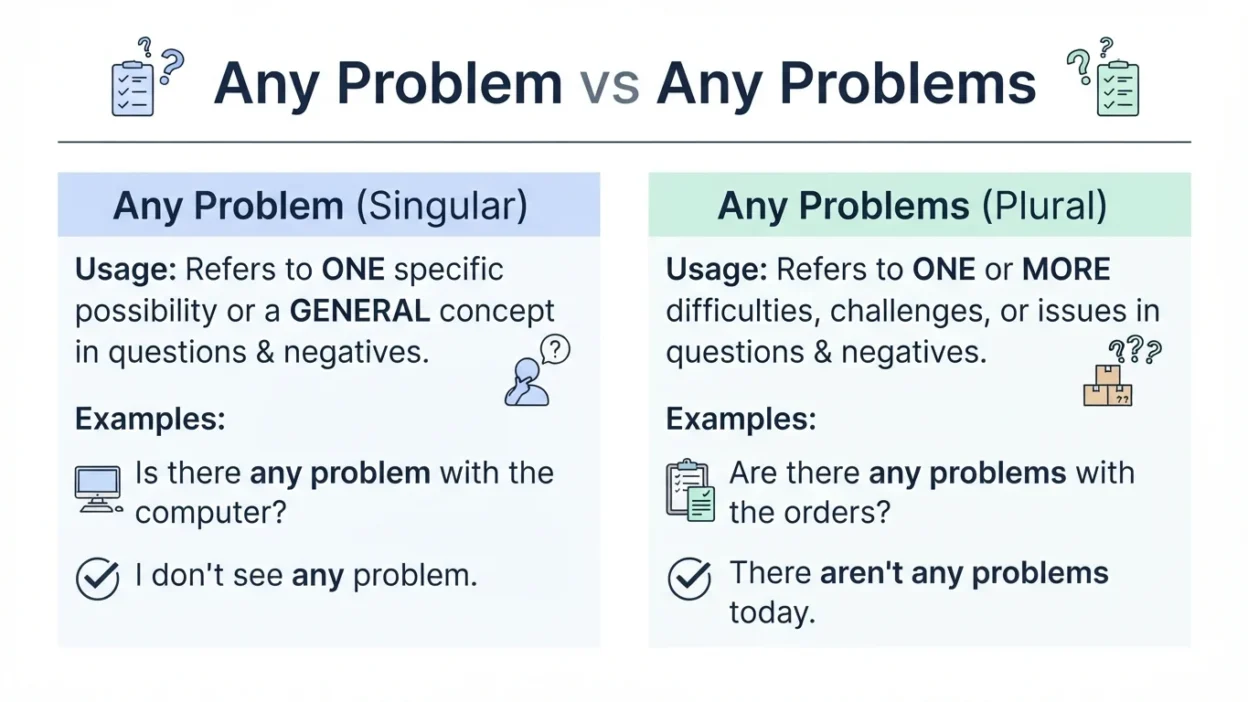
- Any problem = one problem or a problem in general.
- Any problems = one or more problems, usually emphasizing possible multiple issues.
For everyday questions about difficulties, “Do you have any problems?” is usually more natural. But “Is there any problem?” is also common when asking whether there is a problem at all.
Why Do People Confuse “Any Problem” and “Any Problems”?
The confusion comes from the word any.
Any can be used with:
- singular countable nouns
- plural countable nouns
- uncountable nouns
For example:
- Is there any problem?
- Are there any problems?
- Is there any water?
The noun that follows any determines whether you need a singular, plural, or uncountable form.
With problem, both singular and plural forms are possible because problem is a countable noun.
Any Problem
“Any problem” uses the singular countable noun problem.
It is commonly used when you mean:
- a problem of any kind
- one possible problem
- a particular problem
- a problem in general
Examples
- Is there any problem with the plan?
- Did you have any problem finding the address?
- If you have any problem, call me.
- I don’t think there is any problem.
- Will there be any problem if I arrive late?
The expression “any problem” is particularly common after there is, if you have, and similar structures.
Any Problems
“Any problems” uses the plural noun problems.
It usually refers to:
- one or more problems
- multiple possible difficulties
- several issues or concerns
Examples
- Are you having any problems?
- Did you have any problems with the software?
- Are there any problems with the car?
- Let me know if you have any problems.
- Did you experience any problems during the trip?
This form is especially natural when asking about someone’s experience or whether anything went wrong.
Comparison Table
| Expression | Meaning | Common Use | Example |
|---|---|---|---|
| Any problem | A problem of any kind / one possible problem | General or singular possibility | Is there any problem? |
| Any problems | One or more problems | Multiple possible issues | Are there any problems? |
| No problem | No difficulty | Fixed expression | No problem! |
| No problems | No difficulties/issues | Multiple issues | We had no problems. |
When to Use “Any Problem”
Use any problem when you are treating problem as one general possibility.
Example 1
Is there any problem with this arrangement?
You are asking whether there is a problem at all.
Example 2
If you have any problem, contact me.
This means if you experience a problem of any kind.
Example 3
Would there be any problem if I changed the date?
You are asking about one possible difficulty resulting from the change.
Example 4
I don’t see any problem with your idea.
Here, “any problem” means any objection or difficulty.
When to Use “Any Problems”
Use any problems when you are thinking about one or more possible problems.
Example 1
Are you having any problems with your computer?
This sounds natural because a computer could have several different issues.
Example 2
Did you have any problems during the journey?
This asks whether any difficulties occurred.
Example 3
Are there any problems with the document?
There could be spelling, formatting, factual, or other issues.
Example 4
Please tell me if you notice any problems.
This refers to potentially multiple issues.
“Do You Have Any Problem?” vs “Do You Have Any Problems?”
This is one of the most common questions learners have.
Do You Have Any Problems?
“Do you have any problems?” is generally more natural when asking whether someone is experiencing difficulties.
For example:
Do you have any problems with your new computer?
It suggests that there could be one or more difficulties.
Do You Have Any Problem?
“Do you have any problem?” can be grammatically possible, but it often sounds less natural in ordinary conversation when used as a broad question.
A more natural singular version is often:
Do you have a problem?
Or:
Are you having any problems?
The plural form is therefore often preferred for a general question about difficulties.
“Is There Any Problem?” vs “Are There Any Problems?”
Both can work.
Is There Any Problem?
This treats problem as a general possibility.
Is there any problem with the new schedule?
It can also be used in a reassuring or formal context:
Is there any problem if I leave early?
Are There Any Problems?
This focuses on possible issues or difficulties.
Are there any problems with the new schedule?
Both are grammatically valid, but the plural version can sound more natural when you are checking for multiple possible issues.
Common Mistakes
Mistake 1: Using “Any” Only With Plural Nouns
Some learners think any must always be followed by a plural noun.
That is incorrect.
You can say:
Is there any problem?
And:
Are there any problems?
Both are possible.
Mistake 2: Saying “Any Problems” in Every Situation
Plural is not automatically better.
For example:
If you have any problem, call me.
This is perfectly natural when “any problem” means any kind of problem.
Mistake 3: Forgetting That “Problem” Is Countable
Because problem is countable, it can be singular or plural.
Compare:
- a problem
- one problem
- any problem
- problems
- any problems
- many problems
Memory Trick
Use this simple rule:
Any problem → any one problem / any kind of problem
Any problems → one or more problems
Think about the question you are asking.
If you are checking whether a problem exists at all, singular can work:
Is there any problem?
If you are checking for possible difficulties or issues, plural is often natural:
Are there any problems?
American vs British English
Both American and British English use any problem and any problems.
There is no major spelling or grammar difference between the two varieties.
However, everyday conversational preferences can vary depending on context.
For example, both varieties commonly use:
No problem!
This is an extremely common informal expression meaning “That is okay” or “There is no difficulty.”
Similar Expressions
Several related expressions are useful to know.
Any Issue
Do you have any issue with the plan?
Any Issues
Are there any issues with the plan?
Any Difficulty
Did you have any difficulty finding the place?
Any Difficulties
Did you experience any difficulties?
Any Trouble
“Trouble” is generally uncountable in this meaning.
Are you having any trouble?
Not:
Are you having any troubles?
No Problem
No problem! I’ll help you.
No Problems
We had no problems during the trip.
Final Verdict
Both “any problem” and “any problems” are correct, but they are not always interchangeable in natural English.
Use “any problem” when referring to a problem as a general possibility or to any single problem:
Is there any problem with this plan?
Use “any problems” when referring to one or more difficulties or issues:
Are there any problems with this plan?
For everyday questions about whether someone is experiencing difficulties, “any problems” is often the more natural choice.
FAQs
Is “any problem” grammatically correct?
Yes. Any problem is grammatically correct when referring to a problem as a general or singular possibility.
Is “any problems” grammatically correct?
Yes. Any problems is also correct and commonly refers to one or more possible difficulties.
Which is more natural: “any problem” or “any problems”?
It depends on the sentence. When asking generally about difficulties, “any problems” is often more natural. When referring to a problem in general, “any problem” works well.
Should I say “Do you have any problem?” or “Do you have any problems?”
“Do you have any problems?” is generally more natural when asking someone whether they are experiencing difficulties.
Is “Is there any problem?” correct?
Yes. “Is there any problem?” is grammatically correct and commonly asks whether there is a problem at all.
Is “Are there any problems?” correct?
Yes. “Are there any problems?” is very natural when checking for possible issues or difficulties.
Can “any” be used with a singular noun?
Yes. Any can be used with singular countable nouns, plural countable nouns, and uncountable nouns.
Examples:
- any problem
- any problems
- any water
Conclusion
The difference between “any problem” and “any problems” depends mainly on whether you are referring to a general or singular possibility or to one or more possible difficulties. Both forms are grammatically correct, so the choice should be based on the meaning and structure of your sentence.
In everyday English, “any problems” is especially common when asking whether someone has experienced difficulties: “Did you have any problems?” However, “any problem” is completely natural when discussing a problem as a general possibility: “Is there any problem with this?”
Remember This
Any problem = any one problem / a problem of any kind
Any problems = one or more problems
For everyday questions about difficulties, “Do you have any problems?” is usually the more natural choice.

An expert in English grammar and expressive writing techniques.
She focuses on helping readers expand their vocabulary with clarity.
Elina believes the right word can transform ordinary writing into powerful communication.