If you’re wondering whether momma or mama is correct, the answer is that both are real English words, but they differ in spelling, style, and regional usage. Both are affectionate or informal ways of referring to one’s mother, so neither is simply a “wrong spelling” of the other.
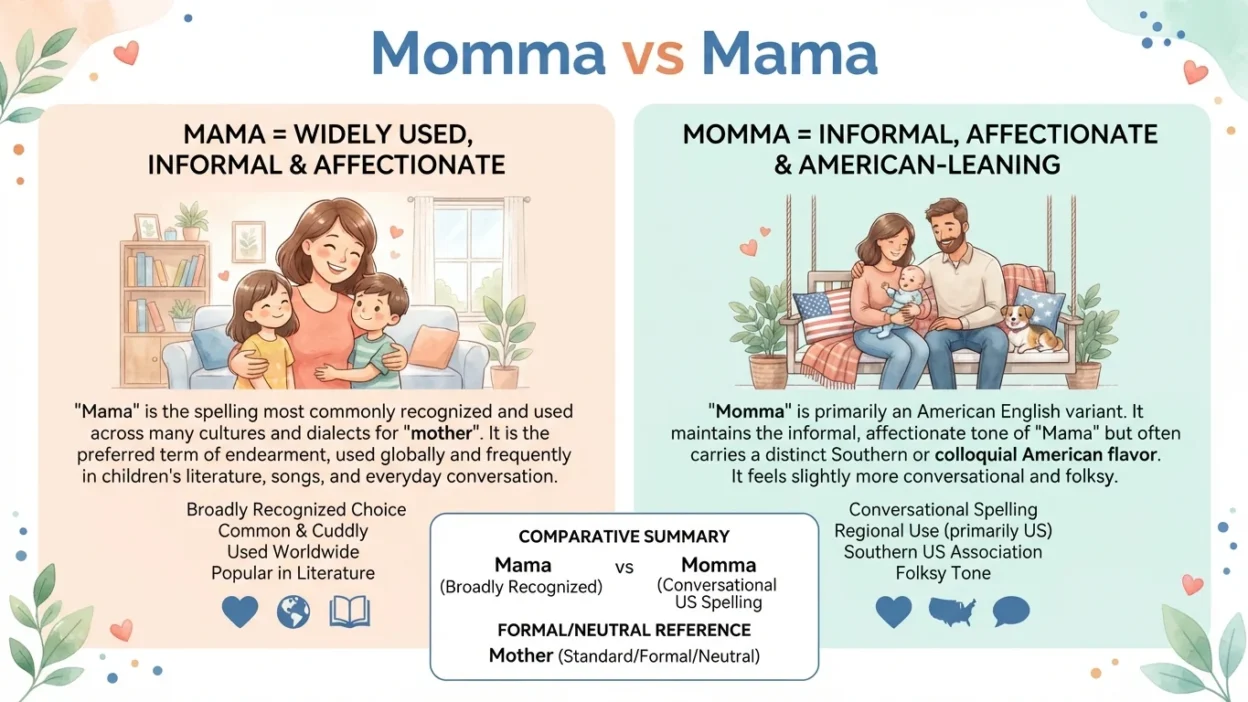
Mama is the more widely recognized and commonly used form across many varieties of English. Momma is also correct, but it is more informal and can have a distinctly American, Southern, or conversational feel. The best choice depends on the tone and context. Below, we’ll explore momma vs mama, their meanings, examples, pronunciation, common usage, and when each word sounds most natural.
Quick Answer
Mama and momma are both correct. Mama is more widely used and generally more neutral, while momma is an affectionate, informal spelling often associated with American English and family speech.
Why People Confuse It
The two words sound very similar, and both are used to mean mother.
The main difference is spelling:
- Mama → shorter and more common internationally
- Momma → informal variant with an extra m
Neither word is inherently incorrect.
However, mama is usually the safer choice if you’re writing for a broad English-speaking audience.
Mama: Meaning and Usage
Mama is an informal and affectionate word for mother.
It is especially common in:
- Family conversations
- Children’s speech
- Informal writing
- Songs and stories
- Affectionate expressions
Examples:
Mama, can you help me?
I love you, Mama.
My mama taught me how to cook.
Mama is also widely used in different cultures and languages, although its exact pronunciation and cultural associations can vary.
Momma: Meaning and Usage
Momma also means mother and is generally used in an affectionate or informal way.
It is especially associated with American English, including casual and family speech.
Examples:
Momma, look what I made!
I miss my momma.
Her momma always supported her.
The spelling momma can sound warmer, more colloquial, or more personal depending on the context.
It is also common in dialogue, songs, fictional writing, and expressions designed to reproduce natural speech.
Comparison Table
| Word | Correct? | Meaning | Style | Common Usage |
|---|---|---|---|---|
| Mama | ✅ Yes | Mother | Informal, affectionate | Broad/international use |
| Momma | ✅ Yes | Mother | Informal, affectionate | Especially American/conversational |
When to Use Each
Use “Mama” when:
You want a simple, familiar, and widely understood term for mother.
I called Mama after work.
Mama made dinner for us.
She is very close to her mama.
It is also a good choice when writing for an international audience.
Use “Momma” when:
You want a more conversational, affectionate, or distinctly American tone.
Momma always knew what to say.
The little boy ran to his momma.
She wanted to make her momma proud.
Momma can be particularly effective in dialogue or creative writing when you want the character’s speech to feel natural.
Examples: Mama vs Momma
- Mama, can you help me?
- I called my mama yesterday.
- Her mama taught her to bake.
- I love you, Mama.
- The child ran toward his mama.
- Momma, look at this!
- He always listened to his momma.
- She wanted to make her momma proud.
- Momma was waiting at home.
- The little girl hugged her momma.
- My mama has always supported me.
- He wrote a letter to his momma.
All of these can be correct depending on the speaker’s preferred form and the intended tone.
Common Mistakes
Mistake 1: Thinking “momma” is always wrong
It isn’t.
✅ Mama
✅ Momma
Both are recognized forms.
Mistake 2: Treating them as completely different words
They have essentially the same basic meaning: mother.
The difference is primarily one of spelling, style, and usage.
Mistake 3: Using “momma” in highly formal writing
While momma is not grammatically incorrect, it is highly informal.
In formal writing, terms such as mother or parent are generally more appropriate.
Mistake 4: Assuming everyone prefers the same form
People may have personal preferences based on family tradition, region, culture, or childhood speech.
Someone may naturally call their mother Mama, while another person may use Momma, Mom, Mum, or another family-specific term.
Memory Trick
A simple way to remember the difference is:
Mama = simple and common
Momma = extra M, more conversational
Think of the extra m in momma as adding a little extra affectionate emphasis.
Mama → common
Momma → casual/affectionate
American vs British English
This is where the distinction becomes more interesting.
Mama is widely understood in both American and British English, although its frequency and pronunciation can vary.
Momma is particularly associated with American English, especially informal and regional speech.
British speakers are more likely to use terms such as:
- Mum
- Mummy (especially for children)
American speakers commonly use:
- Mom
- Mommy
- Mama
- Momma
However, mama itself is not exclusively American or British. It is used internationally.
Similar Words
Mother
The standard and more formal term.
My mother works at a university.
Mom
A very common American informal term.
My mom is at home.
Mum
Common in British English and several other varieties.
My mum called me earlier.
Mommy
A childlike or affectionate American form.
Mommy, I’m hungry.
Mummy
Commonly used by children in British English.
Mummy, can you read me a story?
Ma
An informal, often regional or old-fashioned term for mother.
Ma is waiting for us.
FAQs
Is “momma” a correct word?
Yes. Momma is a recognized informal spelling meaning mother.
Is “mama” or “momma” more common?
Mama is generally more widely used across English-speaking contexts, while momma is particularly common in informal American usage.
Is “momma” American English?
Momma is strongly associated with informal American English, although it can be understood elsewhere.
Is “mama” British English?
Yes, mama can be used in British English, although mum is generally more common in everyday British usage.
Are mama and momma pronounced the same?
They can be pronounced very similarly, depending on the speaker and dialect. The main difference is their spelling and stylistic associations.
Is “mama” formal?
No. Mama is generally informal and affectionate. Mother is the more neutral or formal term.
Which should I use: mama or momma?
For a broadly understood, simple choice, mama is usually the safer option. Choose momma when you want an informal, affectionate, or American conversational feel.
Final Verdict
Both mama and momma are correct words for mother. The difference isn’t primarily grammar; it is about usage, spelling, regional preference, and tone. Mama is shorter, widely recognized, and suitable for many informal contexts, while momma has a more colloquial and affectionate feel and is especially associated with American speech.
If you’re writing an article, educational content, or general-purpose text, mama is usually the more universally recognizable choice. If you’re writing dialogue, a personal message, a song, or a story where an American conversational tone is intended, momma can work beautifully.
Remember This
✅ Mama = Correct
✅ Momma = Also correct
Mama → more widely used and neutral-informal
Momma → more conversational and affectionate, especially American
For formal writing:
Mother is usually the best choice.
Conclusion
The momma vs mama question doesn’t have the same answer as a typical spelling mistake such as messege vs message. Both mama and momma are legitimate forms. They both express an affectionate or informal way of referring to one’s mother, but their popularity and stylistic associations can differ.
When in doubt, mama is a safe and widely understood choice. If you want a more personal, colloquial, or American family-speech style, momma is perfectly acceptable. Ultimately, the best form can depend on the speaker’s family, culture, region, and personal preference.

A passionate linguist who specializes in word relationships and vocabulary building.
He has spent years studying synonyms and semantic patterns across languages.
Arman writes to make language learning simple, precise, and engaging.