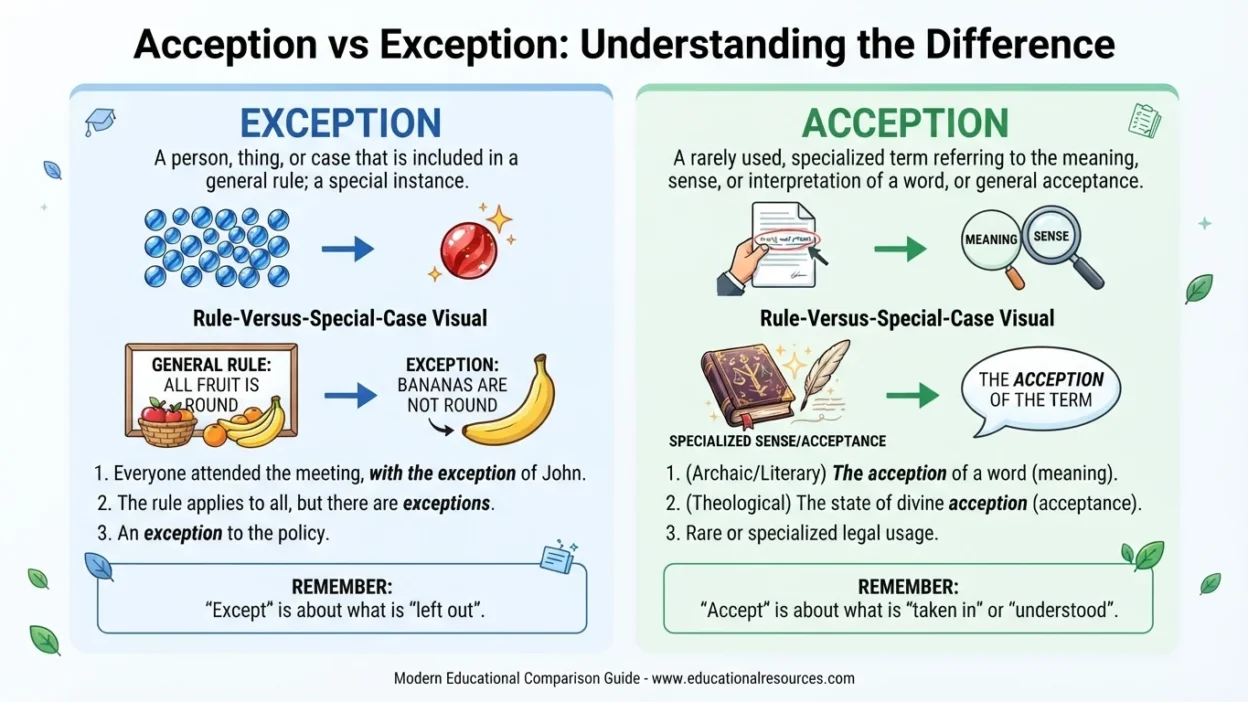
“Acception” and “exception” look and sound similar, so it is easy to confuse them. However, they are not interchangeable. Exception is a common and standard English word, while acception is a rare, specialized word that most people will not need in everyday English.
If you are writing an email, essay, article, academic paper, or professional document, exception is almost certainly the word you want. Understanding the difference can help you avoid spelling mistakes and choose the correct word confidently.
Quick Answer
Exception means something or someone that does not follow a general rule or pattern.
Acception is a rare word referring to the acceptance or a particular interpretation/meaning of a word or expression. It is uncommon in modern everyday English.
Easy rule: If you mean “something excluded from a rule,” use exception.
Why Do People Confuse Acception and Exception?
The confusion mainly comes from their similar spelling and pronunciation.
Both words contain -ception, which makes them visually similar. However, their meanings are very different.
For example:
- Everyone must attend except Sara. → exception
- This rule has one exception. → exception
In ordinary modern English, acception is rarely used. If you accidentally write “acception” when you mean an unusual case or a rule that does not apply, exception is correct.
What Does “Exception” Mean?
Exception is a noun meaning a person, thing, or situation that does not follow a general rule, statement, or pattern.
Examples
- There is one exception to this rule.
- Everyone passed the exam, with the exception of two students.
- I usually drink coffee, but today is an exception.
- Children under five are not allowed, with the exception of infants.
Common phrases with “exception”
You will often see exception in expressions such as:
- an exception to the rule
- make an exception
- with the exception of
- take exception to
- without exception
- no exception
Example
Everyone is required to follow the policy without exception.
Here, exception refers to a situation in which the general rule does not apply.
What Does “Acception” Mean?
Acception is a rare and specialized noun. Historically and in specialized linguistic or theological contexts, it can refer to acceptance, reception, or a particular sense or interpretation of a word.
It is not a word you will normally need in everyday English.
Because acception is uncommon, using it in ordinary writing can sound unusual or may simply be a mistake if you intended exception.
Example of specialized usage
A historical linguistic discussion might refer to the acception of a particular term, meaning its particular sense or interpretation.
For general writing, however, it is usually better to choose a more familiar word such as:
- meaning
- sense
- interpretation
- acceptance
depending on the intended meaning.
Acception vs Exception: Comparison Table
| Word | Meaning | Usage | Example |
|---|---|---|---|
| Exception | Something that does not follow a general rule | Very common | This case is an exception to the rule. |
| Acception | A rare term related to acceptance or a particular sense/interpretation | Very uncommon/specialized | The scholar discussed the historical acception of the term. |
When to Use “Exception”
Use exception when you are talking about something that is different from or excluded from a general rule.
Use “exception” for:
1. Breaking a rule
There is an exception to the policy.
2. A person excluded from a general statement
Everyone came to the meeting, with one exception.
3. Something unusual
This year was an exception to the usual pattern.
4. Disagreement or objection
The phrase take exception to means to object to something.
She took exception to his rude comment.
When to Use “Acception”
Use acception only when you specifically need its rare or specialized meaning.
It may appear in historical, linguistic, philosophical, or theological writing. Even then, make sure that acception is actually the intended term.
In most situations, a clearer modern word will work better.
For example:
- Rare: The acception of the word changed over time.
- More natural: The meaning of the word changed over time.
Acception vs Exception Examples
Here are examples that make the difference easier to remember.
Exception
- There is an exception to every rule.
- Everyone attended the event, with one exception.
- This restaurant is closed on Sundays, without exception.
- She made an exception for her friend.
- No one is allowed inside, with the exception of staff.
- His case is an exception to the general rule.
- I usually exercise in the morning, but today is an exception.
- The discount applies to all products, with some exceptions.
- They made an exception because of the emergency.
- This situation is unusual and should be treated as an exception.
Acception
Because acception is rare, examples are much less common in everyday English.
- The researcher examined the historical acception of the term.
- The text contains an unusual acception of the word.
For most modern readers, meaning, sense, or interpretation may be clearer in such sentences.
Common Mistakes
Mistake 1: Using “acception” for a rule that does not apply
❌ There is one acception to the rule.
✅ There is one exception to the rule.
Mistake 2: Treating “acception” as a normal synonym for “exception”
They are not standard interchangeable synonyms.
❌ Everyone excepted John from the rule because he was an acception.
✅ Everyone made an exception for John.
Mistake 3: Using “exception” when you mean “meaning”
If you are discussing the meaning of a word, sense, meaning, or interpretation may be more appropriate than either word.
Memory Trick
Here is a simple way to remember the difference:
EXCEPTION = EXCLUDED FROM A RULE
Think:
EX = outside
CEPTION = think of something being taken out of the general rule
So:
Exception → something outside the usual rule
For acception, remember that it is accepted as a rare, specialized term, not the everyday word for an unusual case.
Exception vs Except
Do not confuse exception with except.
Except is usually a preposition, conjunction, or verb meaning to leave someone or something out.
Everyone came except Ali.
Exception is a noun.
Ali was the only exception.
A useful pattern is:
Everyone came except Ali.
Ali was an exception.
American vs British English
There is no major American-versus-British spelling difference between exception and acception.
Exception is the standard word in both American and British English.
Acception exists as a rare historical or specialized term in both varieties, but it is not a normal everyday alternative to exception.
So whether you are writing for an American or British audience, exception is the correct choice when you mean “something that does not follow a general rule.”
Related Words
Understanding related words can make the distinction easier.
Exception
- exemption
- exclusion
- irregularity
- deviation
- anomaly
- special case
- unusual case
Acception
Depending on context, related modern words may include:
- acceptance
- meaning
- sense
- interpretation
- usage
- definition
Be careful, though: these are not all exact synonyms.
Exception vs Exemption
Another useful distinction is between exception and exemption.
An exception is something that does not follow a general rule.
An exemption is official permission not to follow a rule, requirement, tax, obligation, or law.
For example:
There is an exception to the rule.
The organization received an exemption from the tax.
This distinction is especially useful in academic, legal, and professional writing.
How to Choose the Right Word
Ask yourself what you mean:
Do you mean “something that does not follow a rule”?
→ Use exception.
Do you mean “a particular meaning or interpretation” in a specialized context?
→ Acception may be appropriate, but consider whether sense, meaning, or interpretation is clearer.
Are you writing normal everyday English?
→ Exception is overwhelmingly more likely to be the word you need.
Final Verdict
Exception is the correct and commonly used word when you mean something that does not follow a general rule, pattern, or statement. It is a standard word in both American and British English.
Acception is a rare, specialized word that may appear in historical, linguistic, or other technical contexts. It should not be used as a spelling variation of exception.
Remember This
Exception = something outside a general rule.
If you are unsure between acception and exception in everyday writing, choose exception when you mean “a special case” or “something excluded from a rule.”
FAQs
Is “acception” a correct English word?
Yes, acception is a real but rare and specialized English word. It is not commonly used in everyday modern English.
Is “exception” the correct word for a rule?
Yes. If something does not follow or is excluded from a general rule, exception is the correct word.
Is acception a synonym of exception?
No. Although the words look similar, they have different meanings and are not normally interchangeable.
What is the easiest way to remember exception?
Remember: exception = a special case outside the general rule.
Can I use acception in academic writing?
You can use it when its specialized meaning is genuinely relevant, but make sure your audience understands the term. In many cases, meaning, sense, or interpretation will be clearer.
Is exception the same in American and British English?
Yes. Exception is standard in both American and British English.
What is the difference between except and exception?
Except means to leave something or someone out, while exception is the noun for a special case that does not follow a general rule.
Which is more common: acception or exception?
Exception is vastly more common in modern English. Acception is rare and specialized.
Conclusion
The difference between acception and exception is mainly about meaning and frequency. Exception is the everyday word you use for a special case, something excluded from a rule, or something that does not fit a general pattern. It appears frequently in everyday, academic, professional, and formal English.
Acception, on the other hand, is a rare specialized term associated with acceptance or a particular sense or interpretation. Unless you are writing in a specialized context where the term is specifically required, exception is almost certainly the better choice. When in doubt, remember: an exception is a special case outside the rule.

A creative writer with a deep interest in word usage and meaning.
He explores synonyms to enhance both academic and creative expression.
Zayn’s work aims to make language richer and more accessible for everyone.