English learners often wonder whether they should say “at the house” or “in the house.” Both expressions are grammatically correct, but they do not always communicate exactly the same idea. The difference mainly depends on whether you are talking about the house as a location or specifically about being inside the building.
Understanding this small distinction can make your English sound much more natural. At the house generally focuses on the house as a place or location, while in the house emphasizes being inside it. However, context matters, and native speakers may sometimes use either expression when the intended meaning is clear. In this guide, you’ll learn when to use each phrase, see practical examples, avoid common mistakes, and understand how these expressions work in American and British English.
Quick Answer
Both “at the house” and “in the house” are correct. Use at the house when you mean someone is at the house or its location, without emphasizing being indoors. Use in the house when you specifically mean someone or something is inside the house.
Why Do People Confuse “At the House” and “In the House”?
The confusion comes from the fact that both at and in can describe locations.
However, English prepositions often communicate different relationships with a place.
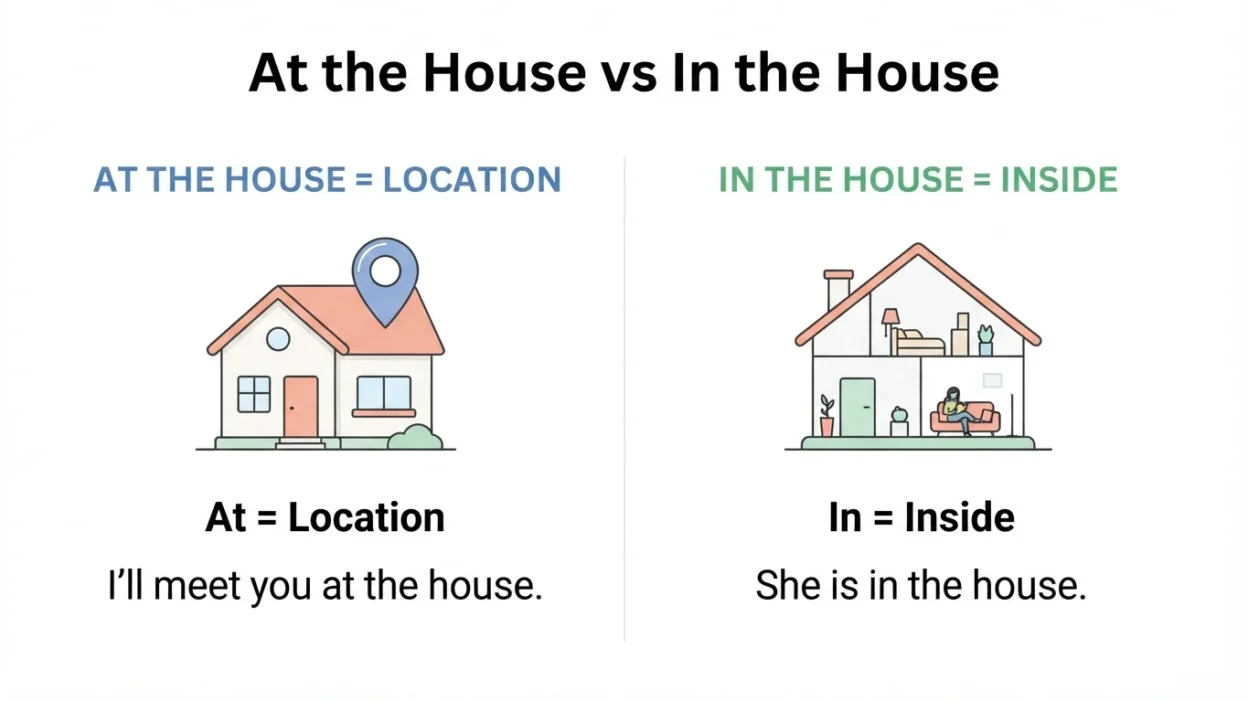
At usually presents a place as a point or location:
I’ll meet you at the house.
In emphasizes being within the boundaries or interior of something:
The children are in the house.
The difference becomes especially important when the speaker wants to clarify whether someone is simply at a particular location or physically inside a building.
“At the House” – Meaning and Usage
At the house means at the location of the house. The expression treats the house as a general place or destination.
It does not necessarily tell us that the person is inside.
Examples
- I’ll meet you at the house.
- She is waiting at the house.
- We left the car at the house.
- They are having a meeting at the house.
- There are several people at the house.
For example:
I’ll see you at the house at 7 p.m.
The speaker is identifying the house as the meeting location. The sentence does not strongly emphasize whether the person will be inside, outside, in the yard, or near the entrance.
When “At the House” Is Especially Natural
Use it when talking about:
- A meeting location
- A destination
- Someone’s general location
- An event held at a home
- Activities associated with a particular house
We had dinner at the house.
The focus is on the location where dinner took place.
“In the House” – Meaning and Usage
In the house means inside the house.
Here, in emphasizes the interior of the building.
Examples
- The children are in the house.
- My keys are in the house.
- Someone is in the house.
- It is very warm in the house.
- I left my jacket in the house.
Consider:
The dog is in the house.
This clearly suggests that the dog is inside the building.
Another example:
I left my phone in the house.
The phone is understood to be somewhere inside the house.
At the House vs In the House: Comparison Table
| Feature | At the House | In the House |
|---|---|---|
| Main idea | Location | Interior |
| Focus | The house as a place | Inside the building |
| Means physically indoors? | Not necessarily | Yes, generally |
| Common use | Meetings, visits, destinations | People or objects inside |
| Example | I’ll meet you at the house. | She is in the house. |
| Preposition | At | In |
When to Use Each
Use “At the House” for a Location
When the house is simply the place where something happens, at is often appropriate.
We met at the house.
There was a party at the house.
I’ll pick you up at the house.
The exact position inside the property is not important.
Use “In the House” for the Interior
When you want to emphasize that someone or something is inside, use in.
The kids are in the house.
Your shoes are in the house.
I heard a noise in the house.
The interior location matters in these sentences.
At the House vs In the House: 10+ Examples
Examples with “At the House”
- I’ll meet you at the house.
- We had lunch at the house.
- She is waiting at the house.
- They are staying at the house this weekend.
- There was a large gathering at the house.
- I’ll pick you up at the house.
- We arrived at the house around noon.
Examples with “In the House”
- The children are in the house.
- I left my wallet in the house.
- Someone is in the house.
- It is quiet in the house.
- The furniture is in the house.
- I heard footsteps in the house.
- She is cooking in the house.
“At the House” Does Not Always Mean Outside
A common misconception is that at the house means someone is outside.
That is not necessarily true.
If someone says:
She is at the house.
She could be inside the house, in the yard, on the porch, or somewhere else immediately associated with the location.
The expression simply identifies the house as the person’s location.
If the speaker wants to clearly communicate that she is indoors, they can say:
She is in the house.
Common Mistakes
Mistake 1: Assuming “At” Means Outside
❌ “At the house” always means outside.
This is not correct.
At the house focuses on the location, not necessarily the person’s exact physical position.
Mistake 2: Using “In” for Every Location
❌ I’ll meet you in the house.
This is grammatically possible, but it specifically suggests meeting inside.
If you simply mean that the house is the meeting location, say:
✅ I’ll meet you at the house.
Mistake 3: Confusing “At Home” with “In the House”
These expressions are related but different.
At home means at one’s home or residence.
I’m at home.
In the house specifically emphasizes being inside the house.
I’m in the house.
Someone could be at home while sitting in the garden, for example, but in the house specifically suggests the interior.
Memory Trick
Remember this simple rule:
AT = LOCATION
Think of at as pointing to a place on a map.
I’m at the house.
IN = INSIDE
Think of in as being within the boundaries of something.
I’m in the house.
A quick memory sentence:
At the house = where?
In the house = inside where?
American vs British English
Both American English and British English use at the house and in the house.
There is no major difference in the basic meaning of these expressions.
For example, both varieties can use:
I’ll meet you at the house.
And:
The children are in the house.
However, speakers may have personal or regional preferences depending on the context.
Similar Expressions
At Home
Means at one’s home or residence.
I’m at home today.
In the Home
Means inside the home, but can sometimes sound more formal or descriptive.
The study examines safety in the home.
At My House
Means at the speaker’s home/location.
Come over at my house.
However, in standard English, “come over to my house” or “come over to my place” is often more natural depending on the sentence.
In My House
Specifically means inside the speaker’s house.
There is a strange noise in my house.
At the Door
Means at or near the door.
Someone is at the door.
In the Room
Means inside a particular room.
She is in the room.
These examples show the broader pattern: at often identifies a location, while in often identifies an interior space.
Frequently Asked Questions
Is “at the house” correct?
Yes. At the house is grammatically correct and commonly used when referring to the house as a location.
Is “in the house” correct?
Yes. In the house is correct when you mean someone or something is inside the house.
What is the difference between “at the house” and “in the house”?
At the house focuses on the house as a location. In the house emphasizes being inside the building.
Does “at the house” mean outside?
No. At the house does not necessarily mean outside. A person can be inside and still be described as being at the house.
Can I say “I’m at the house”?
Yes. This is natural when you want to communicate your general location.
Can I say “I’m in the house”?
Yes. This specifically communicates that you are inside the house.
Which is better: “at the house” or “in the house”?
Neither is universally better. Choose at the house for a general location and in the house when emphasizing the interior.
Final Verdict
The choice between at the house and in the house depends on what you want to emphasize.
Use at the house when the house is the general location or destination:
I’ll meet you at the house.
Use in the house when you want to say that someone or something is inside:
The children are in the house.
The distinction is simple once you focus on the meaning of the prepositions. At treats the house as a location, while in places someone or something within its interior.
Conclusion
Both at the house and in the house are correct expressions, but they serve slightly different purposes. At the house is useful when talking about a house as a location, meeting point, or destination. It does not necessarily tell us exactly where the person is within the property. In the house, on the other hand, specifically emphasizes being inside the building.
For everyday English, remember the simplest rule: at = location, in = inside. If you are talking about where an event, meeting, or person is generally located, at the house may be the better choice. If you need to emphasize that someone or something is physically indoors, use in the house.
Remember This
At the house = at the location
In the house = inside the building
Example:
“I’ll meet you at the house.”
“The children are in the house.”