If you have ever wondered whether the correct spelling is brite or bright, you are not alone. These words look and sound similar, and you may even see brite used in brand names, product labels, advertisements, or informal writing. However, that does not mean the two spellings have the same status in standard English.
The standard spelling is bright. It is the word you should normally use when describing something that gives off or reflects a lot of light, has a vivid color, shows intelligence, or suggests a positive and hopeful quality. Brite is generally a nonstandard spelling, although it can appear intentionally in names, trademarks, branding, or stylized language. Knowing this distinction will help you choose the right form in professional, academic, and everyday writing.
Quick Answer
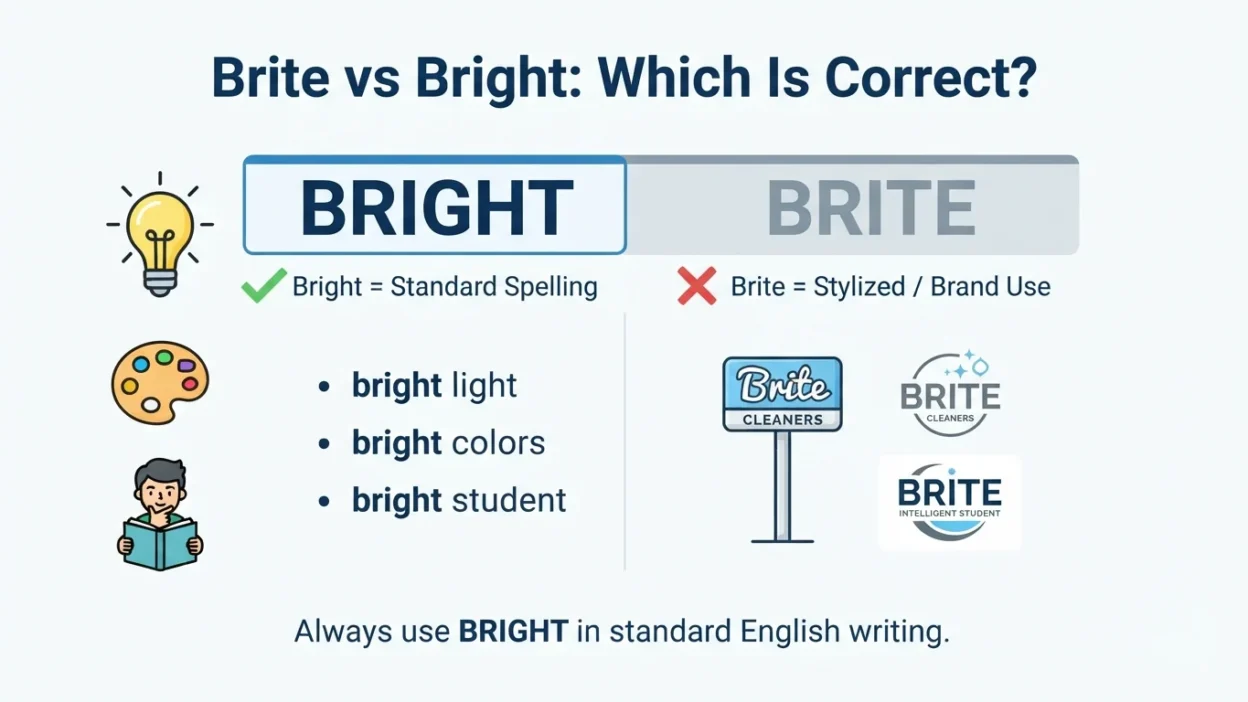
Bright is the standard and correct spelling in general English. It can describe light, colors, intelligence, cheerfulness, or something promising. Brite is usually a stylized or nonstandard spelling and is sometimes used in brand names or product names. For formal and standard writing, use bright.
Why Do People Confuse “Brite” and “Bright”?
The main reason for the confusion is pronunciation.
Brite and bright are normally pronounced the same way. When people hear the word rather than see it written, they may naturally spell it brite.
English also contains many words where the pronunciation does not perfectly reveal the spelling. In this case, the standard spelling includes the letters -ght:
bright
The spelling brite may look simpler, but it is not the normal standard spelling of the adjective.
“Bright” – Meaning and Usage
Bright is the standard English word.
It has several meanings depending on context.
1. Giving Off or Reflecting a Lot of Light
The room was filled with bright sunlight.
She turned on the bright lamp.
Here, bright describes strong or noticeable light.
2. Strong or Vivid in Color
She wore a bright yellow dress.
The painting uses bright colors.
In this sense, bright describes colors that are vivid, intense, or noticeable.
3. Intelligent
Bright can also describe someone who is intelligent or quick to learn.
She is a very bright student.
He is bright and hardworking.
4. Cheerful or Positive
The word can describe someone’s mood or personality.
She has a bright personality.
He always has a bright outlook on life.
5. Promising or Hopeful
Bright can describe a positive future.
She has a bright future ahead of her.
The young athlete has a bright career ahead.
“Brite” – Meaning and Usage
Brite is generally not the standard spelling of the ordinary English adjective bright.
You may encounter it in:
- Brand names
- Product names
- Company names
- Advertising
- Informal or stylized writing
- Creative names
For example, a company might deliberately choose Brite as part of its brand identity.
That does not make brite the standard spelling of the everyday adjective.
If you are writing:
The room is very ___.
The standard answer is:
✅ The room is very bright.
Not:
❌ The room is very brite.
Brite vs Bright: Comparison Table
| Feature | Bright | Brite |
|---|---|---|
| Standard English spelling | ✅ Yes | ❌ Generally no |
| Common adjective | ✅ Yes | ❌ No |
| Describes light | ✅ Yes | ❌ Not normally |
| Describes color | ✅ Yes | ❌ Not normally |
| Means intelligent | ✅ Yes | ❌ No |
| Used in branding | ✅ Yes | ✅ Sometimes |
| Formal writing | ✅ Recommended | ❌ Avoid unless it is a proper name |
| Pronunciation | /braɪt/ | Usually /braɪt/ |
| Best choice | ⭐ Bright | Usually avoid |
When to Use “Bright”
Use bright whenever you are using the standard English adjective.
Bright Light
The bright light hurt my eyes.
Bright Colors
I love bright colors.
Bright Student
She is a bright student.
Bright Future
He has a bright future.
Bright Smile
She greeted everyone with a bright smile.
Bright Morning
It was a bright and beautiful morning.
When Can “Brite” Be Used?
There are situations where Brite may be correct because it is intentionally part of a name.
For example, if a company, product, or organization officially uses Brite in its name, you should preserve that spelling.
The important distinction is:
Brite as a name or brand ≠ brite as the standard spelling of bright.
So if you see Brite on a product label, website, or company logo, it may be a deliberate spelling choice.
However, you should not automatically transfer that spelling into ordinary English sentences.
Examples of “Bright”
Here are natural examples using the standard word:
- The sun was very bright this morning.
- She wore a bright red jacket.
- The room has bright windows.
- He is a bright and curious student.
- She has a bright future.
- The flowers have bright colors.
- Turn down the bright light.
- His bright smile made everyone feel welcome.
- We saw a bright star in the sky.
- The children painted the walls in bright colors.
- She had a bright idea.
- The office looked bright and welcoming.
Common Expressions with “Bright”
Bright appears in many common English expressions.
Bright Idea
An intelligent or useful idea.
That’s a bright idea.
Bright Future
A promising future.
She has a bright future ahead.
Bright Side
The positive aspect of a difficult situation.
Try to look on the bright side.
Bright and Early
Very early in the morning.
We need to leave bright and early tomorrow.
Bright Eyes
Eyes that appear lively, alert, or shining.
The child had bright eyes.
Bright Red / Bright Blue / Bright Green
These describe vivid colors.
She bought a bright blue bag.
Common Mistakes
Mistake 1: Using “brite” in ordinary writing
❌ The room is very brite.
✅ The room is very bright.
Mistake 2: Assuming pronunciation determines spelling
Because brite and bright can sound alike, it is easy to choose the wrong spelling.
Remember that pronunciation alone does not determine standard English spelling.
Mistake 3: Changing “bright” to “brite” because it looks simpler
English spelling does not always follow the simplest phonetic pattern.
The correct standard spelling remains:
bright
Mistake 4: Treating a brand spelling as normal English
A company can creatively spell a word in its name.
For example, a brand may use Brite.
That does not mean you should use brite in an ordinary sentence.
Memory Trick
A simple way to remember the correct spelling is:
Bright has “ght” at the end.
Think:
BRI + GHT = BRIGHT
You can also remember the phrase:
Bright light has “ght.”
So when you’re describing light, color, intelligence, or a promising future, choose bright.
American vs British English
There is no significant American-versus-British spelling difference here.
Both American English and British English use:
bright
For example:
The room is bright.
She is a bright student.
The spelling brite is not a standard American or British alternative for the ordinary adjective bright.
If Brite appears as part of a company, product, or brand name, its spelling should be preserved as the proper name uses it.
Bright vs Similar Words
Light
Light can refer to illumination or something that is not heavy.
The room has plenty of light.
Brilliant
Brilliant can mean extremely bright, highly intelligent, or excellent.
The scientist had a brilliant idea.
Vivid
Vivid commonly describes strong, intense colors or clear images.
She chose a vivid blue color.
Radiant
Radiant describes something shining or glowing, often beautifully.
She looked radiant in the sunlight.
Intelligent
Intelligent directly describes someone’s ability to understand, learn, or reason.
He is highly intelligent.
Bright can have this meaning too, but it is generally more informal.
Frequently Asked Questions
Is “brite” a correct spelling?
Brite is generally not the standard spelling of the ordinary English word. It may be used intentionally in brand names, product names, or stylized writing.
Is “bright” the correct spelling?
Yes. Bright is the standard spelling.
Are “brite” and “bright” pronounced the same?
They are commonly pronounced the same when brite is used as a stylized spelling: /braɪt/.
Can I use “brite” in formal writing?
Generally, no. Use bright in formal, academic, professional, and general English unless Brite is part of an official name.
What does “bright” mean?
Bright can mean giving off or reflecting a lot of light, having a vivid color, being intelligent, being cheerful, or being promising.
Can “Brite” be a name?
Yes. Brite can be intentionally used in company, product, or brand names. Proper names should retain their official spelling.
Which is correct: “bright colors” or “brite colors”?
The standard phrase is bright colors.
✅ She loves bright colors.
Final Verdict
When choosing between brite vs bright, use bright for standard English.
Bright can describe strong light, vivid colors, an intelligent person, a cheerful quality, or a promising future. It is the correct spelling for ordinary sentences in both American and British English.
Brite, meanwhile, is generally a nonstandard or stylized spelling. You may see it in brand names, product names, advertising, or other creative contexts. If it is part of an official name, keep the spelling exactly as the name uses it. Otherwise, choose bright.
Conclusion
The correct standard spelling is bright, not brite. Whether you are describing a bright light, bright colors, a bright student, a bright idea, or a bright future, the word should normally be written with -ght at the end.
Although brite may appear in branding and creative contexts, it should not be used as a replacement for bright in ordinary formal or professional English. When in doubt, remember the simple rule: BRIGHT is the standard spelling; BRITE is usually a stylized or proper-name form.
Remember This
Bright = standard English spelling
Brite = usually a stylized/brand spelling
✅ bright light
✅ bright colors
✅ bright student
✅ bright future
❌ brite light
❌ brite colors

An expert in English grammar and expressive writing techniques.
She focuses on helping readers expand their vocabulary with clarity.
Elina believes the right word can transform ordinary writing into powerful communication.