Choosing between “by which” and “in which” can be confusing because both phrases contain the relative pronoun which, yet they express different relationships between ideas. The correct choice depends on the meaning of the sentence and, especially, on the preposition that naturally belongs with the verb or noun you are using.
In general, by which often describes a method, means, process, or way something happens. In which commonly refers to something happening inside a place, situation, condition, period, or context. Understanding this distinction will help you write clearer and more natural English in academic writing, professional communication, essays, and everyday sentences.
Quick Answer
Use by which when you mean “by means of which,” “through which,” or “using which.” Use in which when you mean “inside which,” “during which,” or “within which,” depending on context. The correct phrase is determined by the meaning of the sentence and the preposition required by the surrounding words.
Why Do People Confuse “By Which” and “In Which”?
The confusion happens because which can refer to a thing, situation, process, or idea, while by and in can both introduce relationships between clauses.
Compare:
This is the method by which we solved the problem.
Here, by which means “by means of which.”
Now consider:
This is the room in which we solved the problem.
Here, in which means “inside which.”
The noun before which may look similar, but the preposition changes the meaning.
“By Which” – Meaning and Usage
By which generally means “by means of which,” “through which,” or “using which.”
It is often used to describe the method or process through which something happens.
Examples
- This is the method by which the machine operates.
- She explained the process by which the results were obtained.
- They developed a system by which customers can track their orders.
- That is the procedure by which applications are reviewed.
- He described the technique by which the data was collected.
In each example, by which introduces a method or process.
Simple Meaning
By which = by means of which / through which
For example:
This is the method by which we communicate.
means:
This is the method through which we communicate.
“In Which” – Meaning and Usage
In which commonly means “inside which,” “within which,” or “during which,” depending on context.
It is used when the following clause describes something occurring within a place, situation, condition, or period.
Examples
- This is the room in which we met.
- I remember the year in which she graduated.
- That was a situation in which nobody knew what to do.
- The company created an environment in which employees could grow.
- This is the box in which I keep my documents.
Simple Meaning
In which = inside which / within which / during which
For example:
This is the house in which I grew up.
means:
This is the house inside which I grew up.
By Which vs In Which: Comparison Table
| Feature | By Which | In Which |
|---|---|---|
| Basic meaning | By means of which | Inside/within/during which |
| Main function | Method or means | Place, situation, condition, or time |
| Common with | Method, process, way, system | Room, place, situation, year, environment |
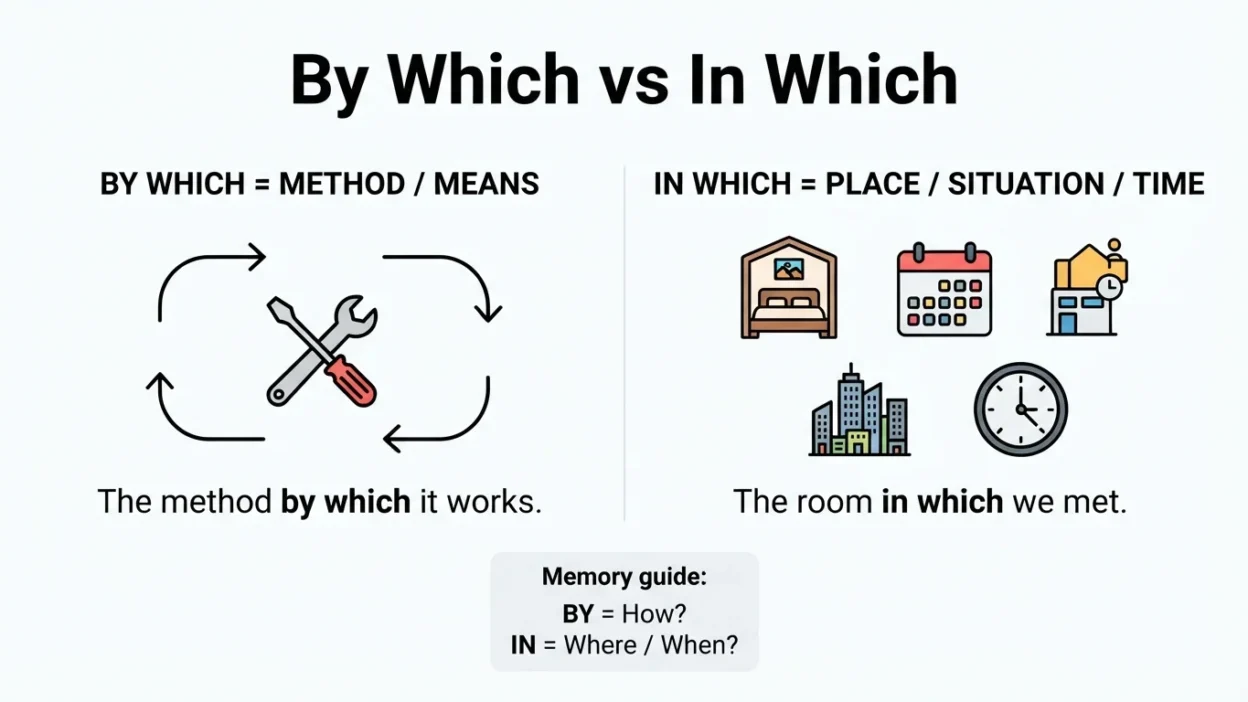
| Example | The method by which it works | The room in which we met |
| Can mean “through which”? | Yes | Sometimes, depending on context |
| Can mean “inside which”? | No | Yes |
| Best question | How? By what method? | Where? Within what? During what? |
When to Use “By Which”
Use by which when the sentence answers the question:
“By what method?” or “How?”
Example
This is the process by which the company produces the product.
Ask:
How does the company produce it?
Answer:
By this process.
Therefore, by which is appropriate.
Common Expressions with “By Which”
You will often see:
- method by which
- process by which
- system by which
- means by which
- mechanism by which
- procedure by which
- way by which
For example:
The researchers studied the mechanism by which plants absorb nutrients.
When to Use “In Which”
Use in which when something happens inside, within, during, or under a particular situation or context.
Place
This is the room in which the meeting took place.
Situation
It was a difficult situation in which everyone had to make a decision.
Time
2020 was the year in which many businesses changed their strategies.
Environment
They created an environment in which students felt comfortable.
Condition
The experiment was conducted under conditions in which the temperature remained constant.
By Which or In Which: Examples
Here are more examples to make the difference clear.
By Which
- This is the method by which the device works.
- She explained the process by which the information was collected.
- They created a system by which customers can make payments online.
- We need to understand the mechanism by which this happens.
- He described the procedure by which applications are processed.
- This is the means by which the organization raises money.
In Which
- This is the room in which we held the meeting.
- I remember the year in which we first met.
- It was a situation in which nobody knew the answer.
- She works in an environment in which creativity is encouraged.
- This is the box in which I stored the books.
- They entered a period in which demand increased rapidly.
A Useful Test: Ask “How?” or “Where/When?”
One of the easiest ways to choose between these phrases is to ask yourself a question.
If the answer is “How?” → Use “By Which”
This is the method by which the problem was solved.
How was it solved?
By this method.
If the answer is “Where, within what, or when?” → Use “In Which”
This is the room in which the problem was discussed.
Where was it discussed?
In this room.
Another example:
2024 was the year in which the company expanded.
When did it expand?
In 2024.
Common Mistakes
Mistake 1: Using “in which” for a method
❌ This is the method in which we solved the problem.
This is generally unnatural if you mean the method used to solve the problem.
Better:
✅ This is the method by which we solved the problem.
Mistake 2: Using “by which” for a physical location
❌ This is the room by which we met.
If you mean the room where the meeting happened:
✅ This is the room in which we met.
Mistake 3: Assuming “which” determines the preposition
The word which does not automatically tell you whether to use by, in, on, with, or another preposition.
The meaning determines the preposition.
Compare:
The method by which it works.
The place in which it works.
The tool with which it works.
Different prepositions create different relationships.
Can “By Which” and “In Which” Sometimes Overlap?
Yes, but they are not normally interchangeable.
For example:
This is the channel through which the information is transmitted.
Here, through which describes the route or means.
In some contexts, by which may also describe a means or mechanism.
However:
This is the environment in which the information is processed.
Here, in which describes the setting or context.
The important point is to focus on the relationship you want to express rather than memorizing the phrases in isolation.
American vs British English
By which and in which are used in both American and British English.
There is no major American-versus-British difference in their basic meanings.
For example, both varieties use:
The method by which the results were obtained.
And:
The situation in which they found themselves was difficult.
In everyday speech, both American and British speakers may prefer simpler alternatives such as that, where, or a sentence without a relative clause. However, by which and in which remain useful, particularly in formal and academic writing.
Similar Expressions
Through Which
Often means by means of which or through the route/process of which.
This is the system through which payments are processed.
With Which
Means using which or refers to an instrument.
This is the tool with which he repaired the machine.
For Which
Means for what purpose or for the thing referred to.
That is the reason for which she left.
On Which
Means on the thing or date referred to.
This is the day on which the decision was announced.
At Which
Often refers to a point, event, level, or location.
That was the moment at which everything changed.
These examples show why the preposition matters. Which stays the same, but the preposition changes the relationship.
Frequently Asked Questions
Is “by which” correct?
Yes. By which is correct and commonly used to describe a method, means, process, or mechanism.
Is “in which” correct?
Yes. In which is correct and commonly refers to something happening inside a place, within a situation, during a period, or under certain conditions.
What is the difference between “by which” and “in which”?
By which generally means “by means of which”, while in which generally means “inside,” “within,” or “during which.”
Can I use “by which” and “through which” interchangeably?
Sometimes, especially when both refer to a method or means, but they are not universally interchangeable. The surrounding context determines the best choice.
Can “in which” refer to time?
Yes.
2025 was the year in which the company expanded.
Here, in which means “during which.”
Is “by which” formal English?
Yes. By which is especially common in formal, academic, technical, and professional writing.
Is “in which” formal English?
Yes. In which is also common in formal and academic writing, although simpler alternatives may sound more natural in casual conversation.
Final Verdict
By which and in which are both correct, but they express different relationships.
Use by which when referring to a method, means, mechanism, or process:
The method by which the machine operates is complex.
Use in which when referring to a place, situation, condition, environment, or period of time:
The environment in which the machine operates is controlled.
The easiest way to remember the difference is to ask what relationship you are describing. If you are explaining how something happens, by which is often appropriate. If you are describing where, within what situation, or during what period something happens, in which is usually the better choice.
Conclusion
The difference between by which and in which comes down to the meaning of the preposition. By which commonly introduces a method or means and can often be understood as “by means of which” or “through which.” On the other hand, in which normally describes something occurring inside a place, within a situation, under certain conditions, or during a particular period.
When you’re unsure, don’t choose based only on how the phrase sounds. Look at the relationship between the two parts of the sentence. Ask yourself whether you mean “how?” or “where, within what, or when?” This simple test will help you choose the correct phrase naturally and confidently.
Remember This
By which = by what method?
The process by which the product is made.
In which = inside/within/during what?
The room in which we met.
Easy rule:
BY → method or means
IN → place, situation, condition, or time