If you have ever written phrases such as “book a timeslot” or “choose a time slot,” you may have wondered whether timeslot or time slot is the correct spelling. Both forms can be seen online, which makes this small spelling question surprisingly confusing.
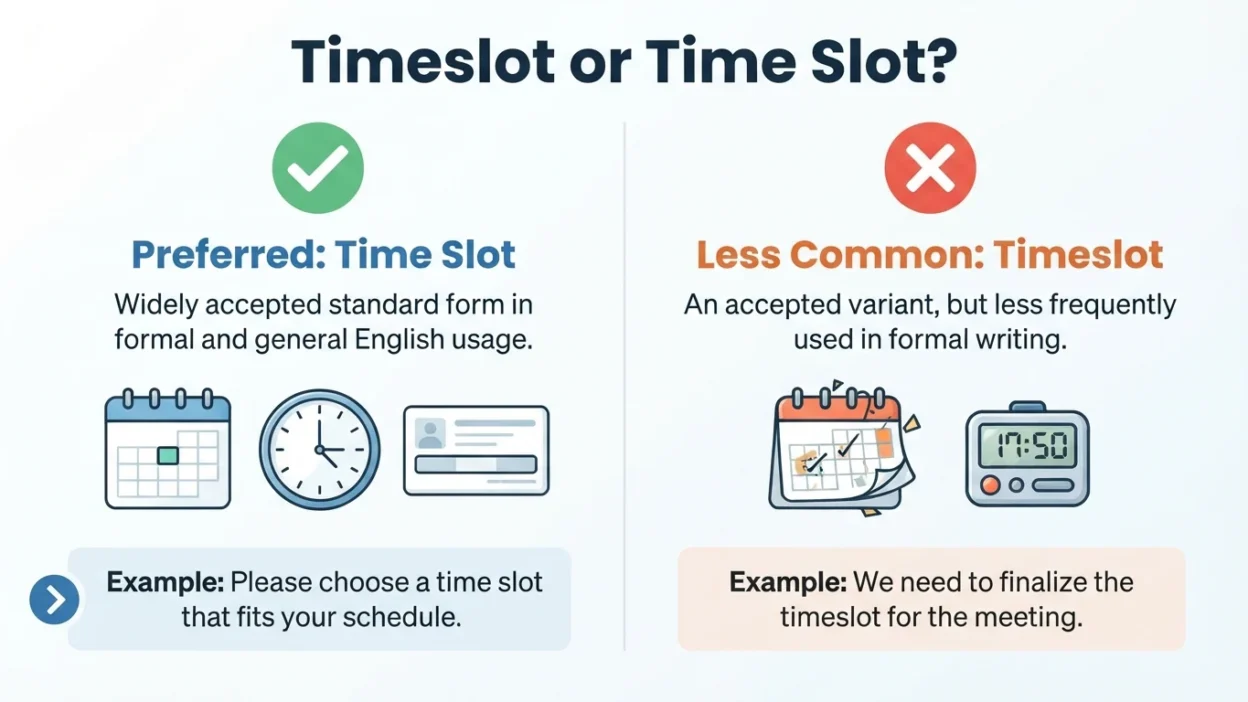
The standard and safest form in modern English is time slot, written as two separate words. It refers to a particular period reserved for an appointment, activity, event, broadcast, or other purpose. Although timeslot sometimes appears as a closed compound, especially in informal or industry-specific writing, time slot is the preferred form for general, professional, academic, and formal English.
Quick Answer
Time slot is the standard form and the best choice for most English writing. It means a specific period of time allocated for an activity, appointment, event, or task. Timeslot is sometimes used as a closed compound, but it is less standard and should generally be avoided in careful writing.
Why Do People Confuse “Timeslot” and “Time Slot”?
The confusion happens because English frequently combines two words into compound nouns over time. For example, words such as website, classroom, and football are written as single words.
Because “time” and “slot” work closely together, some writers naturally assume that timeslot should also be one word.
However, standard usage generally favors time slot as an open compound noun.
You will commonly see it in contexts involving:
- Appointments
- Interviews
- Meetings
- Classes
- Television and radio programming
- Work schedules
- Reservations
- Online bookings
- Delivery schedules
- Events
What Does “Time Slot” Mean?
A time slot is a particular period of time assigned or reserved for something.
For example:
I have a doctor’s appointment in the 10:00 a.m. time slot.
Here, “time slot” means the specific period during which the appointment is scheduled.
Another example is:
Please select an available time slot for your interview.
The phrase refers to one of the available periods from which the person can choose.
Simple Definition
Time slot = a specific period of time reserved for a particular activity.
What Does “Timeslot” Mean?
Timeslot is sometimes found as a closed compound spelling, particularly in certain digital, technical, broadcasting, or informal contexts.
For example, you may encounter:
The program received a popular evening timeslot.
However, this spelling is less generally preferred than time slot.
If you are writing an article, email, academic paper, business document, website, or professional message, time slot is the safer and more widely accepted choice.
Time Slot vs Timeslot: Comparison Table
| Feature | Time Slot | Timeslot |
|---|---|---|
| Spelling | Two words | One word |
| Standard general usage | ✅ Yes | Less preferred |
| Formal writing | ✅ Recommended | Usually avoid |
| Meaning | Specific period of time | Same intended meaning |
| Common in appointments | ✅ Very common | Less common |
| Common in business writing | ✅ Yes | Less preferred |
| Common in academic writing | ✅ Yes | Usually avoid |
| Best choice | ⭐ Yes | Usually no |
When Should You Use “Time Slot”?
Use time slot when referring to a designated or available period of time.
1. Appointments
Please select a convenient time slot for your appointment.
2. Interviews
The candidate was given a 30-minute time slot for the interview.
3. Meetings
I am available during the 2:00 p.m. time slot.
4. Classes
Students can choose a morning or afternoon time slot.
5. Reservations
We have several time slots available for reservations.
6. Scheduling
The manager assigned each employee a different time slot.
7. Events
Each speaker has a 20-minute time slot.
Examples of “Time Slot” in Sentences
Here are some natural examples:
- Please choose a time slot that works for you.
- I booked the 4:00 p.m. time slot.
- The morning time slot is already full.
- Do you have an available time slot tomorrow?
- Each student was assigned a different time slot.
- The interview will take place during your selected time slot.
- We need to reserve a time slot for the meeting.
- There are no available time slots this evening.
- You can change your time slot before confirming the appointment.
- The delivery service gave me a two-hour time slot.
- Please arrive a few minutes before your scheduled time slot.
- The conference gives each speaker a 15-minute time slot.
Common Mistakes
Mistake 1: Writing “timeslot” in formal writing
❌ Please select your preferred timeslot.
✅ Please select your preferred time slot.
The second version is the safer standard choice.
Mistake 2: Using “time slot” as a verb
“Time slot” is normally a noun.
❌ Please time slot my appointment.
Instead, use:
✅ Please schedule my appointment.
Or:
✅ Please assign me a time slot.
Mistake 3: Confusing “time slot” with “time”
The two expressions are related but not always interchangeable.
Time is general:
What time is the meeting?
Time slot refers to an allocated period:
Which time slot would you prefer for the meeting?
Is “Timeslot” Always Wrong?
Not necessarily.
Timeslot does appear in real-world English, and some dictionaries or specialized industries may recognize it as a variant or use it in particular contexts. However, its usage is much less universal than time slot.
Therefore, if your goal is clear, standard English, especially in formal or professional writing, time slot is the better choice.
Think of it as a practical writing rule:
When in doubt, write “time slot.”
Time Slot or Time-Slot?
Another question is whether to use a hyphen.
In ordinary noun usage, use:
✅ time slot
You generally do not need:
❌ time-slot
However, hyphenation can sometimes depend on sentence structure when a compound phrase is used adjectivally. Most everyday uses of this expression are simply written as time slot.
American vs British English
There is no major American-versus-British spelling difference for the standard expression.
Both American and British English commonly use:
time slot
For example:
American English:
Please select an available time slot.
British English:
Please select an available time slot.
The difference is therefore not primarily about American versus British English. It is about standard open-compound usage versus the less common closed form timeslot.
Similar Expressions
Several expressions can communicate a similar idea depending on the context.
Appointment Time
Refers to the specific time of an appointment.
What is your appointment time?
Scheduled Time
Refers to the time at which something has been arranged to happen.
The meeting will begin at the scheduled time.
Time Period
Refers more generally to a period or duration.
The study covered a long time period.
Time Frame
Refers to the period within which something is expected to happen.
We have a two-week time frame.
Window
Often refers to an available period during which something can happen.
The delivery window is between 2 and 4 p.m.
Session
Refers to a planned period of activity.
The training session starts at 9 a.m.
Easy Memory Trick
Remember:
TIME + SLOT = TIME SLOT
Think of a schedule divided into separate spaces. Each space is a “slot” for a particular activity.
So:
time + slot → time slot
Keep the two words separate in your writing.
A simple memory sentence is:
Choose a time slot, not a timeslot.
Frequently Asked Questions
Is “time slot” one word or two?
Time slot is normally written as two words. It is the standard and safest form for general English.
Is “timeslot” grammatically correct?
Timeslot is used in some English contexts, but it is less standard and less widely preferred than time slot. For careful writing, use time slot.
Which is correct: “available timeslot” or “available time slot”?
Available time slot is the preferred form.
Please choose an available time slot.
Is “time slot” formal English?
Yes. Time slot is perfectly appropriate in professional, academic, business, and formal communication.
Can I write “time slots” in the plural?
Yes.
We have three time slots available tomorrow.
The plural simply adds -s to “slot.”
Should “time slot” be hyphenated?
Usually, no. The standard form is time slot, with a space.
What is the difference between a time slot and an appointment?
A time slot is a period that can be assigned or reserved. An appointment is the scheduled arrangement itself.
For example:
The 3:00 p.m. time slot is available.
Once you book it:
I have a 3:00 p.m. appointment.
Final Verdict: Timeslot or Time Slot?
When choosing between timeslot or time slot, use time slot in most situations. It is the standard open form and is especially appropriate for professional, academic, business, and general-purpose English.
Although timeslot can be found in published and online writing, its usage is less consistent. There is little reason to choose the closed spelling when the widely understood and conventional form time slot is available.
Remember This
Time slot = preferred and standard
Timeslot = less common variant; generally avoid in careful writing
If you’re writing an email, website, article, booking form, or professional document, stick with time slot.
Conclusion
The correct choice for most English writing is time slot, written as two separate words. It describes a specific period reserved for an appointment, meeting, class, interview, event, broadcast, or another scheduled activity. Examples include “available time slot,” “morning time slot,” and “book a time slot.”
While timeslot may appear in some contexts, time slot is the clearer and safer choice. Remember the simple rule: when referring to a scheduled period of time, write “time slot” as two words.

An expert in English grammar and expressive writing techniques.
She focuses on helping readers expand their vocabulary with clarity.
Elina believes the right word can transform ordinary writing into powerful communication.