English has many compound nouns whose plural forms can be surprisingly difficult to remember. Passerby, passersby, and passerbyers are a good example. Since “passerby” refers to a person walking or traveling past a particular place, it is easy to assume that adding -ers or simply -s should create the plural. However, standard English follows a different pattern here.
The correct singular form is passerby, while the traditional and standard plural form is passersby. Passerbyers is incorrect and should not be used in standard English. Understanding why the plural changes the first part of the compound rather than adding an ending to “by” makes this word much easier to remember and use correctly.
Quick Answer
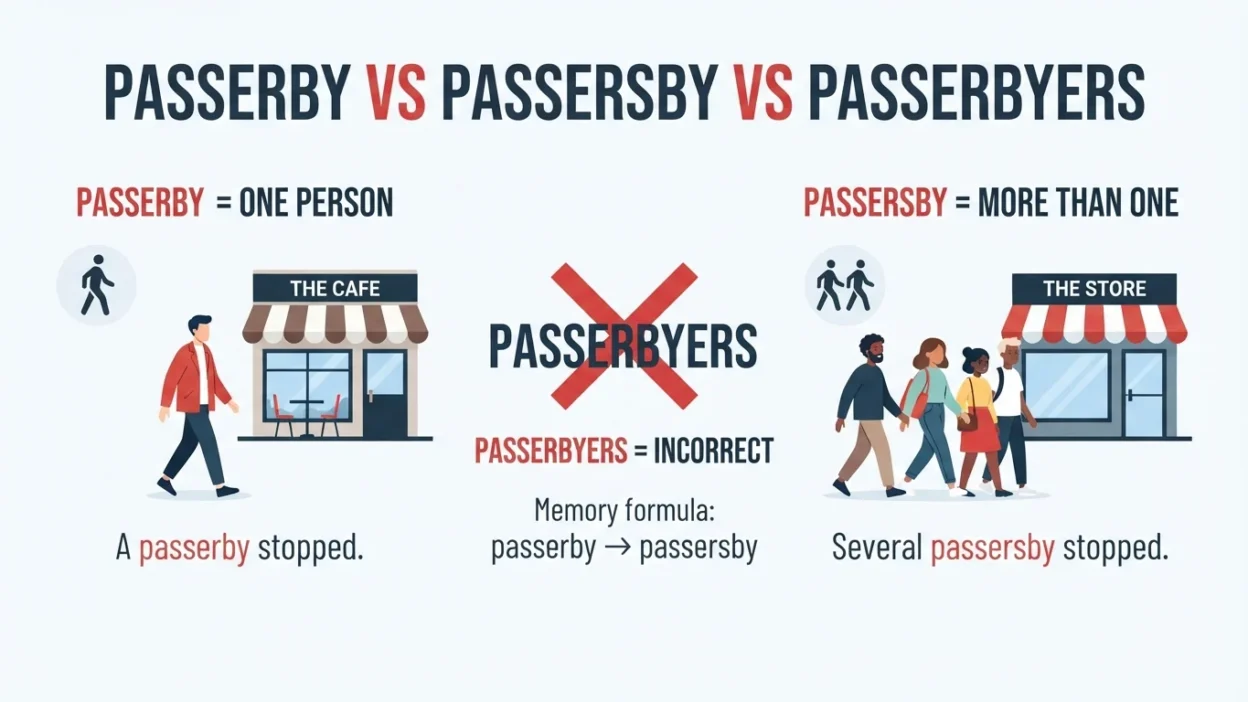
Passerby is the singular form, meaning one person who passes by. Passersby is the standard plural form, meaning two or more people who pass by. Passerbyers is incorrect. The easiest rule is: one passerby, two or more passersby.
Why Do People Confuse “Passerby,” “Passersby,” and “Passerbyers”?
The confusion comes from the unusual structure of the word.
Passerby is a compound noun made from:
- passer = someone who passes
- by = past or nearby
When making the plural, English traditionally pluralizes passer, producing:
passer → passers
So:
passerby → passersby
This can seem unusual because many English nouns simply add -s to the end.
For example:
book → books
But passerby is different because by is not the main noun being pluralized.
“Passerby” – Singular Form
Passerby refers to one person who passes by a particular place.
Examples
- A passerby helped the injured man.
- A passerby noticed the lost dog.
- The police asked a passerby what had happened.
- One passerby stopped to offer assistance.
- A curious passerby looked through the window.
Simple Definition
Passerby = one person who passes by.
For example:
A passerby saw the accident.
This means one person who happened to be passing the location saw the accident.
“Passersby” – Plural Form
Passersby is the standard plural of passerby.
It refers to two or more people who pass by.
Examples
- Several passersby stopped to watch.
- The accident attracted many passersby.
- Two passersby helped the older man.
- The street was crowded with passersby.
- Police interviewed several passersby.
Simple Definition
Passersby = two or more people who pass by.
The important spelling change is:
passerby → passersby
Not:
❌ passerbyers
“Passerbyers” – Is It Correct?
No. Passerbyers is not the standard plural form of passerby.
The word already contains passer, which refers to someone who passes. Adding -ers to the entire word creates an unnecessary and incorrect construction.
Therefore:
❌ passerbyers
✅ passersby
If you are writing an essay, article, email, report, or other formal content, always use passersby for the plural.
Passerby vs Passersby vs Passerbyers: Comparison Table
| Form | Correct? | Meaning | Example |
|---|---|---|---|
| passerby | ✅ Yes | One person passing by | A passerby called for help. |
| passersby | ✅ Yes | More than one person passing by | Several passersby stopped. |
| passerbyers | ❌ No | Incorrect plural | ❌ Several passerbyers stopped. |
When to Use “Passerby”
Use passerby when talking about one person.
Examples
A passerby found the wallet.
The passerby called the police.
One passerby noticed the problem.
You can also use a determiner such as:
- a passerby
- one passerby
- the passerby
- this passerby
- that passerby
When to Use “Passersby”
Use passersby when referring to multiple people.
Examples
Several passersby gathered around the scene.
The street was full of passersby.
Many passersby ignored the advertisement.
The musician entertained the passersby.
Notice that the plural -s is attached to passer, not to the end of the entire compound.
Passerby or Passer-By?
The standard modern spelling is generally passerby, written as one word.
You may occasionally encounter older or variant forms with a hyphen, but passerby is the normal spelling in contemporary English.
The plural remains:
passersby
Examples of “Passerby”
Here are natural examples using the singular form:
- A passerby found my lost phone.
- A passerby called an ambulance.
- The passerby stopped to help.
- One passerby witnessed the accident.
- A passerby gave directions to the tourists.
- The police questioned a passerby.
- A passerby noticed smoke coming from the building.
- The passerby returned the wallet to its owner.
Examples of “Passersby”
Here are examples using the plural form:
- Several passersby stopped to watch the performance.
- Many passersby noticed the unusual display.
- The street was crowded with passersby.
- Two passersby helped move the injured person.
- The artist attracted a lot of attention from passersby.
- Several passersby gave useful information to the police.
- The shop’s bright sign caught the attention of passersby.
- The street performer entertained dozens of passersby.
Common Mistakes
Mistake 1: Using “passerbyers”
❌ Several passerbyers stopped.
✅ Several passersby stopped.
Passerbyers is not the standard plural.
Mistake 2: Writing “passerbys”
❌ Many passerbys watched the show.
✅ Many passersby watched the show.
The plural is passersby, not passerbys.
Mistake 3: Using “passersby” for one person
❌ A passersby helped me.
✅ A passerby helped me.
Use passerby after singular determiners such as a or one.
Mistake 4: Adding “people” unnecessarily
Because passerby already refers to a person, saying:
❌ passerby people
is usually unnecessary.
Simply say:
✅ passersby
Memory Trick
Here is the easiest way to remember the plural:
One passerby → two passersby
Think of passer as the part that changes:
passer + by
becomes:
passers + by
So:
passerby → passersby
Do not add -ers to the entire word.
Easy Formula
One = passerby
More than one = passersby
Never = passerbyers
American vs British English
Passerby and passersby are used in both American and British English.
There is no major difference in the standard plural form.
American English:
Several passersby stopped to help.
British English:
Several passersby stopped to help.
Both varieties use passersby as the standard plural.
Similar Words
Several words can have meanings related to passerby.
Pedestrian
A pedestrian is a person traveling on foot, especially in relation to roads and traffic.
The driver stopped for a pedestrian.
Not every pedestrian is necessarily a passerby, although the meanings can overlap.
Bystander
A bystander is someone who is present at an event but is not directly involved.
A bystander called the police.
Onlooker
An onlooker is someone who watches an event.
Several onlookers watched the performance.
Spectator
A spectator is someone who watches a sporting event, show, or other activity.
The spectators cheered loudly.
Pedestrian passerby
In some contexts, a person walking past a location can be described as both a pedestrian and a passerby.
However, passerby focuses on the person’s act of passing by, while pedestrian focuses on traveling on foot.
Frequently Asked Questions
Is “passerby” correct?
Yes. Passerby is the correct singular form for one person who passes by.
What is the plural of “passerby”?
The standard plural is passersby.
One passerby → several passersby
Is “passerbyers” correct?
No. Passerbyers is not the standard English plural of passerby.
Is “passerbys” correct?
No. The standard plural is passersby, not passerbys.
Why is the plural “passersby” instead of “passerbys”?
Because the word is a compound noun consisting of passer + by. The plural marker is added to passer, producing passersby.
Can “passerby” be used for both singular and plural?
In careful standard English, use passerby for singular and passersby for plural. This distinction makes your writing clear.
Is “passer-by” correct?
Passerby is the standard modern spelling. Older or variant hyphenated forms may appear, but passerby is the safest contemporary form.
Final Verdict
When choosing between passerbyers, passersby, and passerby, the correct form depends on whether you mean one person or multiple people.
Use passerby for one person:
A passerby stopped to help.
Use passersby for multiple people:
Several passersby stopped to help.
Avoid passerbyers and passerbys in standard English.
The easiest rule is simple: passerby is singular; passersby is plural.
Conclusion
The word passerby describes a person who passes by a particular place. When you are talking about one person, use passerby. When you are talking about two or more people, use passersby. The plural may look unusual, but it follows the structure of the compound noun: passer + by becomes passers + by.
Although passerbyers may seem logical at first glance, it is not the standard plural form. Likewise, passerbys is incorrect. For clear and professional English, remember the simple pattern: one passerby, two or more passersby.
Remember This
Singular: passerby
A passerby helped the child.
Plural: passersby
Several passersby helped the child.
Incorrect: passerbyers / passerbys
Memory trick:
passerby → passersby

A passionate linguist who specializes in word relationships and vocabulary building.
He has spent years studying synonyms and semantic patterns across languages.
Arman writes to make language learning simple, precise, and engaging.