Have you ever wondered whether to say “I didn’t do nothing” or “I didn’t do anything”? These two expressions can sound similar in casual conversation, but they are not treated the same way in standard English. Choosing the right one is especially important when writing emails, assignments, professional messages, or formal content.
The main issue is negative words. The sentence “I didn’t do anything” uses one grammatical negative, while “I didn’t do nothing” contains two negative elements. In standard English, using two negatives together can create a double negative, which usually changes or confuses the intended meaning. Let’s look at the difference, examples, common mistakes, and an easy way to remember which expression to use.
Quick Answer
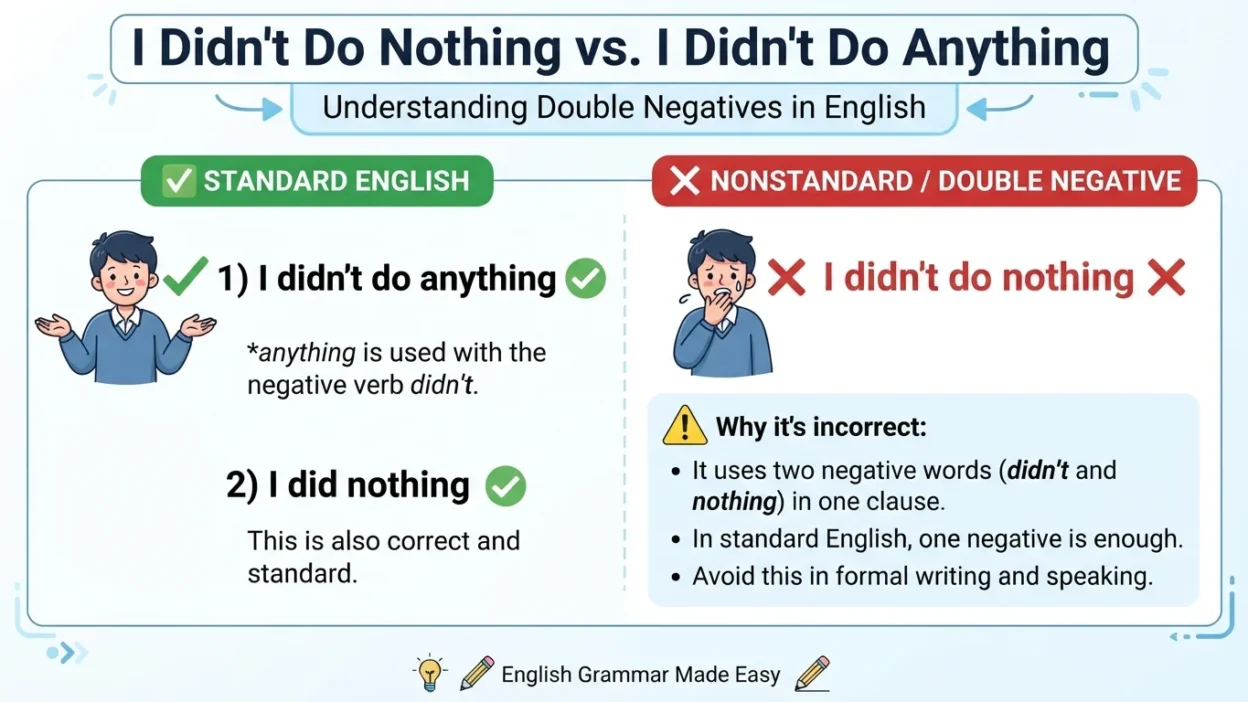
“I didn’t do anything” is the correct choice in standard English when you mean that you did not do any action.
“I didn’t do nothing” is generally considered a double negative in standard English. Some dialects and informal varieties use double negatives for emphasis, but it should usually be avoided in formal or standard writing.
Why People Confuse “I Didn’t Do Nothing” and “I Didn’t Do Anything”
The confusion happens because nothing and anything can both refer to an absence of things or actions.
For example:
- I did nothing.
- I didn’t do anything.
Both sentences communicate essentially the same idea.
The difference appears when nothing is combined with another negative such as didn’t.
The word didn’t already makes the verb negative:
I didn’t do…
Adding nothing introduces another negative:
I didn’t do nothing.
In standard English, this creates a double negative.
“I Didn’t Do Anything”
“I didn’t do anything” is the standard and grammatically appropriate expression when you want to say that you performed no action.
The structure is:
Subject + did not/didn’t + verb + anything
Examples:
- I didn’t do anything wrong.
- She didn’t do anything yesterday.
- We didn’t do anything unusual.
- He didn’t do anything to hurt you.
- They didn’t do anything about the problem.
Meaning
“I didn’t do anything” means:
I did not do any action.
It can also mean that you were not responsible for something.
For example:
“Who broke the window?”
“I didn’t do anything!”
Here, the speaker is denying responsibility.
Why “Anything” Works
After a negative verb such as didn’t, English commonly uses anything rather than nothing.
Compare:
- I did something. ✅
- I didn’t do anything. ✅
- I did nothing. ✅
The last two have approximately the same meaning.
“I Didn’t Do Nothing”
“I didn’t do nothing” contains two negative elements:
- didn’t = did not
- nothing = not anything
In standard English, this is usually considered a double negative.
If your intended meaning is “I did not do anything,” the standard version is:
I didn’t do anything.
Instead of:
I didn’t do nothing.
Is “I Didn’t Do Nothing” Always Wrong?
Not necessarily in every variety of English.
Double negatives occur in some dialects and informal speech. In those varieties, two negative words can work together to strengthen a negative meaning.
You may hear sentences such as:
“I didn’t do nothing.”
in everyday conversation, music, movies, or particular regional dialects.
However, if you are learning standard written English, especially for school, exams, professional writing, academic work, or formal communication, it is safer to use:
I didn’t do anything.
Comparison Table
| Expression | Standard English? | Meaning | Best Use |
|---|---|---|---|
| I didn’t do anything. | ✅ Yes | I did not do any action. | Formal and informal |
| I did nothing. | ✅ Yes | I did not do any action. | Formal and informal |
| I didn’t do nothing. | ⚠️ Usually nonstandard | Intended as “I did not do anything” | Some dialects/informal speech |
| I did something. | ✅ Yes | I performed an action. | General use |
| I didn’t do something. | ✅ Grammatically possible | I did not do a particular thing | Specific situations |
When to Use Each
Use “I Didn’t Do Anything”
Use “I didn’t do anything” when you want to say that you did not perform any action.
Examples:
- I didn’t do anything during the break.
- I didn’t do anything to cause the problem.
- I didn’t do anything wrong.
- I didn’t do anything after work.
- I didn’t do anything unusual.
This is the best choice for standard English.
Use “I Did Nothing”
You can also say “I did nothing.”
This is completely grammatical and has the same basic meaning.
Examples:
- I did nothing all weekend.
- She did nothing to stop him.
- He did nothing wrong.
- We did nothing about the situation.
“I did nothing” can sometimes sound more direct or formal than “I didn’t do anything.”
Avoid “I Didn’t Do Nothing” in Formal Writing
If you are writing an essay, application, report, email, or professional message, avoid:
I didn’t do nothing.
Instead, write:
I didn’t do anything.
or:
I did nothing.
Examples: “I Didn’t Do Anything”
Here are several natural examples:
- I didn’t do anything wrong.
- She didn’t do anything to upset him.
- I didn’t do anything after dinner.
- We didn’t do anything special this weekend.
- He didn’t do anything about the complaint.
- They didn’t do anything to help us.
- I didn’t do anything with your computer.
- She didn’t do anything unusual today.
- I didn’t do anything during the meeting.
- He said he didn’t do anything wrong.
- We didn’t do anything without asking first.
- I didn’t do anything to cause this problem.
Examples: “I Didn’t Do Nothing”
You may hear “I didn’t do nothing” in informal speech or certain dialects.
For example:
“I didn’t do nothing to him.”
In standard English, this would normally be written as:
“I didn’t do anything to him.”
Another example:
“I didn’t do nothing wrong.”
Standard English:
“I didn’t do anything wrong.”
The important point is that hearing a form in everyday speech does not automatically make it the preferred form for standard written English.
Common Mistakes
Mistake 1: Using “Nothing” After “Didn’t”
Incorrect in standard English when intended as a simple negative:
I didn’t do nothing.
Better:
I didn’t do anything.
Mistake 2: Thinking “Nothing” Is Always Wrong
The word nothing itself is not wrong.
You can correctly say:
I did nothing.
The problem is the combination of didn’t + nothing when both are intended to express one standard negative.
Mistake 3: Changing the Verb Form
After didn’t, use the base form of the verb.
Correct:
I didn’t do anything.
Incorrect:
I didn’t did anything.
Correct:
She didn’t go anywhere.
Incorrect:
She didn’t went anywhere.
Remember:
did + base verb
Mistake 4: Using “Didn’t” and “No” Together Incorrectly
The same principle applies to other negative words.
For example:
I didn’t see nobody.
In standard English, say:
I didn’t see anybody.
Or:
I saw nobody.
Memory Trick
Here is an easy rule:
Negative + anything = standard
Positive + nothing = standard
Think of these pairs:
- I didn’t do anything. ✅
- I did nothing. ✅
Avoid combining:
- I didn’t do nothing. ⚠️
A simple formula is:
didn’t → anything
did → nothing
This isn’t an absolute rule for every grammatical construction, but it is a very useful shortcut for this particular sentence pattern.
American vs British English
There is no major difference between American and British standard English in this situation.
Both varieties normally use:
- I didn’t do anything.
- I did nothing.
The double-negative form “I didn’t do nothing” can occur in informal speech and regional dialects in both broader English-speaking communities, but it is not the preferred form in standard formal writing.
So whether you are writing American English or British English, the safest standard choice is:
I didn’t do anything.
Similar Expressions
Several other expressions can communicate the same basic idea.
I Did Nothing
This is concise and grammatically correct.
I did nothing all day.
I Didn’t Do Anything
This is extremely common and natural in everyday English.
I didn’t do anything all day.
I Didn’t Do a Thing
This is informal and emphatic.
I didn’t do a thing all morning.
It means essentially the same as “I didn’t do anything.”
I Did Not Do Anything
This is the expanded form of “I didn’t do anything.”
I did not do anything wrong.
It can sound more formal or emphatic.
I Wasn’t Doing Anything
This focuses on an activity that was not happening at a particular time.
I wasn’t doing anything when you called.
Notice that this is different from simply saying that you performed no action during an entire period.
“I Didn’t Do Anything” vs “I Did Nothing”
Both are correct, but there can be a slight difference in style.
I didn’t do anything sounds very natural in everyday conversation.
I did nothing can sound more concise, emphatic, or formal.
Compare:
I didn’t do anything yesterday.
and:
I did nothing yesterday.
Both are grammatically correct.
The first is generally more conversational, while the second can feel more direct.
What About “I Didn’t Do Something”?
This sentence is also grammatically possible, but its meaning is different.
“I didn’t do something” usually refers to a particular thing that was expected, suggested, or discussed.
For example:
I didn’t do something you asked me to do.
This means there was a specific thing that the speaker failed to do.
By contrast:
I didn’t do anything.
means the speaker did no action at all or is making a general negative statement.
Compare:
I didn’t do anything.
= I did not do any action.
I didn’t do something.
= There was a particular thing I did not do.
This distinction is useful for ESL learners because anything and something are not interchangeable.
Frequently Asked Questions
Is “I didn’t do nothing” grammatically correct?
In standard English, it is generally considered a double negative and should be avoided when you mean “I did not do anything.” Some dialects use double negatives naturally in informal speech.
Is “I didn’t do anything” correct?
Yes. “I didn’t do anything” is standard, natural, and grammatically correct.
Can I say “I did nothing”?
Yes. “I did nothing” is also completely correct and means essentially the same thing as “I didn’t do anything.”
Why is “anything” used after “didn’t”?
In standard English, anything commonly appears in negative sentences.
For example:
I didn’t see anything.
She didn’t buy anything.
We didn’t hear anything.
Is “I didn’t do nothing” a double negative?
Yes. In standard English, didn’t and nothing are both negative elements, so their combination is generally treated as a double negative.
Do Americans say “I didn’t do nothing”?
You may hear it in informal speech or particular dialects, but standard American English generally uses “I didn’t do anything” for formal and standard communication.
What is the simplest way to remember the difference?
Remember:
I didn’t + anything
or
I + did + nothing
So:
I didn’t do anything. ✅
I did nothing. ✅
Final Verdict
If you are choosing between “I didn’t do nothing” and “I didn’t do anything,” use “I didn’t do anything” in standard English.
The sentence “I didn’t do nothing” contains a double negative and is generally considered nonstandard when the intended meaning is “I did not do anything.” It may appear in dialectal or informal speech, but it is not the best choice for academic, professional, or formal writing.
The other correct option is “I did nothing.” Both “I didn’t do anything” and “I did nothing” communicate the idea that no action was performed.
Conclusion
The difference between “I didn’t do nothing” and “I didn’t do anything” comes down to how standard English handles negative words. Because didn’t already makes a sentence negative, standard English normally uses anything rather than nothing after it. Therefore, “I didn’t do anything” is the safest and most natural choice.
You can also use “I did nothing,” which is equally grammatical. For everyday conversation, “I didn’t do anything” is especially natural, while “I did nothing” can sound more concise or emphatic. If you are writing for school, work, an exam, or a professional audience, remember the simple rule: didn’t + anything; did + nothing.
Remember This
I didn’t do anything. ✅
I did nothing. ✅
I didn’t do nothing. ⚠️ Usually avoid in standard English.
Easy memory trick:
👉 Didn’t → anything
👉 Did → nothing

A passionate linguist who specializes in word relationships and vocabulary building.
He has spent years studying synonyms and semantic patterns across languages.
Arman writes to make language learning simple, precise, and engaging.