Propose and purpose look and sound somewhat similar, so it is easy to confuse them when writing or speaking English. However, these two words have completely different meanings and grammatical uses.
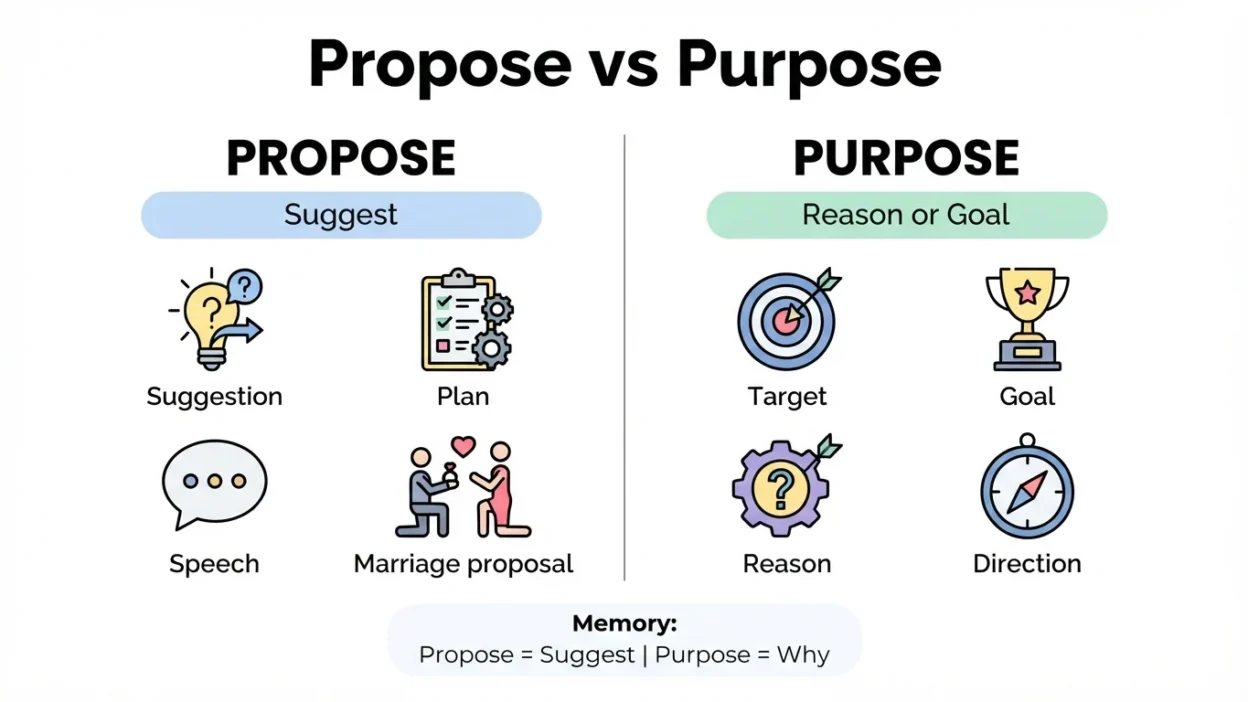
Propose is a verb that means to suggest an idea, plan, or course of action. It can also mean to formally ask someone to marry you. Purpose, on the other hand, is usually a noun referring to the reason something exists or the goal behind an action. Understanding this difference will help you choose the correct word in essays, emails, conversations, and professional writing.
Quick Answer: Propose vs Purpose
Propose is a verb meaning “to suggest” or “to formally ask for marriage.” Purpose is a noun meaning “the reason for something” or “the goal someone wants to achieve.” For example, “I propose a new plan” uses propose, while “What is the purpose of this meeting?” uses purpose.
Why People Confuse Propose and Purpose
The confusion mainly comes from their similar spelling and pronunciation. Both words begin with “pro” and contain similar vowel sounds, making them easy to mix up, especially for English learners.
Their meanings, however, are quite different:
- Propose → suggest or put forward an idea
- Purpose → reason, aim, or goal
There is also a grammatical difference. Propose is primarily a verb, while purpose is primarily a noun.
Compare:
“I propose a different solution.”
Here, propose describes an action.
“The purpose of the solution is to reduce costs.”
Here, purpose identifies the reason or goal.
Propose: Meaning and Usage
Propose is a verb. It means to suggest something for consideration, discussion, or acceptance.
Common meanings of propose
- To suggest an idea or plan
- “I propose a new strategy for the project.”
- To formally suggest something
- “The committee proposed several changes.”
- To ask someone to marry you
- “He proposed to his longtime partner.”
- To formally put forward a plan or action
- “The government proposed new regulations.”
Common phrases with propose
- propose a plan
- propose an idea
- propose a solution
- propose changes
- propose a theory
- propose a new approach
- propose a law
- propose marriage
- propose to someone
Examples of propose
- “I propose that we start the meeting earlier.”
- “She proposed a creative solution to the problem.”
- “The researchers proposed a new explanation.”
- “They proposed several improvements.”
- “He proposed to her during their vacation.”
Remember: If you are suggesting something, you probably need propose.
Purpose: Meaning and Usage
Purpose is primarily a noun. It refers to the reason something exists, the reason an action is performed, or the goal someone wants to achieve.
Common meanings of purpose
- Reason for something
- “What is the purpose of this machine?”
- Goal or objective
- “The purpose of the campaign is to raise awareness.”
- Intended use
- “This room serves a special purpose.”
- A sense of direction or meaning
- “She feels a strong sense of purpose in her career.”
Common phrases with purpose
- purpose of something
- main purpose
- primary purpose
- intended purpose
- specific purpose
- purpose of the meeting
- purpose of the study
- sense of purpose
- for the purpose of
- on purpose
Examples of purpose
- “The purpose of this meeting is to discuss the budget.”
- “What is the purpose of this tool?”
- “He works with a strong sense of purpose.”
- “She did it on purpose.”
- “The study was conducted for the purpose of collecting data.”
Remember: If you are talking about the reason, aim, or goal, use purpose.
Propose vs Purpose: Comparison Table
| Feature | Propose | Purpose |
|---|---|---|
| Part of speech | Verb | Noun |
| Main meaning | To suggest | Reason, aim, or goal |
| Common use | Propose an idea | Purpose of something |
| Another meaning | Ask someone to marry you | Intended function |
| Example | “I propose a new plan.” | “What is the purpose?” |
| Related question | What do you suggest? | Why does it exist? |
When to Use Propose
Use propose when someone is suggesting an idea, plan, solution, change, or action.
Use propose for:
Ideas
- “She proposed an interesting idea.”
Plans
- “The manager proposed a new marketing plan.”
Solutions
- “He proposed a solution to the problem.”
Changes
- “The organization proposed several changes.”
Formal suggestions
- “The committee proposed a new policy.”
Marriage
- “He proposed to his girlfriend.”
A useful pattern is:
Subject + propose + idea/plan/solution
For example:
“The teacher proposed a new method.”
When to Use Purpose
Use purpose when you are explaining why something exists, happens, or is done.
Use purpose for:
Reasons
- “What is the purpose of this rule?”
Goals
- “The purpose of the project is to improve communication.”
Functions
- “The purpose of this button is to reset the system.”
Intentions
- “He came here with a specific purpose.”
Personal direction
- “She found a new sense of purpose.”
A useful pattern is:
the purpose of + noun + is + reason/goal
For example:
“The purpose of this lesson is to improve vocabulary.”
12 Examples of Propose and Purpose
Here are practical examples to make the difference easier to remember:
- I propose a new solution to the problem.
→ I am suggesting a solution. - The purpose of the meeting is to discuss the project.
→ The reason for the meeting is discussion. - She proposed a change to the schedule.
→ She suggested a change. - What is the purpose of this device?
→ What is this device intended to do? - The researchers proposed a new theory.
→ They suggested a theory. - The purpose of the experiment was to test the hypothesis.
→ The goal was to test it. - He proposed to her after several years together.
→ He asked her to marry him. - The purpose of the campaign is to educate people.
→ Its goal is education. - The manager proposed several improvements.
→ The manager suggested improvements. - This tool has a specific purpose.
→ It has a particular intended use. - I propose that we postpone the meeting.
→ I suggest postponing it. - She believes her work has a meaningful purpose.
→ She believes her work has an important goal or meaning.
Common Mistakes
Mistake 1: Using purpose when you mean suggest
❌ “I purpose a new idea.”
✅ “I propose a new idea.”
Why?
You are suggesting the idea, so the verb propose is required.
Mistake 2: Using propose when you mean reason
❌ “What is the propose of this meeting?”
✅ “What is the purpose of this meeting?”
Why?
You are asking about the reason or goal, so use the noun purpose.
Mistake 3: Confusing “propose to” with “purpose”
❌ “He purposed to her.”
✅ “He proposed to her.”
When talking about marriage, the correct verb is propose.
Mistake 4: Confusing purpose with proposal
Proposal is the noun related to propose.
- Propose = verb
- Proposal = noun
- Purpose = noun meaning reason or goal
Example:
“She proposed a new plan.”
“Her proposal was accepted.”
Memory Trick: Propose vs Purpose
Try this simple memory trick:
PROPOSE = PUT FORWARD
If you propose something, you put an idea, plan, or suggestion forward.
PURPOSE = WHY
If you ask about the purpose, you are asking why something exists or is done.
Think:
Propose → Suggest
Purpose → Why
This quick association can help you avoid the mistake in everyday writing.
American vs British English
There is no major difference between American and British English when using propose and purpose.
Both varieties use:
- propose for suggesting something
- propose to someone for a marriage proposal
- purpose for a reason, aim, or goal
For example, both American and British speakers would naturally say:
“The purpose of the meeting is to discuss the new project.”
And:
“She proposed a different approach.”
The spelling and basic meanings remain the same.
Similar Words
Understanding related words can make the distinction even clearer.
Words related to propose
- suggest
- recommend
- offer
- put forward
- present
- advocate
- nominate
Example:
“She suggested a different approach.”
This is similar to:
“She proposed a different approach.”
Words related to purpose
- reason
- aim
- goal
- objective
- intention
- function
- use
Example:
“The goal of the project is to improve customer service.”
This is closely related to:
“The purpose of the project is to improve customer service.”
Propose vs Purpose in a Sentence
A simple way to choose between the two is to look at what you are trying to say.
Ask yourself:
Am I suggesting something?
If yes, use propose.
“I propose a new plan.”
Am I explaining why something exists or is being done?
If yes, use purpose.
“The purpose of the plan is to save money.”
This question-based method works particularly well for ESL learners because it focuses on meaning rather than spelling.
FAQs About Propose or Purpose
1. Is “propose” and “purpose” the same?
No. Propose is mainly a verb meaning to suggest something or ask someone to marry you. Purpose is mainly a noun meaning the reason, aim, or goal of something.
2. Is it “I purpose a plan” or “I propose a plan”?
The correct sentence is “I propose a plan.” Propose means to suggest or put forward a plan.
3. What is the noun form of propose?
The noun form is proposal.
For example:
“The committee proposed a new policy.”
“The committee’s proposal was approved.”
4. What is the meaning of purpose?
Purpose means the reason something exists, the goal of an action, or the intended use of something.
5. Is “purpose” a verb?
Purpose can also function as a verb in some contexts, although it is much more commonly used as a noun. As a verb, it can mean to intend or design something for a particular use.
For everyday writing, the noun purpose is far more common.
6. Is “propose” used for marriage?
Yes. Propose can mean to ask someone to marry you.
Example:
“He proposed to her on their anniversary.”
7. What is the easiest way to remember propose and purpose?
Remember:
Propose = suggest.
Purpose = why.
If you are putting an idea forward, use propose. If you are explaining the reason or goal, use purpose.
Final Verdict
Propose and purpose are both correct English words, but they have different meanings and grammatical roles. Propose is a verb used when someone suggests an idea, plan, solution, or action. It can also describe asking someone to marry you.
Purpose is primarily a noun that describes the reason, goal, aim, or intended function of something. The easiest distinction is simple: propose means “suggest,” while purpose means “reason or goal.” Once you connect these words with their core meanings, it becomes much easier to use them correctly.
Remember This
PROPOSE = SUGGEST
PURPOSE = WHY
If you are suggesting an idea, choose propose.
If you are explaining the reason or goal, choose purpose.
Correct: “I propose a new strategy.”
Correct: “The purpose of the strategy is to improve efficiency.”
Conclusion
Knowing the difference between propose or purpose can prevent a surprisingly common English mistake. Although the words look similar, their functions are completely different. Use propose when you want to suggest something, and use purpose when you want to talk about a reason, goal, intention, or function.
For ESL learners, writers, students, and professionals, the easiest rule is to remember the two key words: propose = suggest and purpose = why. Keep this distinction in mind, and you will be able to use both words naturally and confidently in everyday and formal English.

An expert in English grammar and expressive writing techniques.
She focuses on helping readers expand their vocabulary with clarity.
Elina believes the right word can transform ordinary writing into powerful communication.