Shown and showed are both forms of the verb show, but they are used differently in English grammar. Because both words describe something that was displayed, presented, or made visible, many learners are unsure which one belongs in a particular sentence.
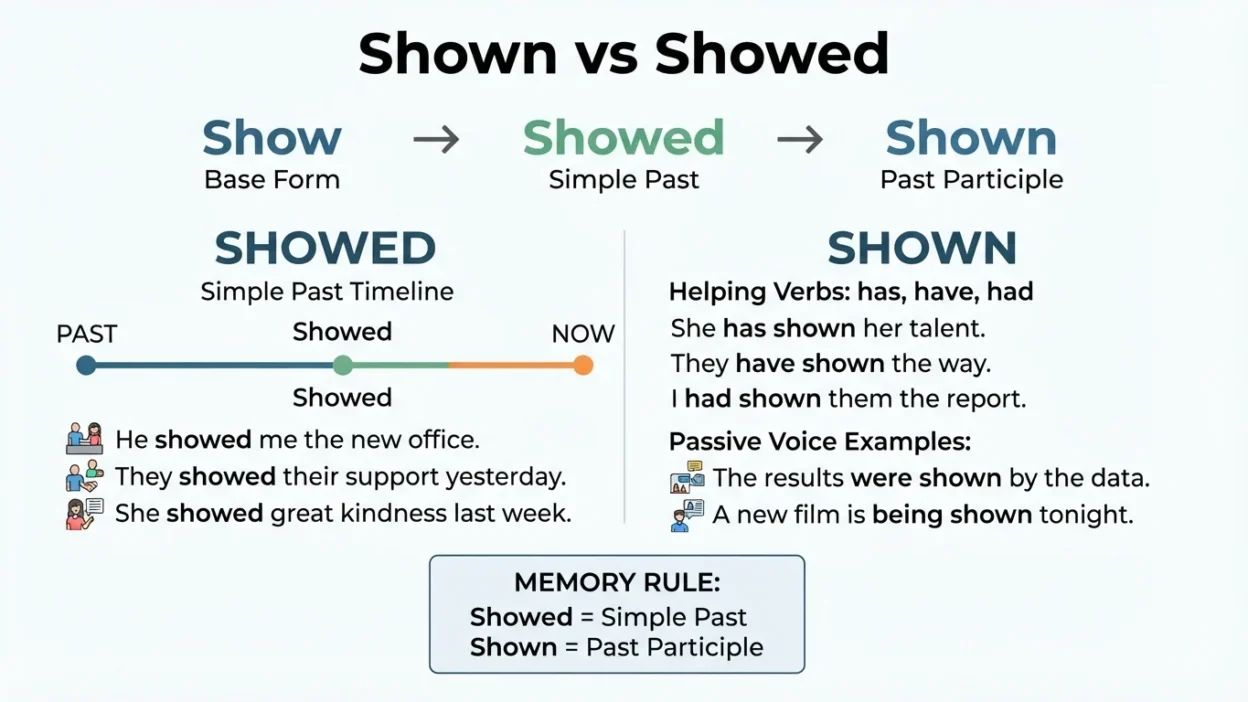
The good news is that the rule is straightforward. Showed is the simple past form of show, while shown is usually the past participle. This means showed normally works as a standalone past-tense verb, whereas shown generally needs a helping verb such as has, have, had, is, or was, depending on the construction.
Quick Answer
Showed is the simple past tense of show.
Shown is the past participle and is normally used with a helping verb.
Examples:
She showed me the picture. ✅
She has shown me the picture. ✅
She shown me the picture. ❌
Easy rule: Showed = simple past. Shown = past participle.
Why Do People Confuse “Shown” and “Showed”?
The confusion happens because show is an irregular verb with more than one accepted past form.
Its main forms are:
| Verb Form | Word |
|---|---|
| Base form | show |
| Simple past | showed |
| Past participle | shown |
So you can say:
I show my work.
I showed my work yesterday.
I have shown my work already.
The important thing is to identify the tense and the helping verb before choosing the form.
What Does “Showed” Mean?
Showed is the simple past tense of show. It describes something that happened in the past.
Examples
- She showed me her new dress.
- He showed us the way.
- They showed their support.
- The teacher showed the students a video.
- I showed him my photographs.
In these sentences, showed stands as the main past-tense verb.
What Does “Shown” Mean?
Shown is the past participle of show.
It is commonly used with has, have, or had:
- She has shown great improvement.
- They have shown their support.
- He had shown me the document.
It can also appear in passive constructions:
- The results were shown on the screen.
- The movie was shown at the festival.
- The evidence was shown to the jury.
Shown vs Showed: Comparison Table
| Word | Grammatical Form | Typical Use | Example |
|---|---|---|---|
| Showed | Simple past | Completed past action | She showed me the photo. |
| Shown | Past participle | Perfect tenses and passive voice | She has shown me the photo. |
When to Use “Showed”
Use showed when you are talking about a completed action in the past and there is no auxiliary verb requiring a past participle.
Examples
She showed me her new phone.
He showed his parents the results.
The guide showed us around the museum.
I showed them my project yesterday.
The teacher showed us an interesting experiment.
Common time expressions with “showed”
You may use showed with expressions such as:
- yesterday
- last night
- last week
- earlier
- a few minutes ago
- in 2025
- when I was younger
For example:
She showed me the message yesterday.
When to Use “Shown”
Use shown when the grammar requires a past participle.
1. Present perfect
Has/have + shown
She has shown remarkable progress.
They have shown great interest.
2. Past perfect
Had + shown
He had shown me the document before the meeting.
3. Future perfect
Will have + shown
By tomorrow, the company will have shown the new product to investors.
4. Passive voice
Be + shown
The film was shown on television.
The results were shown to the committee.
“Has Shown” vs “Showed”
Both can be correct, but they belong to different grammatical structures.
Showed
She showed me the results yesterday.
This describes a completed past action.
Has shown
She has shown me the results.
This is present perfect. It connects a past action to the present or focuses on experience/recent relevance.
The time expression can also help:
She showed me the results yesterday. ✅
She has shown me the results already. ✅
She has shown me the results yesterday. ❌
With a finished specific past time such as yesterday, simple past showed is normally preferred.
10+ Examples of “Showed”
- She showed me her new car.
- He showed us how to solve the problem.
- They showed great courage.
- The teacher showed the class a video.
- I showed her the message.
- He showed his friends the photograph.
- The doctor showed me the results.
- She showed everyone her artwork.
- The guide showed us around the city.
- The presentation showed how the system works.
- He showed his appreciation for their help.
10+ Examples of “Shown”
- She has shown great improvement.
- He has shown strong leadership.
- They have shown considerable interest.
- The results have shown a clear pattern.
- She had shown me the document earlier.
- The movie was shown at the theater.
- The evidence was shown to the judge.
- The results were shown on the screen.
- The product has been shown to customers.
- He has shown that he can handle the responsibility.
- The data have shown a significant change.
Common Mistakes
Mistake 1: Using “shown” without a helping verb
❌ She shown me the picture.
✅ She showed me the picture.
In standard modern English, shown normally needs a helping verb in this type of sentence.
Mistake 2: Using “showed” after “has”
❌ She has showed me the results.
✅ She has shown me the results.
For standard English, use the past participle after has/have/had.
Mistake 3: Confusing simple past with past participle
Remember:
show → showed → shown
Do not automatically choose shown just because the action happened in the past.
The tense determines the form.
Memory Trick
Use this simple pattern:
SHOW → SHOWED → SHOWN
Think of it like this:
Yesterday → SHOWED
Has/Have/Had → SHOWN
Examples:
I showed it yesterday.
I have shown it already.
Golden Rule
Showed = simple past
Shown = past participle
American vs British English
There is an interesting historical detail here.
In both American and British English, showed is the standard simple past form, and shown is widely used as the past participle.
However, showed can occasionally be found as a past participle in some varieties or older usage, particularly in certain literary or dialectal contexts.
For modern standard English, especially in formal, academic, professional, and educational writing, the safest pattern is:
show → showed → shown
So write:
She has shown excellent progress. ✅
rather than:
She has showed excellent progress. ❌
Shown vs Shown to Be
A common formal construction is:
has been shown to be
For example:
The method has been shown to be effective.
This means evidence or experience has demonstrated that something is effective.
Other examples:
- The treatment has been shown to be safe.
- The strategy has been shown to be effective.
- The technique has been shown to be reliable.
This construction is particularly common in academic and professional writing.
Shown vs Seen
Do not confuse shown with seen.
Shown comes from show and means displayed, presented, or demonstrated.
Seen comes from see and means perceived with the eyes or otherwise noticed.
Compare:
She showed me the picture.
I have seen the picture.
The person shows something; another person sees it.
How to Choose the Right Word
Ask yourself what grammatical structure you are using.
Use “showed” when:
- You are describing a simple past action.
- No perfect-tense auxiliary requires a past participle.
He showed me the document.
Use “shown” when:
- It follows has.
- It follows have.
- It follows had.
- It appears in a passive construction such as was shown or were shown.
- It follows another auxiliary structure requiring the past participle.
She has shown great improvement.
Quick Guide
- I show → present/base form
- I showed → simple past
- I have shown → present perfect
- I had shown → past perfect
- It was shown → passive voice
- She has shown → correct
- She has showed → incorrect in standard English
Final Verdict
Showed and shown are both correct forms of the verb show, but they have different grammatical jobs. Showed is the simple past form, while shown is the standard past participle.
Remember the pattern show → showed → shown. Use showed for a straightforward past action, such as “She showed me the picture.” Use shown after has, have, or had, and in passive constructions, such as “She has shown me the picture” or “The picture was shown to the class.”
FAQs
Is “shown” the past tense of show?
Not exactly. Showed is the simple past tense, while shown is the past participle.
Is “showed” correct?
Yes. Showed is the standard simple past form of show.
She showed me the picture.
Is “shown” correct?
Yes. Shown is the standard past participle.
She has shown me the picture.
Is “I have showed” correct?
In standard modern English, the preferred form is:
I have shown.
Not:
I have showed. ❌
Can I say “She shown me”?
No, not in standard English. Say:
She showed me.
Or:
She has shown me.
What is the past participle of show?
The standard past participle is shown.
has shown
have shown
had shown
What is the difference between “showed” and “shown”?
Showed is simple past. Shown is past participle.
She showed me yesterday.
She has shown me already.
Is “was shown” correct?
Yes. Was shown is a standard passive construction.
The documentary was shown on television.
Conclusion
The choice between shown and showed depends on grammar, not simply on whether the action happened in the past. Showed is the simple past form and can stand as the main verb in a past-tense sentence. Shown is the past participle and normally appears with helping verbs such as has, have, or had, or in passive constructions.
The easiest way to remember the difference is show → showed → shown. If you are describing a straightforward past event, choose showed. If you have a structure such as has shown, have shown, had shown, or was shown, choose shown. Once you recognize the grammatical pattern, this commonly confused pair becomes easy to use correctly.

An expert in English grammar and expressive writing techniques.
She focuses on helping readers expand their vocabulary with clarity.
Elina believes the right word can transform ordinary writing into powerful communication.