English has many words that look or sound similar but have completely different meanings. This can be confusing, especially for students, ESL learners, writers, and anyone trying to improve their vocabulary. Three terms that are often mixed up are homophone, homograph, and homonym.
Although these words are related, they describe different kinds of word relationships. Understanding the difference can help you recognize spelling patterns, pronunciation similarities, and words with multiple meanings.
The easiest way to remember them is to focus on sound and spelling. Homophones share a sound, homographs share a spelling, and homonyms are words that are the same in some form but have different meanings.
Quick Answer
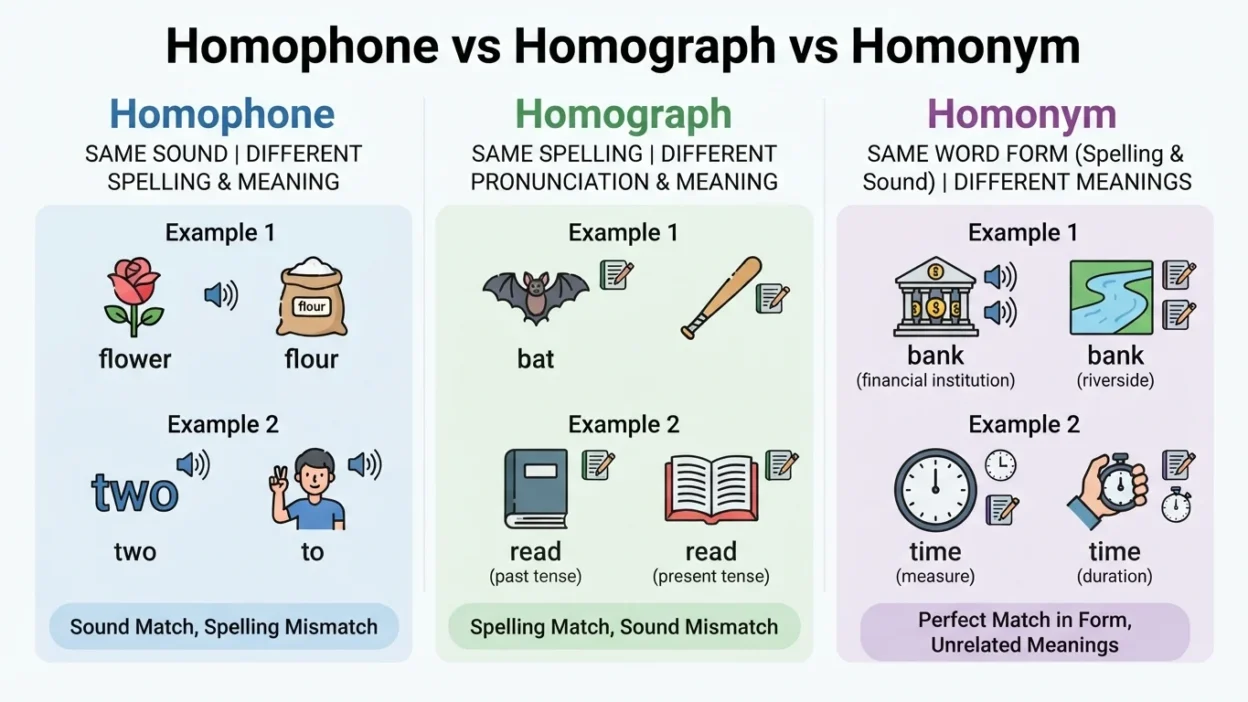
A homophone is a word that sounds the same as another word but has a different meaning or spelling, such as flour and flower. A homograph is spelled the same as another word but has a different meaning, such as bat (animal) and bat (sports equipment). A homonym is a broader term for words that share the same spelling or pronunciation while having different meanings.
Why People Confuse Homophones, Homographs, and Homonyms
The confusion comes from the Greek roots behind these terms.
- Homo- means “same.”
- -phone relates to sound.
- -graph relates to writing or spelling.
- -nym means name or word.
So:
Homophone = same sound
Homograph = same spelling
Homonym = same word form/name
The tricky part is that homonym can be used differently depending on the dictionary or linguistic tradition. Some definitions use it as an umbrella term for words that have the same spelling and/or pronunciation but different meanings.
What Is a Homophone?
A homophone is a word that is pronounced the same as another word but has a different meaning and often a different spelling.
For example:
- flower — the blooming part of a plant
- flour — a powder used in cooking and baking
They sound alike but are spelled differently and have different meanings.
Common Homophone Examples
| Homophone | Meaning | Homophone |
|---|---|---|
| flour | baking ingredient | flower |
| sea | large body of salt water | see |
| right | correct/direction | write |
| pair | two things | pear |
| sun | star at the center of our solar system | son |
| night | period of darkness | knight |
| hear | perceive sound | here |
| allowed | permitted | aloud |
| brake | stopping mechanism | break |
| plain | simple/ordinary | plane |
Example Sentences
- I bought some flour to bake a cake.
- The garden has a beautiful flower.
- Can you hear me?
- Please come over here.
- Turn right at the corner.
- Please write your name.
The pronunciation may be identical or nearly identical depending on the accent, but the spelling and meanings are different.
What Is a Homograph?
A homograph is a word that has the same spelling as another word but a different meaning.
Some homographs are also pronounced differently. These are often called heteronyms.
For example:
bat
- bat = a flying mammal
- bat = a piece of sports equipment
The spelling and pronunciation are the same, but the meanings are different.
Another example is lead:
- lead = to guide
- lead = a type of metal
Here, the spelling is the same, but the pronunciation is different.
Common Homograph Examples
| Word | Meaning 1 | Meaning 2 |
|---|---|---|
| bat | flying mammal | sports equipment |
| bark | tree covering | sound made by a dog |
| bank | financial institution | side of a river |
| spring | season | source of water |
| light | not heavy | illumination |
| match | contest | small stick used to make fire |
| left | opposite of right | departed |
| watch | look carefully | timepiece |
| seal | marine animal | close tightly |
| lead | guide | metal |
Example
The dog began to bark near the bark of the tree.
The word bark has the same spelling but two different meanings.
What Is a Homonym?
Homonym is the broadest and sometimes most confusing term of the three.
In general, homonyms are words that have the same spelling or pronunciation but different meanings. Depending on the linguistic definition being used, homonyms may include both homophones and homographs.
For example:
bank
- a place where people keep money
- the land beside a river
The word is spelled and pronounced the same, but its meanings are different.
Another example:
bat
- a flying animal
- a piece of sports equipment
Because these words have the same form but unrelated meanings, they can be described as homonyms.
Homophone vs Homograph vs Homonym: Comparison Table
| Feature | Homophone | Homograph | Homonym |
|---|---|---|---|
| Same sound? | Yes | Sometimes | Often |
| Same spelling? | Usually no | Yes | Often |
| Different meanings? | Yes | Yes | Yes |
| Main focus | Pronunciation | Spelling | Same word form/name |
| Example | flour / flower | bat / bat | bank / bank |
The Simplest Difference
Think of the three words like this:
Homophone → Sound
Homograph → Spelling
Homonym → Same word form with different meanings
When to Use Each Term
Use “Homophone” When Sound Is the Same
If two words sound alike but have different meanings, they are homophones.
Example:
- to
- too
- two
All three are pronounced alike in standard English, but their spellings and meanings differ.
Use “Homograph” When Spelling Is the Same
If two words are spelled exactly the same but have different meanings, they are homographs.
Example:
- spring = a season
- spring = a coil or source of water
Use “Homonym” as the Broader Category
When words have the same written or spoken form but different meanings, homonym may be used as the general term.
However, terminology varies among textbooks and linguists. That’s why you may sometimes see a word classified as both a homonym and a homograph.
10+ Examples of Homophones, Homographs, and Homonyms
Homophones
- sea / see — ocean / perceive with your eyes
- right / write — correct / form words on paper
- pair / pear — two things / fruit
- flower / flour — plant bloom / baking ingredient
- night / knight — darkness / medieval warrior
- son / sun — male child / star
- hear / here — perceive sound / this place
- brake / break — stopping device / separate or damage
Homographs
- bat — animal / sports equipment
- bark — tree covering / dog sound
- bank — financial institution / river edge
- light — illumination / not heavy
- watch — observe / timepiece
- match — contest / fire-starting stick
Homonyms
- bank — financial institution / river edge
- bat — animal / sports equipment
- seal — marine mammal / close securely
- park — public green space / leave a vehicle somewhere
Notice that some examples can fit more than one category depending on the definition being used.
Common Mistakes
Mistake 1: Thinking Homophones Have the Same Spelling
They don’t necessarily have the same spelling.
Wrong idea: Homophones are words spelled alike.
Correct: Homophones are primarily about sound.
For example:
right / write
They sound alike but are spelled differently.
Mistake 2: Thinking Every Homograph Has a Different Pronunciation
Not all homographs have different pronunciations.
bat / bat has the same pronunciation but different meanings.
Other homographs, such as lead, have different pronunciations.
Mistake 3: Treating Homonym and Homophone as Exact Synonyms
They are related, but they are not always interchangeable.
Homophone specifically highlights pronunciation.
Homograph specifically highlights spelling.
Homonym is often used as a broader category.
Memory Trick
Here is an easy three-word memory trick:
HOMO + PHONE = SAME SOUND
Think of a phone as something you hear through.
Homophone = same sound.
HOMO + GRAPH = SAME WRITING
Think of a graph as something written or represented.
Homograph = same spelling.
HOMO + NYM = SAME NAME/WORD
Think of -nym as referring to a name or word.
Homonym = same word form/name, different meaning.
So remember:
Phone = sound
Graph = writing
Nym = name/word
American vs British English
The basic concepts of homophones, homographs, and homonyms are the same in American and British English.
However, pronunciation can vary between accents. This means that two words may be homophones in one variety of English but not perfectly homophonous in another.
For example, regional pronunciation differences can affect whether two words sound identical.
The important point is that the classification often depends on the pronunciation variety being discussed.
Similar Words
You may also encounter a few related linguistic terms.
Heteronym
A heteronym is a word spelled the same as another word but pronounced differently and having a different meaning.
Example:
lead
- /liːd/ = to guide
- /lɛd/ = a metal
Polysemy
Polysemy occurs when one word has multiple related meanings.
For example, head can refer to a person’s body part, the leader of a group, or the top/front of something. These meanings are related rather than completely unrelated.
Homophone
Same or nearly the same pronunciation, different meaning, often different spelling.
Homograph
Same spelling, different meaning; pronunciation may be the same or different.
Homonym
A broader term commonly used for words sharing the same form or pronunciation while having different meanings.
Final Verdict
The easiest way to distinguish these three terms is to focus on what is the same.
Homophones have the same sound. Homographs have the same spelling. Homonyms are words with the same form or sound but different meanings, and the exact definition can vary by linguistic source.
For everyday English learning, you do not need to memorize complicated terminology. Just ask yourself: Do they sound the same? Are they spelled the same? Or do they simply share a word form while having different meanings?
FAQs
1. What is the main difference between a homophone and a homograph?
A homophone focuses on sound, while a homograph focuses on spelling. Homophones sound alike, whereas homographs are spelled alike.
2. Is “flower” and “flour” a homonym?
They are definitely homophones because they sound alike but have different spellings and meanings. Some broader definitions of homonym may include them, but “homophone” is the more precise term.
3. Is “bat” a homograph?
Yes. Bat can mean a flying mammal or sports equipment. It has the same spelling in both meanings.
4. Is every homograph a homonym?
Under broad definitions of “homonym,” yes, homographs can be considered a type of homonym. However, terminology varies, so educational sources may distinguish the categories more strictly.
5. What is an example of a homonym?
Bank is a common example. It can mean a financial institution or the land alongside a river.
6. What is a heteronym?
A heteronym is a type of homograph whose different meanings have different pronunciations, such as lead meaning “guide” versus lead meaning the metal.
7. What is the easiest way to remember these terms?
Remember:
Homophone = same sound
Homograph = same spelling
Homonym = same word form/name
Conclusion
Homophone, homograph, and homonym may sound like complicated grammar terms, but their differences become much easier once you focus on sound and spelling. Homophones sound the same, homographs are spelled the same, and homonyms are a broader category involving words that share a form or pronunciation while having different meanings.
Learning these terms is useful because English contains many confusing word pairs and groups. Once you understand the pattern, words such as right/write, bat/bat, and bank/bank become much easier to analyze and remember.
Remember This
Homophone → same sound
Homograph → same spelling
Homonym → same word form/name, different meaning

A creative writer with a deep interest in word usage and meaning.
He explores synonyms to enhance both academic and creative expression.
Zayn’s work aims to make language richer and more accessible for everyone.