English irregular verbs can be tricky because they do not always follow the usual -ed pattern. Sweeped vs swept is a good example. When talking about the past tense of sweep, many learners naturally want to add -ed and say “sweeped.” However, standard English uses a completely different form: swept.
If you have ever wondered whether to say “I sweeped the floor” or “I swept the floor,” the answer is straightforward: swept is correct in standard English. Sweeped is generally considered incorrect when you mean the past tense or past participle of sweep. Learning the verb forms and a few simple examples will make this distinction easy to remember.
Quick Answer
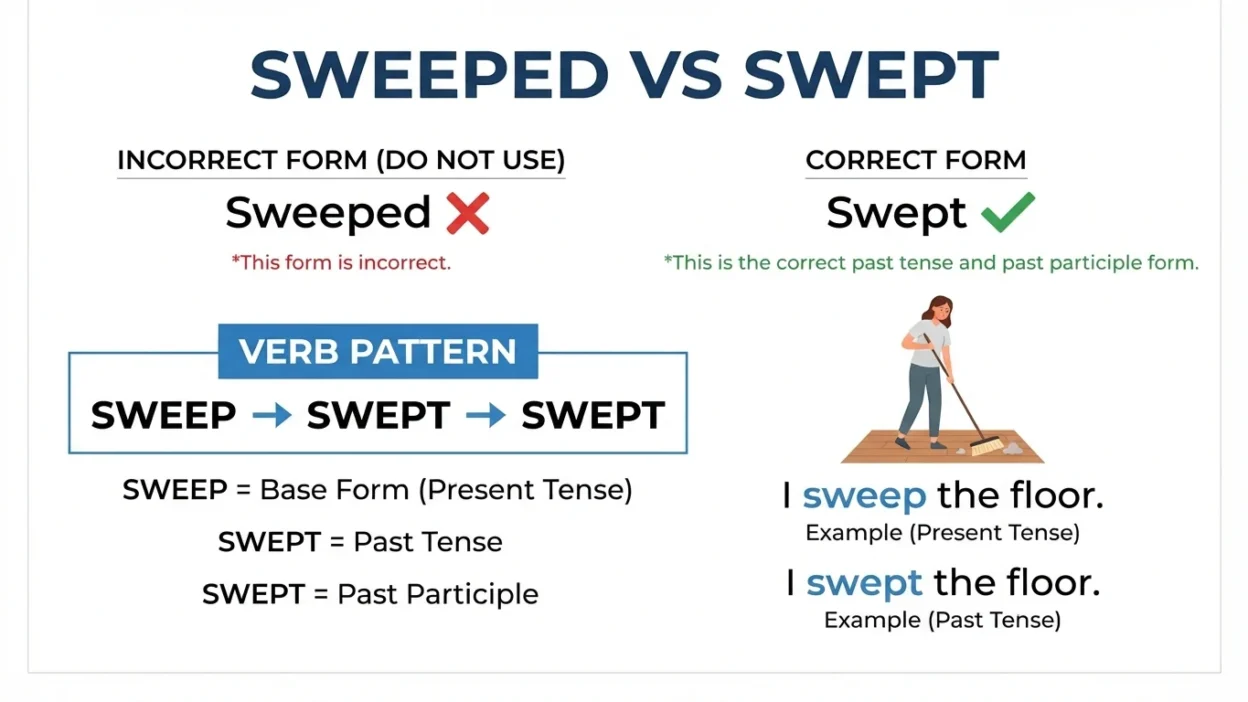
Swept is the correct past tense and past participle of sweep. Sweeped is not the standard form. For example, say “I swept the floor yesterday,” not “I sweeped the floor yesterday.” The verb forms are sweep → swept → swept.
Why People Confuse Sweeped and Swept
The main reason for the confusion is that many English verbs form their past tense by adding -ed.
For example:
- clean → cleaned
- walk → walked
- jump → jumped
- wash → washed
Because sweep ends in a consonant sound and looks like an ordinary verb, learners may assume that its past form is sweeped.
However, sweep is an irregular verb.
Instead of adding -ed, it changes to swept.
sweep → swept → swept
This is similar to other irregular verbs such as:
- keep → kept
- sleep → slept
- feel → felt
- leave → left
First Word: Sweeped
Sweeped is generally not correct in standard modern English when used as the past tense or past participle of sweep.
For example:
❌ I sweeped the floor yesterday.
The correct sentence is:
✅ I swept the floor yesterday.
Although you may occasionally encounter “sweeped” in informal writing, learner English, or nonstandard usage, it should be avoided in formal and standard English.
Why “Sweeped” Sounds Natural
It follows a common English pattern:
verb + -ed = past tense
So learners may reason:
sweep + ed = sweeped
That pattern works for many regular verbs, but not for sweep.
The correct irregular form is:
sweep → swept
Second Word: Swept
Swept is the correct past tense and past participle of sweep.
The verb sweep can mean to clean a surface using a broom or brush. It can also have several figurative meanings, such as moving across an area quickly or winning everything in a series of competitions.
Examples of Swept
- I swept the kitchen floor.
- She swept the room before the guests arrived.
- They swept the dirt into a pile.
- The wind swept across the field.
- The team swept the series.
Verb Forms
| Form | Verb |
|---|---|
| Base form | sweep |
| Simple past | swept |
| Past participle | swept |
| Present participle | sweeping |
So the complete pattern is:
Sweep → Swept → Swept
Comparison Table
| Feature | Sweeped | Swept |
|---|---|---|
| Standard English? | ❌ No | ✅ Yes |
| Base verb | Sweep | Sweep |
| Past tense | ❌ Incorrect | ✅ Correct |
| Past participle | ❌ Incorrect | ✅ Correct |
| Example | I sweeped the floor. | I swept the floor. |
| Verb type | Incorrect regularized form | Irregular verb form |
Easy Rule
Never use sweeped when you mean the past tense of sweep.
Use:
sweep → swept
For the past participle, use:
have/has/had swept
When to Use Each
Use “Sweep” for the Present
Use sweep when describing an action that happens now, regularly, or in the future.
Examples:
- I sweep the floor every morning.
- We sweep the classroom after school.
- She will sweep the porch later.
Use “Swept” for the Simple Past
Use swept when the action happened in the past.
Examples:
- I swept the floor yesterday.
- She swept the kitchen this morning.
- They swept the leaves from the driveway.
Use “Swept” After Have, Has, or Had
Swept is also the past participle.
Examples:
- I have swept the room.
- She has swept the floor.
- They had swept the entire building before the inspection.
Notice that swept remains the same in both the simple past and past participle.
12 Examples of Sweep vs Swept
- I sweep the floor every evening.
- I swept the floor yesterday.
- She sweeps the kitchen every morning.
- She swept the kitchen before dinner.
- We swept the leaves from the yard.
- He has swept the entire room.
- They had swept the hallway before the guests arrived.
- The wind swept across the open field.
- The waves swept over the rocks.
- The team swept the championship series.
- I will sweep the porch later.
- She is sweeping the floor right now.
Incorrect vs Correct
❌ She sweeped the floor.
✅ She swept the floor.
❌ We have sweeped the room.
✅ We have swept the room.
❌ He sweeped the leaves away.
✅ He swept the leaves away.
Common Mistakes
Mistake 1: Adding -ed to Sweep
Incorrect:
I sweeped the floor.
Correct:
I swept the floor.
The verb is irregular, so it does not take the regular -ed ending.
Mistake 2: Using “Swept” as the Present Form
Incorrect:
I swept my room every day.
If you mean this is a regular present habit, use:
I sweep my room every day.
If you are describing something that happened in the past, swept is correct.
Mistake 3: Using “Sweeped” After Have
Incorrect:
She has sweeped the floor.
Correct:
She has swept the floor.
Remember that the past participle is also swept.
Mistake 4: Confusing Swept and Sweeping
Swept = past tense/past participle
Sweeping = present participle
Compare:
She swept the floor yesterday.
She is sweeping the floor now.
Memory Trick
Here is an easy way to remember the correct form:
Sweep Has Two “Swept” Forms
Think:
SWEEP → SWEPT → SWEPT
The first form is sweep, but both past forms are swept.
You can also connect sweep with similar irregular verbs:
- sleep → slept
- keep → kept
- sweep → swept
These verbs have similar -eep → -ept patterns.
Simple Memory Sentence
Yesterday, I swept the floor.
Whenever you are talking about the past, think swept, not sweeped.
American vs British English
There is no meaningful difference between American and British English in the standard past-tense form of sweep.
Both varieties use:
sweep → swept → swept
For example:
- American English: “I swept the floor.”
- British English: “I swept the floor.”
Sweeped is not the standard past form in either variety.
Similar Words
Several irregular verbs follow patterns that can help you understand swept.
Keep → Kept
She kept the book.
Sleep → Slept
I slept for eight hours.
Feel → Felt
He felt tired.
Weep → Wept
She wept after hearing the news.
Creep → Crept
The cat crept quietly across the room.
These examples show that English has many verbs whose past forms cannot simply be created by adding -ed.
Sweeped vs Swept: Final Verdict
The correct word is swept. Sweeped is not the standard past tense or past participle of sweep. Because sweep is an irregular verb, its forms are sweep, swept, swept.
Use sweep for the base or present form, swept for the simple past, and swept again as the past participle after has, have, or had. If you remember “sweep → swept → swept,” you will avoid this common mistake.
FAQs
1. Is “sweeped” a correct word?
Not as the standard past tense or past participle of sweep. The correct form is swept.
2. Is it “I sweeped the floor” or “I swept the floor”?
The correct sentence is:
I swept the floor.
3. What is the past tense of sweep?
The past tense of sweep is swept.
She swept the room.
4. What is the past participle of sweep?
The past participle is also swept.
They have swept the floor.
5. What are the three forms of sweep?
The three main forms are:
Sweep → Swept → Swept
6. Is “swept” an irregular verb?
Swept is the irregular past and past participle form of the verb sweep. The base verb is sweep.
7. Why isn’t “sweeped” correct?
Because sweep is an irregular verb. It does not form its past tense by simply adding -ed. Its standard past form is swept.
Conclusion
The difference between sweeped vs swept is simple once you remember that sweep is an irregular verb. Although adding -ed works with many English verbs, it does not work with sweep. The correct forms are sweep, swept, swept.
Use swept when describing a completed action in the past or when using the past participle with have, has, or had. So instead of saying “I sweeped the floor,” say “I swept the floor.” This small grammar rule will make your English more accurate and natural.
Remember This
Sweep → Swept → Swept
❌ I sweeped the floor.
✅ I swept the floor.
Sweep = present/base form
Swept = past + past participle

A passionate linguist who specializes in word relationships and vocabulary building.
He has spent years studying synonyms and semantic patterns across languages.
Arman writes to make language learning simple, precise, and engaging.