Sell and sale are two common English words that look and sound closely related, so it is easy to confuse them. Both are connected to the idea of exchanging something for money, but they play different grammatical roles in a sentence. Knowing when to use sell and when to use sale can make your English clearer and more accurate.
The key difference is simple: sell is a verb, while sale is a noun. You sell something when you offer it to someone in exchange for money. A sale is the event, activity, or transaction in which something is sold. Once you understand this basic distinction, choosing between the two becomes much easier.
Quick Answer
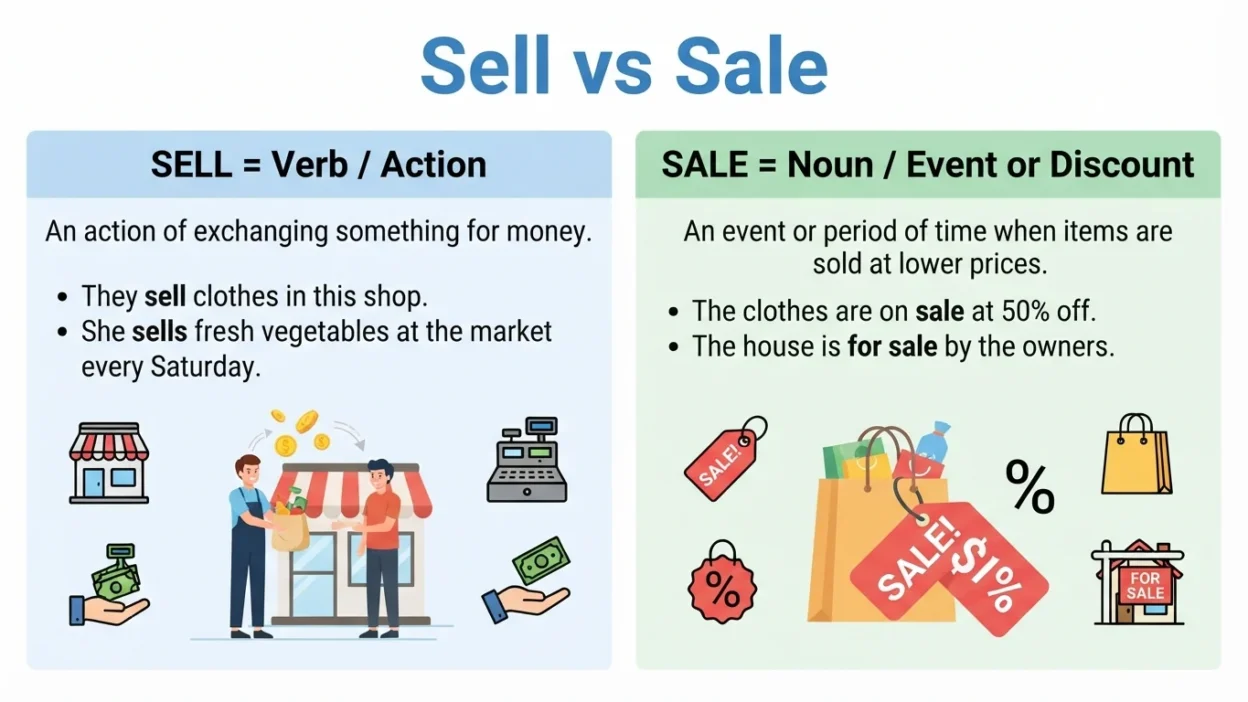
Sell is a verb meaning “to give something to someone in exchange for money.” Sale is a noun referring to the act or process of selling something, or a period when products are offered at reduced prices. For example, “They sell shoes” and “The shoes are on sale.”
Why People Confuse Sell and Sale
The confusion happens because sell and sale are closely related in meaning and come from the same general word family.
They are also pronounced differently:
- sell sounds like cell
- sale sounds like sail
The most important difference, however, is grammatical.
Sell = verb
Sale = noun
Compare:
- We sell furniture.
- The store has a furniture sale.
The first sentence describes an action. The second refers to an event or occasion.
First Word: Sell
Sell is a verb.
It means to give something to another person in exchange for money.
Examples of Sell
- I want to sell my old laptop.
- They sell fresh vegetables.
- She sells handmade jewelry online.
- The company sells software to businesses.
- He decided to sell his car.
Different Forms of Sell
| Form | Example |
|---|---|
| sell | I sell books. |
| sells | She sells books. |
| sold | They sold the house. |
| selling | He is selling his bike. |
The past tense of sell is sold, not “selled.”
Sell → sold → sold
Second Word: Sale
Sale is a noun.
It can refer to the act or transaction of selling something. It can also describe a special period when stores offer products, often at lower prices.
Examples of Sale
- The store is having a sale.
- I bought this jacket during the winter sale.
- The sale of the house was completed yesterday.
- There is a big sale on shoes this weekend.
- The company announced the sale of its property.
Sale in Shopping
When you see a sign saying:
“SALE”
it usually means that products are being offered at special or reduced prices.
For example:
These shoes are on sale.
This does not mean the word “sale” is an action. It names the shopping event or special pricing period.
Comparison Table
| Feature | Sell | Sale |
|---|---|---|
| Part of speech | Verb | Noun |
| Basic meaning | To exchange something for money | An act, transaction, or period of selling |
| Pronunciation | Rhymes with “bell” | Rhymes with “mail” |
| Example | I want to sell my car. | The car is for sale. |
| Shopping use | They sell clothes. | The clothes are on sale. |
| Past form | Sold | Not applicable |
Easy Rule
If you are talking about doing the action, use sell.
If you are talking about the event, transaction, or special price, use sale.
When to Use Each
Use “Sell” for an Action
Use sell when someone is performing the action of exchanging something for money.
Examples:
- We sell computers.
- She wants to sell her house.
- They sell organic food.
- He is selling his old phone.
Here, “sell” describes what someone does.
Use “Sale” for an Event or Transaction
Use sale when referring to the process or transaction of selling.
Examples:
- The sale of the house took three months.
- The business announced the sale of its assets.
Use “Sale” for Discounts
Use sale when a store offers products at reduced prices.
Examples:
- The store is having a summer sale.
- These shoes are on sale.
- I found this dress in the clearance sale.
12 Examples: Sell vs Sale
- I want to sell my old phone.
- The store will sell new products next month.
- They sell fresh bread every morning.
- She decided to sell her car.
- The store is having a huge sale.
- These jackets are on sale today.
- We bought the furniture during a holiday sale.
- The sale of the property was finalized last week.
- Does this store sell children’s clothing?
- I saw an advertisement for a summer sale.
- They are selling their house.
- The company made a profit from the sale of its products.
Common Phrases With Sell
Here are some useful expressions containing sell:
Sell something
They sell books online.
Sell out
To sell all available items.
The concert tickets sold out quickly.
Sell well
To be purchased frequently.
This product sells well during the holiday season.
Sell for
To be sold at a particular price.
The painting sold for $5,000.
Sell to
To provide something to a particular person or group for money.
The company sells its products to retailers.
Common Phrases With Sale
On sale
Available at a reduced price.
These shoes are on sale.
For sale
Available for someone to buy.
The house is for sale.
On sale now
Currently available at a special price or for purchase.
New products are on sale now.
Sale price
The price offered during a sale.
The sale price is $40.
Sales tax
A tax charged on certain purchases.
The sales tax is included at checkout.
Common Mistakes
Mistake 1: Using “Sale” as a Verb
Incorrect:
I want to sale my car.
Correct:
I want to sell my car.
Why? Because the sentence needs a verb describing the action.
Mistake 2: Using “Sell” After “On”
Incorrect:
These shoes are on sell.
Correct:
These shoes are on sale.
The fixed expression is on sale.
Mistake 3: Confusing “For Sale” and “For Sell”
Incorrect:
My house is for sell.
Correct:
My house is for sale.
For sale means something is available to be purchased.
Mistake 4: Writing “Selled”
Incorrect:
She selled her car.
Correct:
She sold her car.
The verb is irregular:
sell → sold → sold
Memory Trick
Use this simple trick:
SELL = DO
If someone is doing the action of selling, use sell.
They sell computers.
SALE = THING/EVENT
If you are talking about a sale, event, transaction, or discount, use sale.
The computers are on sale.
Another easy reminder:
You SELL something.
Something is FOR SALE.
This is one of the easiest ways to remember the difference.
American vs British English
Sell and sale have the same basic meanings in American and British English.
Both varieties use:
- sell as a verb
- sale as a noun
- on sale for products offered at reduced prices
- for sale for something available to buy
There can be differences in shopping vocabulary between American and British English, but the distinction between sell and sale remains the same.
Similar Words
Several words are related to sell and sale.
Purchase
A purchase is something that you buy, or the act of buying something.
The purchase was completed online.
Buy
Buy means to obtain something by paying money.
I want to buy a new laptop.
Vendor
A vendor is a person or business that sells goods or services.
The vendor sells handmade products.
Seller
A seller is a person or company that sells something.
The seller offered a lower price.
Discount
A discount is a reduction in the usual price.
The store offered a 20% discount.
Bargain
A bargain is something bought at a particularly good price.
This jacket was a real bargain.
Sell vs Sale: Final Verdict
The difference between sell and sale is mainly grammatical. Sell is a verb, so you use it when describing the action of exchanging something for money. Sale is a noun, so you use it for the act, transaction, event, or period of selling.
When shopping, two expressions are especially important: “on sale” and “for sale.” If you are talking about someone performing the action, use sell: “They sell shoes.” If you are referring to an event or reduced price, use sale: “The shoes are on sale.”
FAQs
1. What is the difference between sell and sale?
Sell is a verb, while sale is a noun. You sell something, but something can be for sale or on sale.
2. Is it “for sale” or “for sell”?
The correct expression is for sale.
The house is for sale.
3. Is it “on sale” or “on sell”?
The correct expression is on sale.
These shoes are on sale.
4. What is the past tense of sell?
The past tense of sell is sold.
She sold her old car.
5. Is sale a verb?
No. In standard modern English, sale is a noun. The verb is sell.
6. Can “sale” mean a discount?
Yes. In shopping contexts, a sale often refers to a period when products are offered at reduced prices.
7. What is an easy way to remember sell vs sale?
Remember:
You SELL something.
Something is FOR SALE.
Conclusion
Although sell and sale are closely related, they have different jobs in a sentence. Sell is the verb used for the action of exchanging something for money, while sale is the noun used for a selling transaction, event, or period of discounted prices.
If you remember just one rule, make it this: people sell things, but things are for sale or on sale. This simple distinction will help you avoid one of the most common mistakes in everyday English, especially in shopping, business, and writing.
Remember This
SELL = verb/action
SALE = noun/event or discount
They sell clothes.
The clothes are on sale.
The house is for sale.
Sell → sold → sold

A passionate linguist who specializes in word relationships and vocabulary building.
He has spent years studying synonyms and semantic patterns across languages.
Arman writes to make language learning simple, precise, and engaging.