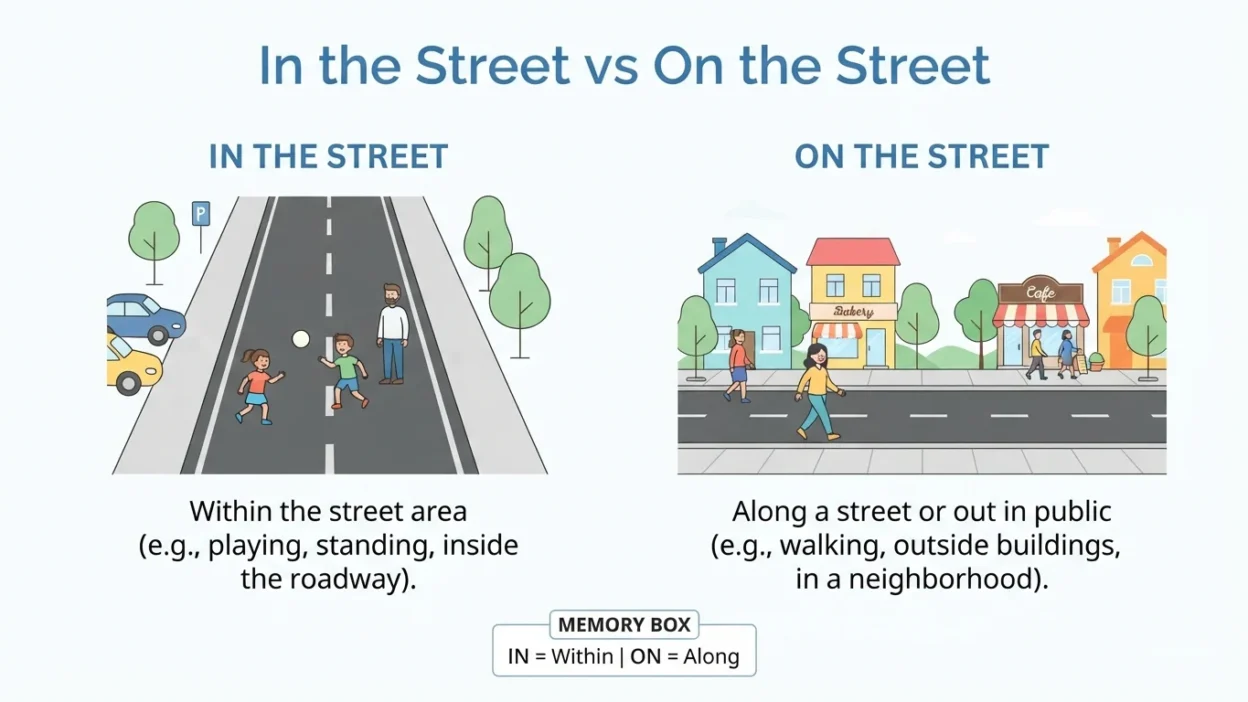
Should you say “in the street” or “on the street”? Both expressions are grammatically correct, but they are not always used in exactly the same way. The choice depends on whether you are emphasizing a position within the street area, a location along a street, or simply being outdoors.
For English learners, this distinction can be confusing because both in and on can describe location. In general, in the street often emphasizes being physically within the street or roadway, while on the street commonly refers to a location along a particular street or being out in public. Understanding the context makes the correct choice much easier.
Quick Answer: In the Street or On the Street?
Both “in the street” and “on the street” are correct. Use in the street when emphasizing that someone or something is physically within the street area or roadway. Use on the street when referring to a location along a street, being present outdoors, or describing something situated on a particular street.
Why People Confuse “In the Street” and “On the Street”
The confusion happens because English uses different prepositions for locations in ways that do not always translate directly from other languages.
We usually use:
- in for something enclosed within an area
- on for something positioned on a surface or along a route
A street can be thought of in both ways.
For example:
“The children are playing in the street.”
Here, the children are physically in the street area.
But:
“There is a pharmacy on the street.”
Here, the speaker is identifying where the pharmacy is located along that street.
The exact meaning depends on the context.
In the Street: Meaning and Usage
In the street usually means within the street area, especially the roadway.
It can emphasize that someone or something is physically occupying the street rather than being inside a building, on a sidewalk, or somewhere else.
Examples
- “The children were playing in the street.”
- “A car was parked in the street.”
- “He was standing in the street.”
- “There was a large crowd in the street.”
- “The accident happened in the street.”
The expression can also be used more generally to contrast the street with an indoor location.
“We heard people shouting in the street.”
This tells us that the activity was happening outside in the street area.
When “in the street” is especially natural
Use in the street when you want to emphasize:
- Physical position in the roadway
- Activity happening within the street
- Something occupying the street
- A contrast between indoors and outdoors
- A person or object physically surrounded by the street area
On the Street: Meaning and Usage
On the street has several common uses.
One of the most common is to describe something located along a particular street.
Examples
- “She lives on Main Street.”
- “There is a café on this street.”
- “The hotel is on the main street.”
- “I saw a new store on the street.”
- “There are several restaurants on this street.”
On the street can also mean out in public or outdoors.
For example:
“I met an old friend on the street.”
This means the meeting happened while the speaker was out in public.
Another example:
“We spent the afternoon walking on the street.”
Here, the expression focuses more generally on being outside and moving along the street.
In the Street vs On the Street: Comparison Table
| Expression | Main Meaning | Typical Use | Example |
|---|---|---|---|
| In the street | Physically within the street area | Activity or position in the roadway | “The children are playing in the street.” |
| On the street | Located along a street | Address/location | “She lives on this street.” |
| In the street | Within the street area | Contrasting with indoors | “He was standing in the street.” |
| On the street | Out in public | Meeting or seeing someone outside | “I saw her on the street.” |
| On the street | Along a particular road | Shops, buildings, businesses | “There are many stores on the street.” |
When to Use “In the Street”
Choose in the street when the sentence describes something that is physically within the street itself.
Example 1
“The children are playing in the street.”
The children are physically occupying the street.
Example 2
“A truck stopped in the street.”
The truck is physically positioned in the roadway.
Example 3
“There was a protest in the street.”
The protest was taking place in the street area.
Example 4
“He left his bicycle in the street.”
The bicycle was physically left there.
A useful question to ask is:
“Is the person or object physically within the street area?”
If yes, in the street may be the better choice.
When to Use “On the Street”
Choose on the street when talking about a location along a street, an address, or being out in public.
Example 1
“My office is on this street.”
The office is located along this street.
Example 2
“She lives on Green Street.”
This describes her address.
Example 3
“There is a bakery on the street.”
The bakery is located along the street.
Example 4
“I met him on the street.”
The meeting happened while the speaker was out in public.
A useful question is:
“Am I talking about a location along a street or being out in public?”
If yes, on the street is often the natural choice.
12 Examples of “In the Street” and “On the Street”
Examples with “In the Street”
- “The children were playing in the street.”
- “A large tree had fallen in the street.”
- “He was standing in the street.”
- “The accident blocked traffic in the street.”
- “We heard loud music coming from the street.”
- “Several people were dancing in the street.”
Examples with “On the Street”
- “She lives on the same street as her sister.”
- “There is a new restaurant on the street.”
- “I saw him on the street yesterday.”
- “The store is located on the main street.”
- “There are several cafés on this street.”
- “We met an interesting artist on the street.”
“In the Street” vs “On the Street” in Everyday Conversation
In everyday English, on the street is extremely common when talking about where someone is or where something is located.
For example:
“Where are you?”
“I’m on the street.”
This generally means the person is outside, rather than inside a building.
But if someone says:
“He is in the street.”
the listener may imagine that the person is actually standing or moving within the roadway.
This difference can affect the mental picture.
Compare:
“She is on the street.”
→ She is outside or somewhere along the street.
“She is in the street.”
→ She is physically in the street area, potentially in the roadway.
Is “On the Street” Used for Addresses?
Yes. On is normally used when giving an address involving a street name.
Examples:
- “I live on King Street.”
- “The office is on Park Avenue.”
- “They opened a store on Oxford Street.”
- “The hotel is on Main Street.”
However, the exact preposition can vary with different types of addresses and regional conventions.
For example, English commonly uses:
“I live at 25 King Street.”
Here, at identifies the specific address, while:
“I live on King Street.”
identifies the street.
“In the Street” vs “In the Road”
In many contexts, in the street and in the road can describe something physically located in the roadway.
For example:
“There is a dog in the street.”
“There is a dog in the road.”
Both can be understood as saying the dog is in the area where vehicles travel.
Regional vocabulary can influence which expression sounds more natural. In British English, road is especially common for general roads, while street is often used for roads in towns and cities.
American vs British English
Both “in the street” and “on the street” are used in American and British English.
There is no major grammatical rule that makes one expression exclusively American or British.
However, vocabulary and context can influence preferences.
For example:
American English:
“She lives on Main Street.”
British English:
“She lives on the same street.”
Both varieties naturally use on for locations along a street.
Likewise:
“The children were playing in the street.”
is natural in both varieties.
Common Mistakes
Mistake 1: Thinking only one expression is correct
❌ “In the street is always wrong.”
That is incorrect.
In the street is completely grammatical when referring to physical presence within the street.
Mistake 2: Using “in” for an address
❌ “I live in Main Street.”
Usually, say:
✅ “I live on Main Street.”
Or, for a specific address:
✅ “I live at 25 Main Street.”
Mistake 3: Assuming “on the street” always means physically standing on the road
Not necessarily.
“There is a bank on the street.”
This normally means the bank is located along that street, not that the bank is literally sitting on the roadway.
Mistake 4: Ignoring context
The best preposition depends on what you want the listener to understand.
Compare:
“The children are in the street.”
This emphasizes their physical position.
“There are several houses on the street.”
This emphasizes location along the street.
Memory Trick
Use this simple rule:
IN = INSIDE THE STREET AREA
“The children are in the street.”
Think about physical presence within the street.
ON = ALONG THE STREET
“The shop is on the street.”
Think about a location along the street.
So remember:
In the street = within the street area
On the street = along a street / out in public
Similar Expressions
English has several related location expressions that learners often confuse.
In the road
Usually means physically within the roadway.
“There was a fallen branch in the road.”
On the road
Can mean traveling or being away from home.
“We have been on the road all day.”
On the sidewalk
Means located on the pedestrian walkway.
“She was standing on the sidewalk.”
At the street corner
Used for a specific point where streets meet.
“Meet me at the street corner.”
Across the street
Means on the opposite side of the street.
“The pharmacy is across the street.”
Understanding these expressions helps you choose prepositions more naturally.
FAQs About “In the Street or On the Street”
1. Is it “in the street” or “on the street”?
Both are correct. In the street usually emphasizes physical presence within the street area, while on the street commonly refers to a location along a street or being out in public.
2. Is “I live in the street” correct?
In standard English, “I live on the street” is normally used when identifying the street where you live.
For example:
“I live on Green Street.”
For a complete address, use at:
“I live at 25 Green Street.”
3. Is “I live on the street” correct?
Yes. It can mean that your home is located along that street.
“I live on Oak Street.”
4. Should I say “in Main Street” or “on Main Street”?
Use on:
“She lives on Main Street.”
5. Is “in the street” grammatically correct?
Yes. It is correct when you mean physically within the street area.
“The children were playing in the street.”
6. What is the difference between “on the street” and “in the street”?
On the street often means along a street or out in public. In the street emphasizes physical presence within the street itself, especially the roadway.
7. Do Americans and British people use these expressions differently?
Both American and British English use in the street and on the street. The main distinction is based on context rather than a major regional grammar difference.
8. Which one should ESL learners use?
Use on the street for a street location or address, and in the street when emphasizing that someone or something is physically within the street area.
Final Verdict
Both “in the street” and “on the street” are correct expressions, but they create slightly different meanings. In the street generally focuses on physical position within the street or roadway, while on the street commonly describes a location along a street, a street address, or being outside in public.
The easiest way to remember the difference is to think about the picture you want to create. If someone is physically occupying the roadway, in the street is usually appropriate. If you are identifying where a home, shop, or business is located, on the street is usually the natural choice.
Conclusion
Choosing between in the street and on the street becomes much easier once you focus on context. Use in the street when you are describing physical presence within the street area, such as children playing, a car stopping, or a crowd gathering. Use on the street when referring to a location along a street, a street address, or being outside in public.
For ESL learners and anyone improving their English grammar, remember the simple distinction: in the street = within the street area, while on the street = along the street or out in public. Both expressions are correct, so the right choice depends on the meaning you want to communicate.
Remember This
IN THE STREET → physically within the street area
ON THE STREET → located along a street / out in public
Example:
“The children are in the street.”
“There are several shops on the street.”
Quick Memory Rule
IN = within
ON = along

An expert in English grammar and expressive writing techniques.
She focuses on helping readers expand their vocabulary with clarity.
Elina believes the right word can transform ordinary writing into powerful communication.