If you are unsure whether to write reevaluation or re-evaluation, you are not alone. The two forms look almost identical, and both appear in English writing. The difference is mainly about spelling style rather than meaning.
The good news is that reevaluation is the preferred closed form in modern standard English. Re-evaluation is also used and can be acceptable, particularly when a writer wants the prefix re- to be visually clear. Both forms mean the same thing: evaluating, reviewing, or assessing something again. In this guide, you will learn which spelling to choose, how to use it correctly, and how to avoid common mistakes.
Quick Answer: Reevaluation or Re-Evaluation?
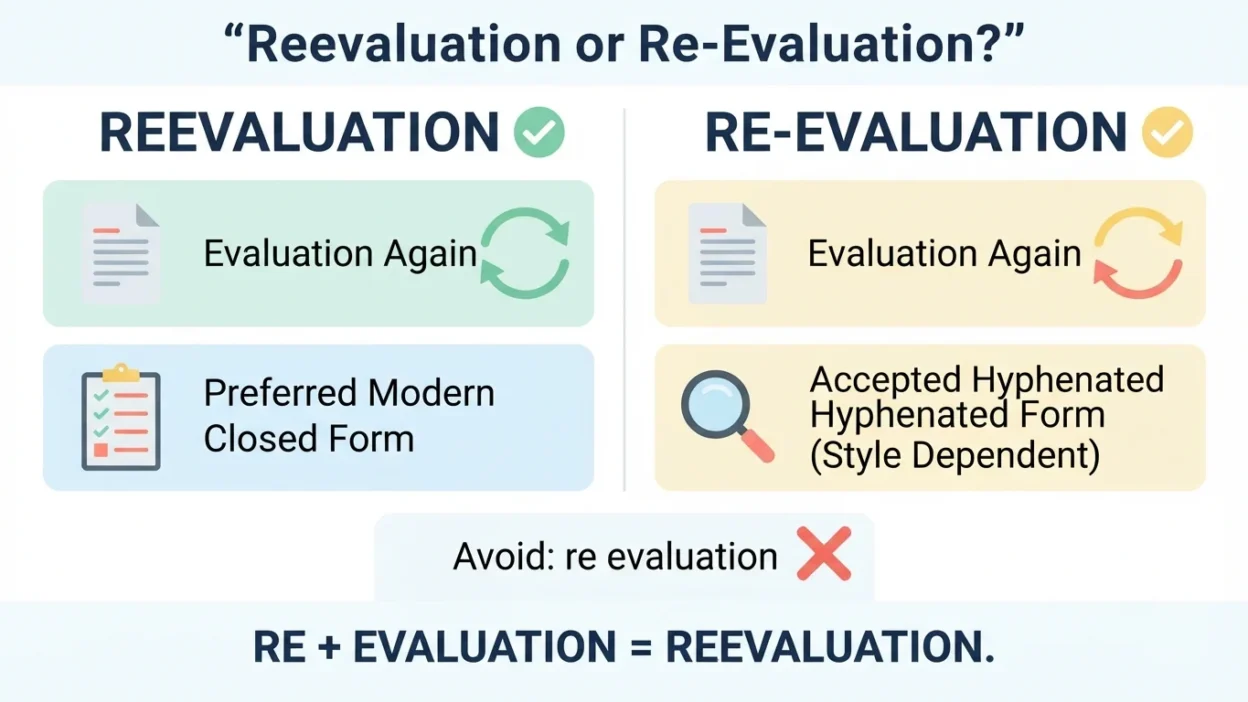
Reevaluation is generally the preferred modern spelling, while re-evaluation is also acceptable in some writing styles. Both mean the process of evaluating something again. For most general, academic, professional, and digital writing, choose reevaluation for a clean and consistent style.
Why People Confuse Reevaluation and Re-Evaluation
The confusion comes from the prefix re-, which means again or back.
When re- is added to evaluation, writers may wonder whether the two parts should remain separated with a hyphen.
Compare:
- re + evaluation → reevaluation
- re + evaluation → re-evaluation
Unlike some compound words where a hyphen can change meaning, these two forms generally communicate the same idea.
The important point is consistency. If your publication, school, employer, or style guide prefers one form, follow that preference throughout your writing.
Reevaluation: Meaning and Usage
Reevaluation is a noun meaning the act of evaluating, reviewing, or considering something again.
It is formed from:
re- + evaluation = reevaluation
The prefix re- means “again,” while evaluation means an assessment or judgment.
Examples of reevaluation
- “The company conducted a reevaluation of its strategy.”
- “The patient’s treatment required reevaluation.”
- “The project is currently under reevaluation.”
- “A reevaluation of the evidence changed the conclusion.”
- “The teacher recommended a reevaluation of the student’s progress.”
Common phrases
You may commonly see reevaluation used with:
- reevaluation of a policy
- reevaluation of a strategy
- reevaluation of evidence
- reevaluation of priorities
- reevaluation of performance
- reevaluation of goals
- reevaluation process
- periodic reevaluation
- careful reevaluation
- further reevaluation
Re-Evaluation: Meaning and Usage
Re-evaluation has the same basic meaning as reevaluation. It refers to evaluating or reviewing something again.
The hyphen makes the prefix re- visually obvious:
re- + evaluation → re-evaluation
For example:
“The committee requested a re-evaluation of the proposal.”
This means that the proposal should be evaluated again.
Although the hyphenated spelling is still encountered, many modern dictionaries and style practices favor the closed form reevaluation.
Reevaluation vs Re-Evaluation Comparison Table
| Feature | Reevaluation | Re-Evaluation |
|---|---|---|
| Meaning | Evaluation again | Evaluation again |
| Part of speech | Noun | Noun |
| Spelling | Closed | Hyphenated |
| Modern usage | Generally preferred | Also used |
| Meaning difference | None in ordinary use | None in ordinary use |
| Example | “The plan needs reevaluation.” | “The plan needs re-evaluation.” |
| Best general choice | ✅ Preferred | Acceptable depending on style |
When to Use Reevaluation
Use reevaluation when you want the standard closed spelling in modern general English.
It works particularly well in:
- Academic writing
- Business writing
- Professional documents
- Reports
- Essays
- Articles
- General online content
Examples
Academic:
“The findings led to a reevaluation of the original hypothesis.”
Business:
“The changing market requires a reevaluation of our pricing strategy.”
Professional:
“The employee’s performance is scheduled for reevaluation.”
General:
“The situation deserves careful reevaluation.”
If you are unsure which version to choose, reevaluation is usually the safest option.
When to Use Re-Evaluation
Re-evaluation may be used when a writer or publication prefers hyphenated forms or wants to make the prefix re- especially clear.
For example:
“The committee called for a complete re-evaluation of the proposal.”
The hyphen can make the word easier to visually break into re + evaluation, particularly for readers who might otherwise momentarily misread the word.
However, you generally do not need the hyphen in ordinary modern writing.
12 Examples of Reevaluation and Re-Evaluation
Here are examples showing how the word works in real sentences:
- The company announced a reevaluation of its long-term goals.
- The evidence prompted a reevaluation of the original decision.
- The teacher recommended reevaluation after reviewing the student’s progress.
- The policy is subject to periodic reevaluation.
- The team conducted a thorough reevaluation of its strategy.
- The new information resulted in a reevaluation of the situation.
- The committee requested a re-evaluation of the proposal.
- A careful reevaluation revealed several weaknesses in the plan.
- The results may require reevaluation in the future.
- The organization began a reevaluation of its priorities.
- The researchers called for a reevaluation of the available evidence.
- After the unexpected results, the scientists began a complete reevaluation of their assumptions.
Notice that replacing reevaluation with re-evaluation generally does not change the meaning.
Common Mistakes
Mistake 1: Assuming only one spelling can ever be correct
It is too simplistic to say that re-evaluation is always wrong.
The hyphenated form is used in real English writing. However, reevaluation is generally the preferred modern form.
Mistake 2: Writing “re evaluation”
❌ “The project needs a re evaluation.”
This form is generally not appropriate.
Use:
✅ “The project needs a reevaluation.”
or
✅ “The project needs a re-evaluation.”
Mistake 3: Confusing reevaluation with evaluation
Evaluation means assessing something.
Reevaluation means assessing it again.
Compare:
“The manager conducted an evaluation.”
This may be the first assessment.
“The manager conducted a reevaluation.”
This suggests that the matter was assessed previously and is now being assessed again.
Mistake 4: Inconsistent spelling
Avoid switching unnecessarily between forms in the same document.
For example, do not write:
“The first section discusses reevaluation, while the second section discusses re-evaluation.”
If there is no reason for the change, choose one style and stay consistent.
Memory Trick
The easiest way to remember the preferred spelling is:
RE + EVALUATION = REEVALUATION
Think of re- as meaning again:
reevaluation = evaluation again
You can also remember:
Reevaluate → Reevaluation
If you use the verb reevaluate, the noun naturally becomes reevaluation.
Reevaluation vs Reevaluate
These words are closely related but have different grammatical roles.
Reevaluation
Noun
“The policy needs reevaluation.”
It names the process of evaluating something again.
Reevaluate
Verb
“We need to reevaluate the policy.”
It describes the action of evaluating something again.
Other related forms include:
- evaluate — verb
- evaluation — noun
- reevaluate — verb
- reevaluation — noun
Example:
“We evaluated the plan last year, but we now need to reevaluate it. The reevaluation may lead to changes.”
American vs British English
There is no major difference in meaning between American and British English when using reevaluation and re-evaluation.
Both varieties can use the closed and hyphenated forms. However, modern English spelling increasingly favors closed compounds when the meaning remains clear.
Therefore, reevaluation is a strong general-purpose choice for both American and British English.
If you are writing for a particular publisher, university, company, or style guide, follow its preferred spelling.
Similar Words
Several words are closely related to reevaluation.
Reassessment
A new or repeated assessment of something.
“The situation requires reassessment.”
Review
A careful examination or consideration.
“The policy is due for review.”
Reconsideration
Thinking about something again, especially a decision.
“The appeal led to reconsideration of the decision.”
Reexamination
Examining something again.
“The evidence required reexamination.”
Revision
Changing something after reviewing it.
“The report underwent several revisions.”
These words can overlap with reevaluation, but they are not always interchangeable.
Which Is Better: Reevaluation or Re-Evaluation?
For most modern writing, reevaluation is the better default.
Choose reevaluation when:
- You want a clean modern spelling.
- You are writing an essay or article.
- You are writing professional content.
- Your style guide prefers closed compounds.
- You want consistency with reevaluate.
Choose re-evaluation when:
- Your publication specifically prefers hyphenated forms.
- Your organization’s style guide uses the hyphen.
- You want to visually emphasize the re- prefix.
In ordinary situations, however, there is no need to worry excessively about the difference.
FAQs About Reevaluation or Re-Evaluation
1. Is reevaluation one word?
Yes. Reevaluation is a standard one-word spelling and is generally the preferred modern form.
2. Is re-evaluation correct?
Yes. Re-evaluation is also used and can be acceptable depending on the style guide or publication.
3. Is reevaluation or re-evaluation more common?
Reevaluation is generally the preferred modern closed form, although the hyphenated version still appears in English writing.
4. What does reevaluation mean?
Reevaluation means evaluating, reviewing, or assessing something again.
5. What is the verb form of reevaluation?
The related verb is reevaluate.
Example:
“We need to reevaluate the plan.”
6. Should I use reevaluation in academic writing?
Yes. Reevaluation is appropriate for academic writing. However, always follow the style guide required by your institution or publication.
7. Is re evaluation correct?
Generally, no. Do not normally write the phrase as two separate words. Use reevaluation or re-evaluation.
8. Does reevaluation mean reconsideration?
They can have similar meanings in some contexts, but they are not always identical. Reevaluation specifically emphasizes assessing or evaluating something again, while reconsideration emphasizes thinking about a matter or decision again.
Final Verdict
Reevaluation and re-evaluation have the same basic meaning: evaluating something again. The main difference is simply the spelling style. Reevaluation is generally the preferred modern closed form and is the best default choice for most academic, professional, and general writing.
Re-evaluation is not necessarily wrong. It remains an accepted and commonly encountered hyphenated form, particularly when a style guide or publication prefers it. The important thing is to use the spelling consistently within your document.
Conclusion
If you are wondering whether to write reevaluation or re-evaluation, the simplest answer is to choose reevaluation in most situations. It is concise, modern, and widely suitable for professional and general English. The word means the process of assessing, reviewing, or considering something again.
The hyphenated re-evaluation can also be used when required by a particular style or when a writer wants to make the prefix re- more visually obvious. Neither form changes the basic meaning. For everyday writing, remember the simple rule: reevaluation = evaluation again.
Remember This
Preferred: ✅ reevaluation
Also used: ✅ re-evaluation
Avoid: ❌ re evaluation
Meaning: evaluating or assessing something again.
Memory trick:
RE + EVALUATION = REEVALUATION