Imitated and intimated look and sound surprisingly similar, but they have completely different meanings. Because only a few letters separate these words, they are easy to confuse, especially for English learners, students, and writers who encounter them in formal or academic contexts.
Imitated is the past tense and past participle of imitate, meaning to copy or reproduce someone’s behavior, appearance, style, or actions. Intimated, meanwhile, is the past tense and past participle of intimate when intimate is used as a verb. It means to suggest or communicate something indirectly. Knowing whether you mean copying or hinting at an idea will help you choose the correct word every time.
Quick Answer: Imitated vs Intimated
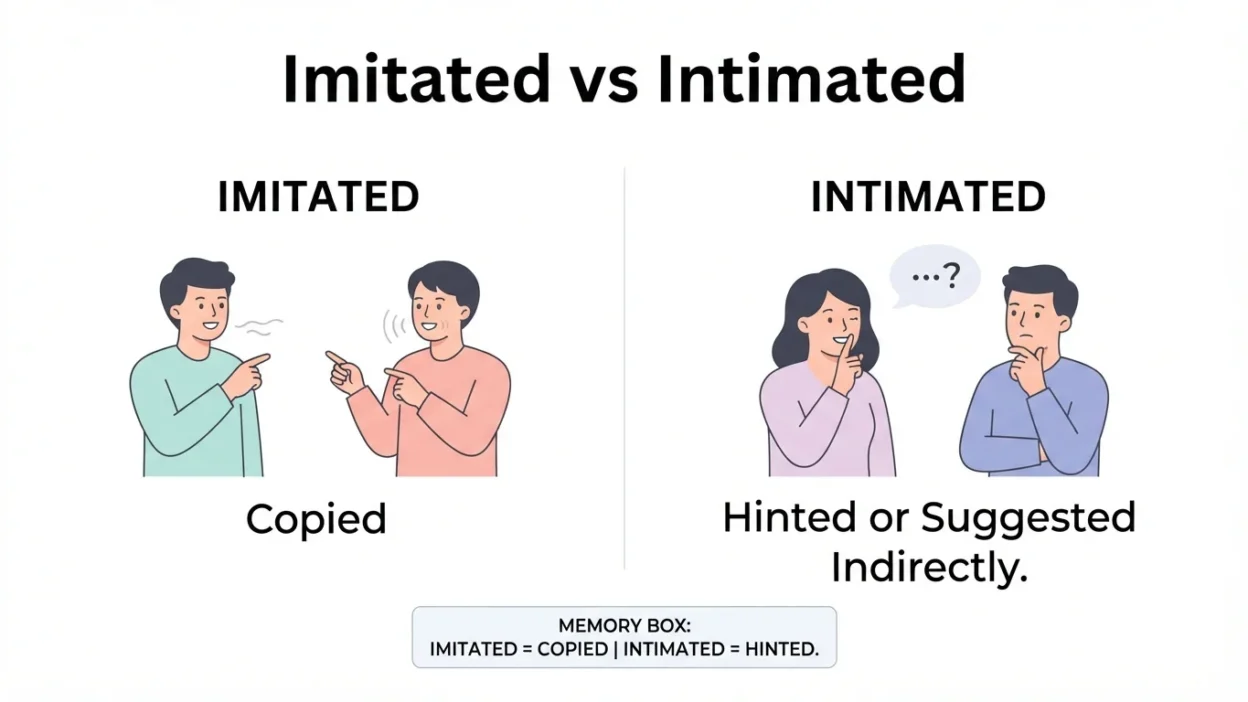
Imitated means copied or reproduced, while intimated means suggested or communicated indirectly. For example, “The child imitated her teacher” means the child copied her teacher. “He intimated that he might resign” means he indirectly suggested that he might resign.
Why People Confuse Imitated and Intimated
The words imitated and intimated have very similar spellings:
- imitated
- intimated
They also have related-looking endings, which can make them particularly confusing when reading quickly.
However, their root verbs are different:
- imitate → imitated
- intimate → intimated
Their meanings are also completely different.
Imitated
Think:
imitated = copied
Intimated
Think:
intimated = hinted or suggested
This simple distinction is the key to using them correctly.
Imitated: Meaning and Usage
Imitated is the past tense and past participle of the verb imitate.
To imitate someone or something means to copy their actions, behavior, appearance, voice, style, or characteristics.
Simple meaning
Imitated = copied or reproduced
Examples
- “The child imitated his father.”
- “She imitated the actor’s accent.”
- “The artist imitated the style of a famous painter.”
- “The students imitated their teacher’s pronunciation.”
- “The comedian imitated the politician’s voice.”
Imitated can refer to:
- Behavior
- Speech
- Movements
- Voice
- Style
- Appearance
- Actions
- Techniques
- Sounds
For example:
“The young singer imitated her favorite performer.”
This means the singer copied or reproduced aspects of the performer’s style.
Intimated: Meaning and Usage
Intimated is the past tense and past participle of intimate when intimate is being used as a verb.
As a verb, intimate means to suggest, indicate, or communicate something indirectly.
Simple meaning
Intimated = hinted or suggested indirectly
For example:
“She intimated that she was unhappy with the decision.”
This means she did not necessarily say directly, “I am unhappy,” but she gave an indication or hint that she was unhappy.
Examples
- “He intimated that he might leave the company.”
- “The manager intimated that changes were coming.”
- “She intimated her concerns during the meeting.”
- “The report intimated that the results were unreliable.”
- “His comments intimated a possible disagreement.”
Intimated is more formal than everyday words such as hinted or suggested.
Imitated vs Intimated: Comparison Table
| Feature | Imitated | Intimated |
|---|---|---|
| Root verb | Imitate | Intimate |
| Part of speech | Verb form | Verb form |
| Main meaning | Copied | Suggested indirectly |
| Common synonym | Copied | Hinted |
| Typical context | Behavior, style, actions | Ideas, intentions, feelings |
| Example | “She imitated her teacher.” | “He intimated that he disagreed.” |
| Tone | General | More formal |
| Opposite idea | Original/created | Stated directly |
When to Use Imitated
Use imitated when someone or something copies another person or thing.
Use “imitated” for actions
“The child imitated his mother.”
The child copied her behavior.
Use “imitated” for speech
“He imitated the actor’s voice.”
He copied the actor’s voice.
Use “imitated” for style
“The designer imitated the traditional style.”
The designer copied elements of that style.
Use “imitated” for behavior
“The students imitated their teacher’s movements.”
They copied the movements.
A useful test is:
Can you replace the word with “copied”?
If yes, imitated is probably correct.
When to Use Intimated
Use intimated when someone suggests or communicates something without saying it directly.
Use “intimated” for intentions
“He intimated that he intended to resign.”
He indirectly suggested his intention.
Use “intimated” for opinions
“She intimated that she disagreed with the proposal.”
She suggested her disagreement without necessarily stating it directly.
Use “intimated” for information
“The report intimated that further investigation was necessary.”
The report indirectly indicated this.
Use “intimated” for feelings
“He intimated that he was disappointed.”
He gave an indirect indication of his disappointment.
A useful test is:
Can you replace the word with “hinted” or “suggested”?
If yes, intimated may be correct.
12 Examples of Imitated and Intimated
Examples with “Imitated”
- “The child imitated his older brother.”
- “She imitated her teacher’s pronunciation.”
- “The comedian imitated the famous singer.”
- “The artist imitated the style of an earlier painter.”
- “The puppy imitated the older dog’s behavior.”
- “He imitated the character’s voice perfectly.”
Examples with “Intimated”
- “The manager intimated that the company would make changes.”
- “She intimated that she was unhappy with the decision.”
- “He intimated that he might accept the offer.”
- “The report intimated that the results needed further review.”
- “The politician intimated that a new policy was being considered.”
- “She intimated her concerns without directly criticizing the plan.”
Imitated vs Intimated in Context
Consider these two sentences:
“The student imitated the teacher.”
The student copied the teacher.
Now compare:
“The student intimated that the teacher was wrong.”
The student indirectly suggested that the teacher was wrong.
The difference is substantial:
Imitated → copied something
Intimated → hinted at something
Common Mistakes
Mistake 1: Using “intimated” when you mean copied
❌ “The child intimated his father.”
This does not mean the child copied his father.
✅ “The child imitated his father.”
Mistake 2: Using “imitated” when you mean hinted
❌ “He imitated that he might resign.”
This is incorrect if you mean that he indirectly suggested his resignation.
✅ “He intimated that he might resign.”
Mistake 3: Confusing “intimate” as a verb with “intimate” as an adjective
Intimate has more than one meaning.
As an adjective, it can describe something personal, private, or closely connected.
“They had an intimate conversation.”
As a verb, intimate means to suggest or indicate indirectly.
“He intimated that he knew the truth.”
The word intimated in this article comes from the verb use.
Mistake 4: Assuming similar spelling means similar meaning
The spelling of these words is similar, but their meanings are not.
Remember:
Imitate → copy
Intimate → hint
Memory Trick
Here is an easy way to remember the difference.
IMITATED = IMITATE = COPY
Think of the word imitate as copying someone.
“She imitated her sister.”
She copied her sister.
INTIMATED = INTIMATE = HINT
Think of intimated as giving an indirect clue.
“He intimated that he was leaving.”
He hinted that he was leaving.
One-line memory trick
IMITATED = COPIED
INTIMATED = HINTED
If you remember those two words, you can usually choose correctly.
American vs British English
There is no major difference between American and British English in the meanings of imitated and intimated.
Both varieties use:
- imitated to mean copied
- intimated to mean suggested or indicated indirectly
For example, the following sentence is natural in both varieties:
“The child imitated his teacher.”
Likewise:
“The manager intimated that further changes were possible.”
The main difference is one of register. Intimated can sound formal, particularly in business, journalism, legal writing, and academic contexts.
In everyday conversation, speakers are more likely to use hinted, suggested, or indicated.
Similar Words
Synonyms for Imitated
Depending on the context, imitated can mean:
- copied
- mimicked
- reproduced
- emulated
- mirrored
- replicated
- followed
- modeled
Example:
“The comedian mimicked the actor.”
This is similar to:
“The comedian imitated the actor.”
Synonyms for Intimated
Depending on the context, intimated can mean:
- hinted
- suggested
- indicated
- implied
- signaled
- implied indirectly
- conveyed
- alluded to
Example:
“She hinted that she was upset.”
This can express a similar idea to:
“She intimated that she was upset.”
Imitated vs Mimicked
Imitated and mimicked can sometimes be synonyms, but mimicked often emphasizes copying someone’s manner, voice, movement, or behavior.
“He imitated the singer.”
“He mimicked the singer’s voice.”
Both can be correct.
However, imitated has a broader range of uses.
Intimated vs Implied
Intimated and implied can overlap, especially when something is communicated indirectly.
For example:
“The manager intimated that layoffs were possible.”
This means the manager indirectly suggested that layoffs might happen.
“The manager implied that layoffs were possible.”
This has a similar meaning.
Implied is generally more common in everyday and academic English, while intimated can sound more formal or literary.
FAQs About Imitated vs Intimated
1. What is the difference between imitated and intimated?
Imitated means copied, while intimated means suggested or hinted at indirectly.
2. Is “imitated” the past tense of imitate?
Yes. The forms are:
imitate → imitated → imitated
Example:
“She imitated her teacher.”
3. Is “intimated” the past tense of intimate?
Yes, when intimate is used as a verb meaning “to suggest or indicate indirectly.”
The forms are:
intimate → intimated → intimated
4. Does intimated mean hinted?
Yes. In many contexts, intimated means that someone hinted at or indirectly suggested something.
5. Does imitated mean copied?
Yes. Imitated means copied or reproduced the actions, behavior, style, appearance, sound, or other characteristics of someone or something.
6. Is intimated a formal word?
Yes. Intimated can sound more formal than hinted or suggested, and it is particularly common in formal, literary, journalistic, or professional writing.
7. Can “imitated” and “intimated” be used interchangeably?
No. They have different meanings.
- Imitated = copied
- Intimated = hinted or suggested indirectly
8. Which is correct: “He imitated that he would leave” or “He intimated that he would leave”?
“He intimated that he would leave” is correct if you mean that he indirectly suggested that he would leave.
Final Verdict
Imitated and intimated are both correct English words, but they should not be confused. Imitated is the past tense and past participle of imitate, meaning copied or reproduced. Intimated comes from the verb intimate and means suggested, indicated, or hinted at indirectly.
The easiest way to remember the distinction is to connect each word with one simple synonym: imitated = copied, while intimated = hinted. Once you understand this difference, choosing the correct word becomes much easier.
Conclusion
Although imitated and intimated look almost alike, they describe two very different actions. When someone copies another person’s behavior, speech, appearance, or style, the correct word is imitated. When someone communicates an idea or intention indirectly, the correct word is intimated.
For ESL learners, students, writers, and professionals, the best memory rule is simple: IMITATED = COPIED and INTIMATED = HINTED. Keep this distinction in mind, and you will avoid one of those small but confusing English vocabulary mistakes.
Remember This
IMITATED → COPIED
“She imitated her teacher.”
INTIMATED → HINTED / SUGGESTED
“He intimated that he might leave.”
Easy Rule
Imitate = copy
Intimate (verb) = hint

A creative writer with a deep interest in word usage and meaning.
He explores synonyms to enhance both academic and creative expression.
Zayn’s work aims to make language richer and more accessible for everyone.